Fish Cheeks is a poignant essay by Amy Tan that explores the complexities of cultural identity and adolescent embarrassment. The narrative recounts a Christmas Eve dinner where Tan's Chinese family hosts the minister's family, highlighting her feelings of shame about her heritage. Through vivid descriptions of traditional Chinese dishes, Tan illustrates the clash between her cultural background and her desire to fit in with American norms. The story ultimately conveys a powerful lesson about embracing one's identity and the importance of cultural pride. This essay resonates with anyone navigating the challenges of cultural differences and acceptance.

Key Points

  • Explores themes of cultural identity and adolescent embarrassment in Amy Tan's Fish Cheeks.
  • Describes a Christmas Eve dinner that highlights the clash between Chinese traditions and American customs.
  • Illustrates the protagonist's feelings of shame and her mother's lesson on cultural pride.
  • Uses vivid imagery to depict traditional Chinese dishes and their significance in the narrative.
newtopiccyclegrowin
Author:Amy Tan
2 pages
Language:English
Type:Essay
newtopiccyclegrowin
Author:Amy Tan
2 pages
Language:English
Type:Essay
361
/ 2
Fish Cheeks
Amy Tan
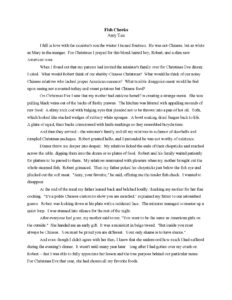
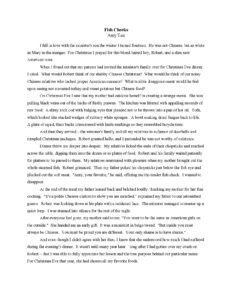
I fell in love with the minister's son the winter I turned fourteen. He was not Chinese, but as white
as Mary in the manger. For Christmas I prayed for this blond-haired boy, Robert, and a slim new
American nose.
When I found out that my parents had invited the minister's family over for Christmas Eve dinner,
I cried. What would Robert think of our shabby Chinese Christmas? What would he think of our noisy
Chinese relatives who lacked proper American manners? What terrible disappoint-ment would he feel
upon seeing not a roasted turkey and sweet potatoes but Chinese food?
On Christmas Eve I saw that my mother had outdone herself in creating a strange menu. She was
pulling black veins out of the backs of fleshy prawns. The kitchen was littered with appalling mounds of
raw food: A slimy rock cod with bulging eyes that pleaded not to be thrown into a pan of hot oil. Tofu,
which looked like stacked wedges of rubbery white sponges. A bowl soaking dried fungus back to life.
A plate of squid, their backs crisscrossed with knife markings so they resembled bicycle tires.
And then they arrived the minister's family and all my relatives in a clamor of doorbells and
rumpled Christmas packages. Robert grunted hello, and I pretended he was not worthy of existence.
Dinner threw me deeper into despair. My relatives licked the ends of their chopsticks and reached
across the table, dipping them into the dozen or so plates of food. Robert and his family waited patiently
for platters to be passed to them. My relatives murmured with pleasure when my mother brought out the
whole steamed fish. Robert grimaced. Then my father poked his chopsticks just below the fish eye and
plucked out the soft meat. "Amy, your favorite," he said, offering me the tender fish cheek. I wanted to
disappear.
At the end of the meal my father leaned back and belched loudly, thanking my mother for her fine
cooking. "It's a polite Chinese custom to show you are satisfied," explained my father to our astonished
guests. Robert was looking down at his plate with a reddened face. The minister managed to muster up a
quiet burp. I was stunned into silence for the rest of the night.
After everyone had gone, my mother said to me, "You want to be the same as American girls on
the outside." She handed me an early gift. It was a miniskirt in beige tweed. "But inside you must
always be Chinese. You must be proud you are different. Your only shame is to have shame."
And even though I didn't agree with her then, I knew that she understood how much I had suffered
during the evening's dinner. It wasn't until many year later long after I had gotten over my crush on
Robert that I was able to fully appreciate her lesson and the true purpose behind our particular menu.
For Christmas Eve that year, she had chosen all my favorite foods.

Questions on Meaning
1. Why does Tan cry when she finds out that the boy she is in love with is coming to dinner?
2. Why does Tan's mother go out of her way to prepare a disturbingly traditional Chinese dinner for her
daughter and guests? What one sentence best sums up the lesson Tan was not able to understand until
years later?
3. How does the fourteen-year-old Tan feel about her Chinese background? about her mother?
4. What is Tan's purpose in writing this essay? Does she just want to entertain readers, or might she have
a weightier goal?
Questions on Writing Strategy
1. How does Tan draw the reader into her story right from the beginning?
2. How does Tan use transitions both to drive and to clarify her narrative?
3. What is the irony of the last sentence of the essay?
4. Paragraph 3 is a passage of pure description. Why does Tan linger over the food? What is the effect
of this paragraph?
Questions on Language
1. The simile about Mary in the second sentence of the essay is surprising. Why? Why is it amusing?
2. How does the narrator's age affect the tone of this essay? Give examples of language particularly
appropriate to a fourteen-year-old.
Suggestions for Writing
1. Journal writing: Think of an occasion when, for whatever reason, you were ashamed of being
different. How did you react? Did you try to hide your difference in order to fit in, or did you reveal or
celebrate your uniqueness?
From journal to essay: Using Tan's essay as a model, write a brief narrative based on the sketch from
your journal. Try to imitate the way Tan integrates the external events of the dinner with her own feelings
about what is going on. Your story may be humorous, like Tan's, or more serious.
2. Take a perspective like that of the minister's son, Robert: Write a narrative essay about a time when
you had to adjust to participating in a culture different from your own. It could be a meal, a wedding or
other rite of passage, a religious ceremony, a trip to another country. What did you learn from your
experiences, about yourself and others?
/ 2
End of Document
361

FAQs

Why does Amy Tan cry about the Christmas dinner invitation?
Amy Tan cries when she learns that Robert, the minister's son she has a crush on, is coming to dinner because she fears he will be disappointed by her family's Chinese customs. She worries that the traditional Chinese food and her relatives' behavior will not meet his expectations of an American Christmas. Tan feels ashamed of her cultural background and is concerned about how Robert will perceive her family.
What lesson does Tan's mother teach her about being Chinese?
Tan's mother teaches her that while she may want to fit in with American girls on the outside, she must always embrace her Chinese identity on the inside. She emphasizes that being different is something to be proud of, and that the only shame one should feel is in having shame about their heritage. This lesson is encapsulated in the idea that the food prepared for the dinner was chosen because it included Amy's favorite dishes.
How does Tan describe the food served at the Christmas dinner?
Tan provides a vivid description of the Christmas dinner, detailing the unusual Chinese dishes prepared by her mother. She describes prawns, a slimy rock cod, tofu, and squid, emphasizing their unappealing appearances to her American guests. The imagery highlights her embarrassment and the cultural gap between her family and the minister's family, showcasing her internal conflict about her heritage.
What is the significance of the fish cheek in the story?
The fish cheek is significant as it represents both a cultural delicacy and a source of embarrassment for Tan. When her father offers her the fish cheek, he highlights it as her favorite part, but she feels humiliated in front of Robert. This moment encapsulates her struggle with her identity and the pressure to conform to American norms, while also illustrating the love and pride her family has in their traditions.
How does Tan's perception of her Chinese background change over time?
Initially, Tan feels ashamed of her Chinese background and is embarrassed by her family's customs during the Christmas dinner. However, as she matures, she comes to appreciate her mother's lesson about cultural pride and the importance of embracing her identity. This shift in perception allows her to recognize the value of her heritage and the love behind the traditions she once found embarrassing.
What does Tan's father do at the dinner that surprises the guests?
During the dinner, Tan's father surprises the guests by leaning back and belching loudly after the meal, thanking her mother for her cooking. He explains that this is a polite Chinese custom to show satisfaction. This action highlights the cultural differences between her family and the minister's family, further emphasizing Tan's feelings of embarrassment and the clash of cultural norms.
What does Tan mean by saying her mother 'understood how much I had suffered'?
Tan's statement reflects her realization that her mother was aware of the emotional turmoil she experienced during the dinner. While she felt ashamed and embarrassed by her family's customs, her mother recognized the struggle of wanting to fit in while also valuing their heritage. This understanding signifies a deeper connection between Tan and her mother, as well as the complexity of navigating cultural identity.