Explore the significant changes in European political boundaries before and after World War I with detailed maps. This analysis highlights the dissolution of empires, such as Austria-Hungary and the Ottoman Empire, and the emergence of new nations like Czechoslovakia and Yugoslavia. Ideal for students studying European history or preparing for exams, this resource provides insights into the Treaty of Versailles and its impact on national borders. Understand the geopolitical shifts that reshaped Europe in the early 20th century.

Key Points

  • Analyzes the political changes in Europe due to World War I.
  • Illustrates the creation of new nations from former empires.
  • Highlights the impact of the Treaty of Versailles on national boundaries.
  • Explains the reconstitution of Poland and the emergence of Czechoslovakia.
newtopiccyclegrowin
2 pages
Language:English
Type:Worksheet
newtopiccyclegrowin
2 pages
Language:English
Type:Worksheet
211
/ 2
EUROPE BEFORE AND AFTER WWI
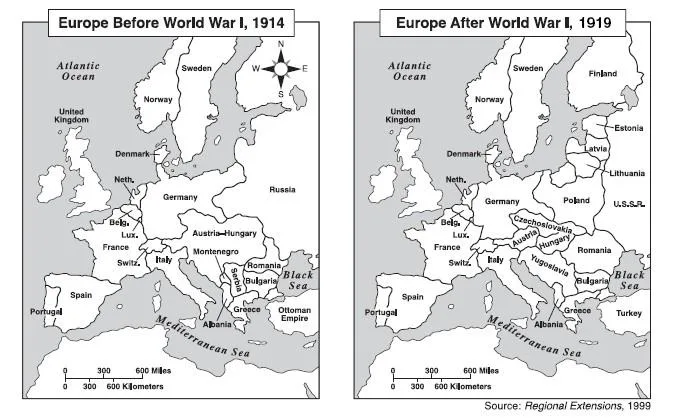
PART I-Color the maps after reading the specific directions given below.
1. On both maps color each country which stayed the same politically(ex. Norway) in GREEN.
2. Be sure to color those first.
4. On both maps color the countries that stayed but their political boundaries changed (ex. Germany) in RED.
3. Now color the new countries on the 1919 Map using colors of your choice ( EXCEPT RED AND GREEN). Remember,
adjoining countries should be done in clearly different colors so that borders are defined.
5. This is not an art project, but neatness counts for clarity reasons.
PART II- Read the maps and the summary to answer questions on the next page.
The Treaty of Versailles was only one of a number of treaties negotiated at the end of World War I.
The treaties resulted in new national boundaries and new countries. As the maps show, the postwar
treaties carved up old empires into many small new nations, causing huge land losses for the
Central Powers and changing the face of Europe.
The former empire of Austria-Hungary was dissolved, and new nations were created from its land: Austria,
Hungary, Czechoslovakia, and Yugoslavia.
Poland, which at one time divided among Germany, Russia, and Austria-Hungary, was reconstituted
(recreated .
The Ottoman Turks had to give up much of their land in southwest Asia and the Middle East. In Europe, they
retained only the country of Turkey.
Russian land gave way to the new nations of Finland, Estonia, Latvia, and Lithuania.
Russia and Austria-Hungary gave up additional territory to Poland and Romania.
EUROPE AFTER WORLD WAR I
Directions: Choose the letter of the
best
answer. Use the maps to answer questions 16.
1 Who lost the
greatest
percentage of land in
the creation of new nations?
A Austria-Hungary
B France
C Germany
D Russia
2 Which nation was formed from the former
lands of the Ottoman Empire?
A Albania
B Finland
C Hungary
D Turkey
3 Which formerly dissolved nation was
reconstituted on the Eastern Front?
A Bulgaria
B Czechoslovakia
C Poland
D Romania
4 In what region of Europe were the new
nations of Finland, Estonia, Latvia, and
Lithuania created?
A northeast
B northwest
C southeast
D southwest
5 After World War I, Serbia became part of
A Hungary.
B Romania.
C Russia.
D Yugoslavia.
6 After national boundaries were redrawn,
which of the Central Powers lost access to
the sea?
A Austria-Hungary
B Germany
C The Ottoman Empire
D Russia
/ 2
End of Document
211

FAQs

What countries were created from the former empire of Austria-Hungary?
The former empire of Austria-Hungary was dissolved after World War I, leading to the creation of several new nations. These include Austria, Hungary, Czechoslovakia, and Yugoslavia. This significant political change resulted from the treaties negotiated at the end of the war, which aimed to redraw national boundaries in Europe.
Which country was reconstituted after World War I from previously divided territories?
Poland was reconstituted after World War I, having previously been divided among Germany, Russia, and Austria-Hungary. The reestablishment of Poland as a nation is a key outcome of the postwar treaties, reflecting the changes in national boundaries and the emergence of new countries in Europe.
What new nations emerged from Russian territory after World War I?
Following World War I, several new nations emerged from Russian territory. These include Finland, Estonia, Latvia, and Lithuania. The dissolution of the Russian Empire and the subsequent treaties led to significant territorial changes in Eastern Europe, creating these independent states.
How did the Treaty of Versailles affect the Central Powers?
The Treaty of Versailles, along with other treaties, resulted in significant land losses for the Central Powers. It led to the dissolution of empires and the creation of new nations, fundamentally changing the political landscape of Europe. The treaties carved up old empires, including Austria-Hungary and the Ottoman Empire, resulting in the establishment of many smaller nations.
Which Central Power lost access to the sea after the redrawing of boundaries?
After the redrawing of boundaries post-World War I, Austria-Hungary lost access to the sea. This loss was part of the broader territorial changes that affected several Central Powers, altering their geographical and political status significantly.
What was the significance of the new nations formed in Europe after WWI?
The formation of new nations in Europe after World War I was significant as it marked the end of several empires and the emergence of national self-determination. Countries such as Czechoslovakia, Yugoslavia, and others were created, reflecting the changing political ideologies of the time. This reshaping of Europe aimed to address ethnic and national identities, although it also led to tensions and conflicts in the years that followed.
Which countries retained their political boundaries after World War I?
Countries that retained their political boundaries after World War I include Norway, which is specifically mentioned as an example in the document. These nations were not significantly altered in terms of their borders, unlike many others that experienced significant changes due to the treaties negotiated at the end of the war.