The EOC Review 2018 Key provides comprehensive answers and explanations for end-of-course assessments across various subjects. It is designed for high school students preparing for their final exams, covering key concepts and problem-solving strategies. This resource includes detailed solutions to practice problems, making it an essential tool for effective study and review. Ideal for educators and students alike, it aids in reinforcing understanding of critical topics in preparation for the EOC assessments.

Key Points

  • Includes detailed answer keys for EOC review questions from various subjects.
  • Covers essential topics and problem-solving techniques for high school assessments.
  • Designed for students preparing for end-of-course exams in 2018.
  • Provides explanations and strategies to enhance understanding of key concepts.
newtopiccyclegrowin
24 pages
Language:English
Type:Study Guide
newtopiccyclegrowin
24 pages
Language:English
Type:Study Guide
70
/ 24
GSE Geometry Unit 1 - Transformations EOC Review
Name: _________________________________ Block: _____
Vocabulary: Translations, Dilations, Reflections, Rotations, and Isometric.
1) Translate the following points by
the rule:
ox,y x +1,y - 4
S (-5, 2)o
Y (-4, 5)o
R (-1, 1)o
A (-4, -2)o
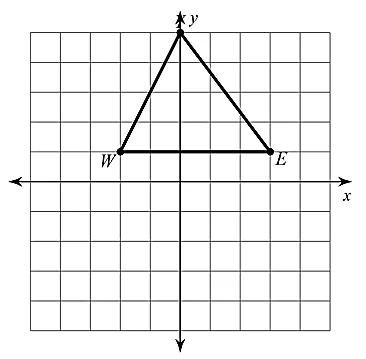
2) Translation: (x, y) o (x 2, y 6)
W(3, 2) C(2, 4) T(3, 5) Z(5,2)
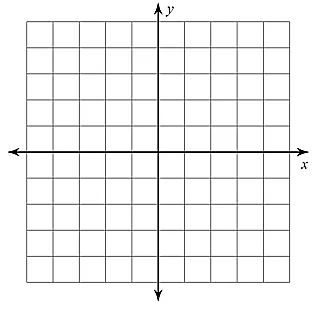
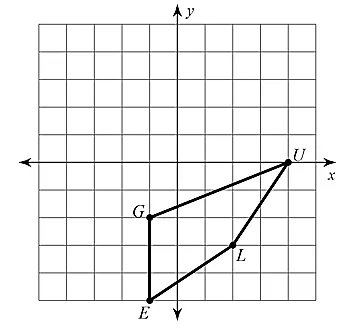
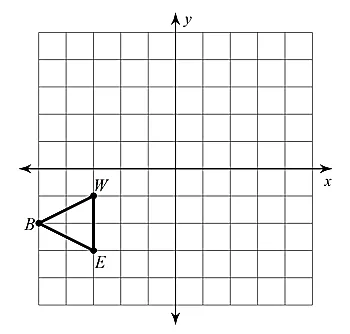
3) Reflection over y = x
4) Reflection over y = -3
5) Rotate the figure 90° CW
6) Rotate the figure 90° CCW
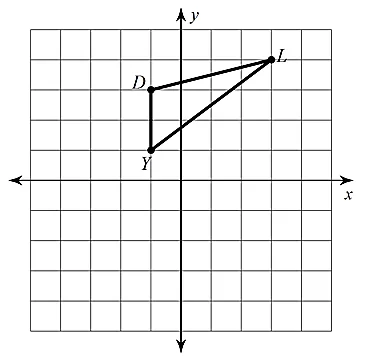
7) Find the coordinates of the new
vertices of the image that has been
dilated by a factor of 5.
S(-5, 2)o
Y (-4, 5)o
R (-1, 1)o
A (-4, -2)o
8) Find the coordinates of the new
vertices of the image that has been
dilated by a factor of 1/2.
W(3, 2)o
C(2, 4)o
T (3, 5)o
Z (5, 2)o
9) Draw a dilation with k = 2
10) Determine the scale factor, k = __
11) Given the points
M (-3, 1) S (5, -2)
Translate: (x 3, y + 2)
Reflect: y = x
M’ o
M’’ o
S’ o
S’’ o
12) Given the points
K (0, -4) P (-6, -3) R (1, 2)
Reflect: over the x-axis
Rotate: 270 CCW
K’ o K’o
P’ o P’o
R’ o R’’ o
GSE Geometry Unit 1 - Transformations EOC Review
Answers
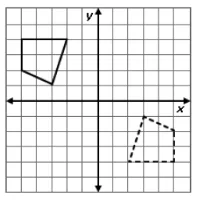
1) Which transformation maps the solid figure
onto the dashed figure?
A. rotation 180 about the origin
B. translation to the right and down
C. reflection across the x-axis
D. reflection across the y-axis
1) ______
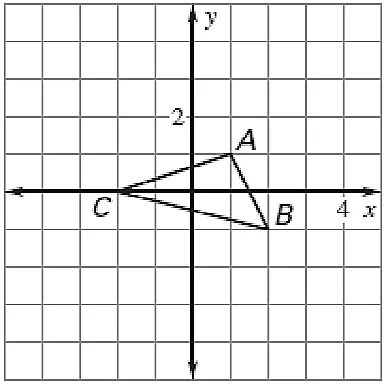
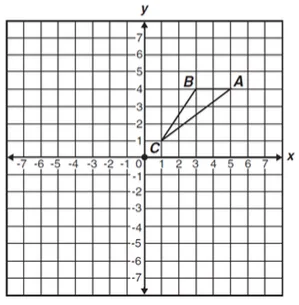
2) If triangle ABC is rotated 180 degrees about
the origin, what are the coordinates of A’?
A. (-5,-4)
B. (-5,4)
C. (-4,5)
D. (-4,-5)
2) ______
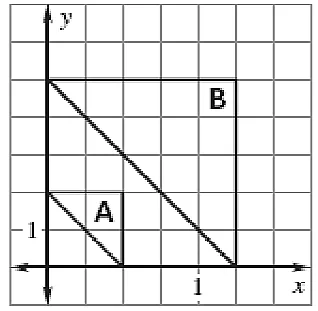
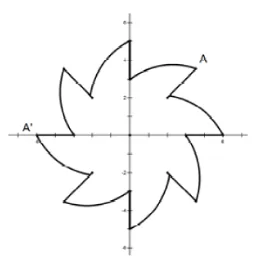
3) Determine the angle of rotation for A to map
onto A’?
A. 45
B. 90
C. 135
D. 180
3) ______
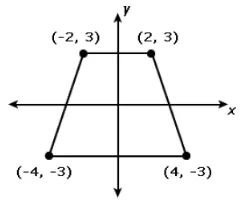
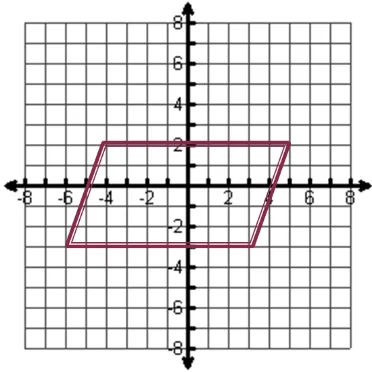
4) Which transformation will place the trapezoid
onto itself?
A. counterclockwise rotation about the origin
by 90
B. rotation about the origin by 180
C. reflection across the x-axis
D. reflection across the y-axis
4) ______
GSE Geometry Unit 1 - Transformations EOC Review
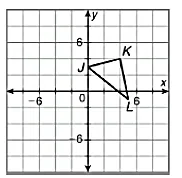
5) ∆𝐽𝐾𝐿 is rotated 90 about the origin and then translated using
(
𝑥, 𝑦
)
(
𝑥 8, 𝑦 + 5
)
. What are the
coordiantes of the final image of L? The coordinates for ∆𝐽𝐾𝐿 are J(5,-1), K(4,4), and J(9,3).
Answers
A. (-7,10)
B. (-7,0)
C. (-9,10)
D. (-9,0)
5) ______
6) Which figure has 90 rotational symmetry?
A. square
B. regular hexagon
C. regular pentagon
D. equilateral triangle
6) ______
7) Point P is located at (4,8) on a coordinate plane. Point P will be relfected over y = x. What will bee
the coordiantes of the image of point P?
A. (28,4)
B. 24,8)
C. (4,28)
D. (8,4)
7) ______
8) Point F is the image when point F is reflected over the line 𝑥 = 2 and then over the line 𝑦 = 3. The
location of F is (3,7). Which of the following is the location of point F?
A. (-7,-1)
B. (-7,7)
C. (1,5)
D. (1,7)
8) ______
9) A triangle has vertices at A(-3,-1), B(-6,-5), C(-1,-4). Which tranformation would produce an image
with vertices A(3,-1), B(6,-5), C(1,-4)?
A. A relfection over the x-axis
B. A relfection over the y-axis
C. A rotation 99 clockwise
D. A rotation 90 counterclockwise
9) ______
10) The vertices of ∆𝐽𝐾𝐿 have coordinates J(5,1), K(-2,-3), and L(-4,1). Under which tranformation is the
image ∆𝐽′𝐾′𝐿′ NOT congrunet to ∆𝐽𝐾𝐿?
A. A translation of two units to the right and two units down
B. A counterclockwise rotation of 180 degrees aound the origin
C. A reflection over the x-axis
D. A dilation with a scale factor of 2 centered at the origin
10) _____
/ 24
End of Document
70

FAQs

What transformations are covered in the EOC Review 2018 Key?
The EOC Review 2018 Key covers various transformations including translations, dilations, reflections, and rotations. Each transformation is described with specific rules and examples, such as translating points by certain rules or reflecting over lines like y = x and y = -3. The document also includes tasks related to rotating figures 90 degrees clockwise and counterclockwise, as well as finding new coordinates after dilations.
How do you find the coordinates after a dilation by a factor of 5?
To find the coordinates after a dilation by a factor of 5, you multiply each coordinate of the original points by 5. For example, if you have a point S with coordinates (-5, 2), after dilation, the new coordinates would be (-5 * 5, 2 * 5), resulting in (-25, 10). The document provides specific examples for points S, Y, R, and A, illustrating how to apply this factor to obtain new coordinates.
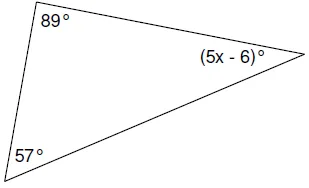
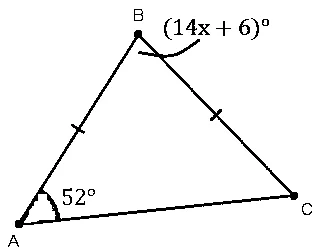
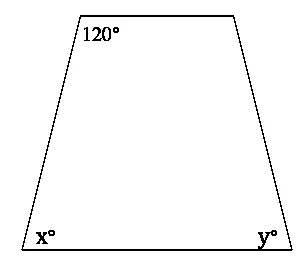
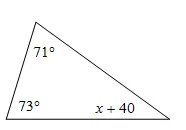
What methods are used to determine angle measures in triangles?
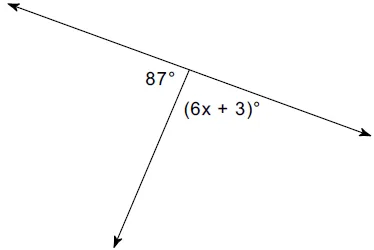
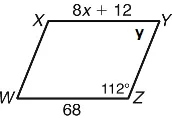
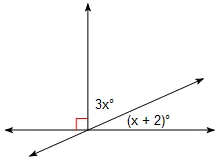
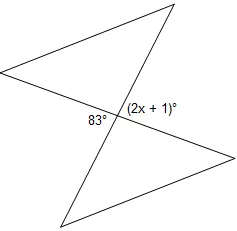
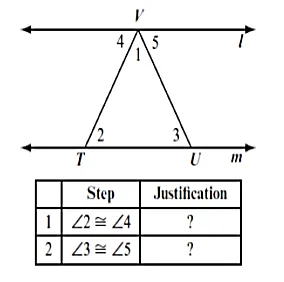
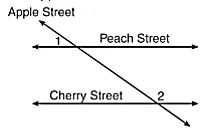
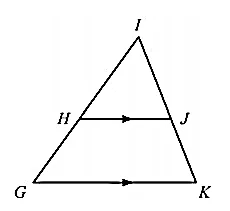
The document discusses several methods for determining angle measures in triangles, including using properties of supplementary and complementary angles, as well as vertical angles. It emphasizes the importance of knowing that the sum of angles in a triangle equals 180 degrees. Additionally, it provides examples of solving for angles using given measures and relationships between angles, such as alternate interior angles and corresponding angles.
What is the significance of the Pythagorean Theorem in the review?
The Pythagorean Theorem is highlighted as a critical concept in the EOC Review 2018 Key, particularly in the context of right triangles. It states that in a right triangle, the square of the length of the hypotenuse is equal to the sum of the squares of the lengths of the other two sides. The document provides examples of how to apply this theorem to find missing side lengths and to solve real-world problems involving right triangles.
How are congruent triangles identified in the study guide?
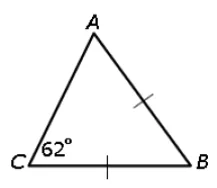
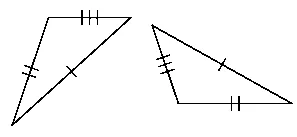
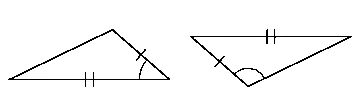
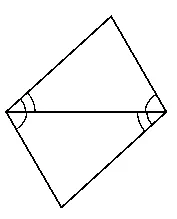
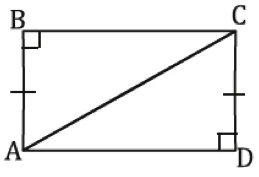
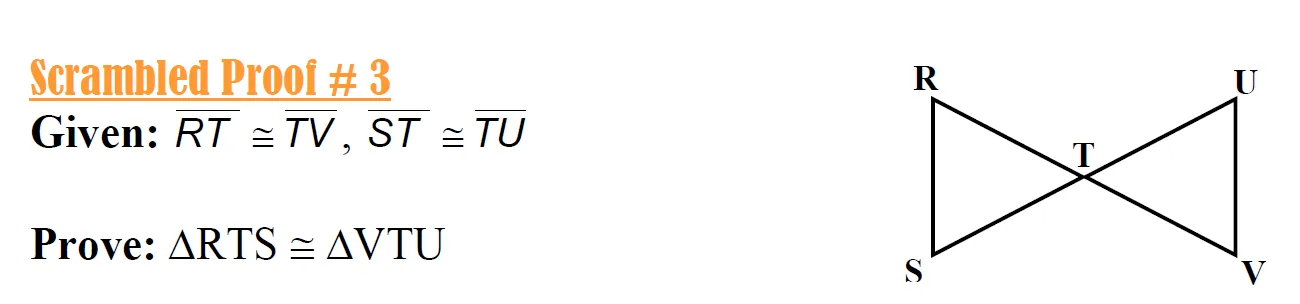
Congruent triangles are identified using several criteria outlined in the document, including SSS (Side-Side-Side), SAS (Side-Angle-Side), and ASA (Angle-Side-Angle). The document explains that if two triangles can be shown to have corresponding sides and angles that are equal, they are congruent. Specific examples illustrate how to apply these criteria to determine triangle congruence in various geometric scenarios.
What types of symmetry are explored in the EOC Review?
The EOC Review explores various types of symmetry, including rotational symmetry and reflectional symmetry. For instance, it discusses which shapes exhibit 90-degree rotational symmetry, such as squares and regular hexagons. The document also includes tasks that require identifying lines of symmetry and determining how shapes can be mapped onto themselves through these symmetries.
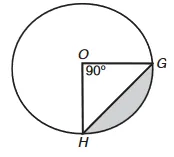
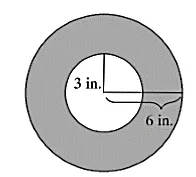
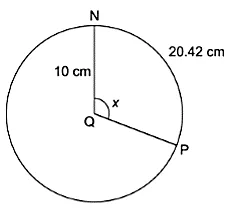
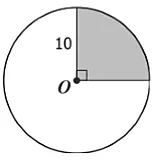
What is the formula for the area and circumference of a circle mentioned in the review?
The document provides the formulas for calculating the area and circumference of a circle. The area is calculated using the formula A = πr², where r is the radius of the circle. The circumference is calculated using the formula C = 2πr. These formulas are essential for solving problems related to circles in the geometry section of the review.