1
Federal University Dutse
Faculty Of Science
Department Of Computer Science
CSC 102: Introduction To Problem Solving (3 Units)
Lecture Note

2
Chapter One (1) General Introduction
1.1 What is a Formal Problem?
Usually the term problem is used to refer to a situation where it is not
immediately obvious how to reach the goal. The exact same situation
can be a problem for one person and not a problem (perhaps just a
simple activity or routine exercise) for another person. Problem solving
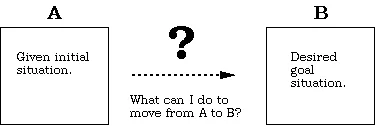
consists of moving from a given initial situation to a desired goal
situation. That is, problem solving is the process of designing and
carrying out a set of steps to reach a goal.
To solve the problem, you need to travel from a starting point, called the
initial state, to an end point, called the goal state. The initial state
includes all of the knowledge and resources you currently have
available. The goal state refers to the solution that you want to reach.
The set of possible ways to travel from the initial state to the goal state is
called the problem space.
Figure1. Problem-solving process--how to achieve final goal?
Problem-solving is a tool, a skill, and a process. As a tool is helps you
solve a problem or achieve a goal. As a skill you can use it repeatedly
throughout your life. And, as a process it involves a number of steps.
Problem-solving is a mental process that involves discovering, analyzing
and solving problems. The ultimate goal of problem-solving is to

3
overcome obstacles and find a solution that best resolves the issue.
The best strategy for solving a problem depends largely on the unique
situation. In some cases, people are better off learning everything they
can about the issue and then using factual knowledge to come up with a
solution. In other instances, creativity and insight are the best options.
1.2 Problem Solving in Everyday Life
People make decisions every day to solve problems that affect their
lives. The problems may be as unimportant as what to watch on
television or as important as choosing a new profession. If a bad
decision is made, time and resources are wasted, so it’s important that
people know how to make decisions well. There are six steps to follow
to ensure the best decision in making problem solving as a process.
These six steps in problem solving include the following:
1.2.1 Identify the problem. The first step toward solving a problem is
to identify the problem. In a classroom situation, most problems have
been identified for you and given to you in the form of written
assignments or problems out of a book. However, when you are doing
problem solving outside the classroom, you need to make sure you
identify the problem before you start solving it. If you don’t know what
the problem is, you cannot solve it.
1.2.2 Understand the problem. You must understand what is involved
in the problem before you can continue toward the solution. This
includes understanding the knowledge base of the person or machine for
whom you are solving the problem. If you are setting up a solution for a
Figures