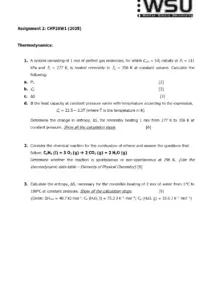
Physical Chemistry II Test 2 assesses students’ understanding of thermodynamics, entropy calculations, and chemical reactions. It includes problems on heating ice, calculating equilibrium constants, and analyzing reaction kinetics. This test is designed for students studying physical chemistry at the university level, providing a comprehensive evaluation of key concepts and problem-solving skills. Topics covered include entropy change, activation energy, and first-order reaction kinetics.

Key Points

  • Calculates total change in entropy for heating ice from -25°C to 80°C.
  • Analyzes thermodynamic data for chemical reactions involving HgS and O2.
  • Explores the Arrhenius equation for reaction kinetics and activation energy.
  • Includes experimental data for a first-order decomposition reaction.
Sihle Usisa mpongwana
2 pages
Language:English
Type:Past Paper
Sihle Usisa mpongwana
2 pages
Language:English
Type:Past Paper
320
/ 2
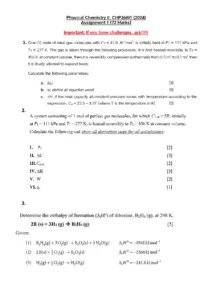
Physical Chemistry II (CHP26W1)
Test 2 (50 marks)
1. Calculate the total change in entropy S of the system when 2.0 moles of ice
is heated from -25.0 to 80 °C at a constant pressure of 1 bar. (8)
{Given:
C
p
,m
(H
2
O(s)) = 37.6 J K
1
mol
1
;
C
p
,m
(H
2
O(l)) = 75.3 J K
1
mol
1
;
H
m
= 6.01 kJ mol
1
}
2. Study the chemical reaction and the thermodynamic data provided in the
table below and answer the questions that follow:
Reaction
HgS (s) + O
2
(g) Hg (l) + SO
2
(g)
H
f
(kJ mol
1
)
-53.6
-
-
-296.8
S (JK
1
mol
1
)
88.3
205.1
76.0
248.2
a. Calculate the equilibrium temperature. (7)
b. At what temperature is the reaction non-spontaneous? (1)
c. Calculate the equilibrium constant K
c
at 298 K. (5)
d. Calculate equilibrium constant K
p
. (2)
3. The effect of temperature on the decomposition of sodium thiosulphate was
investigated. The Arrhenius plot was constructed using the experimental data.
Consider the graph and answer the questions that follow:
a. Calculate the activation energy E
a
(4)
b. Calculate the value of the pre-exponential factor, A. (3)
c. Calculate the rate constant k at 350 K using the Arrhenius equation. (3)
4
4,5
5
5,5
6
6,5
7
0,0031 0,0032 0,0033 0,0034 0,0035 0,0036
ln k
1/T
4. The experimental data below was obtained from a decomposition reaction
A P. Time was measured from 0 to 4000 second. Use the data to answer
the questions that follow:
[A] (mM)
10,9
7,63
5,32
3,71
2,59
a. Graphically show that the reaction is 1
st
order with respect to the
concentration of A. All data points and axis must be clearly visible. (10)
b. Graphically determine the rate constant for the reaction.(4)
c. Calculate the half-life (t
1/2
).(3)
/ 2
End of Document
320

FAQs

what is Physical Chemistry II Test 2 - CHP26W1 about

The Physical Chemistry II Test 2 - CHP26W1 focuses on various aspects of physical chemistry, including thermodynamics, reaction kinetics, and entropy calculations.

  • It includes questions on entropy changes during phase transitions.
  • The exam covers chemical reactions and their thermodynamic data.
  • Students are required to analyze experimental data and apply concepts like the Arrhenius equation.

how to calculate entropy change in Physical Chemistry II Test 2 - CHP26W1

To calculate the total change in entropy (∆S) in Physical Chemistry II Test 2 - CHP26W1, you need to consider the heating of substances and their phase transitions.

  • Use the formula: ∆S = ∆H/T for phase changes.
  • Account for specific heat capacities (Cp) for different phases.
  • Combine entropy changes from all steps, including heating and phase changes.

what are the key topics in Physical Chemistry II Test 2 - CHP26W1

Key topics in Physical Chemistry II Test 2 - CHP26W1 include thermodynamic principles, reaction spontaneity, and kinetic analysis.

  • Thermodynamic data interpretation for chemical reactions.
  • Calculating equilibrium constants (Kc and Kp).
  • Understanding the Arrhenius equation and activation energy.

how to determine the rate constant in Physical Chemistry II Test 2 - CHP26W1

Determining the rate constant (k) in Physical Chemistry II Test 2 - CHP26W1 involves using the Arrhenius equation.

  • The equation is k = A * e^(-Ea/RT), where A is the pre-exponential factor, Ea is the activation energy, R is the gas constant, and T is the temperature in Kelvin.
  • Graphical methods can also be employed using ln(k) versus 1/T plots.

what is the significance of activation energy in Physical Chemistry II Test 2 - CHP26W1

Activation energy (Ea) is crucial in Physical Chemistry II Test 2 - CHP26W1 as it determines the rate of chemical reactions.

  • Higher Ea indicates slower reactions, while lower Ea suggests faster reactions.
  • It is calculated using the slope from Arrhenius plots.
  • Understanding Ea helps predict reaction behavior under varying conditions.

how to graphically show first-order reactions in Physical Chemistry II Test 2 - CHP26W1

Graphically showing first-order reactions in Physical Chemistry II Test 2 - CHP26W1 involves plotting concentration versus time data.

  • For a first-order reaction, plot ln([A]) against time.
  • The resulting graph should yield a straight line, indicating a constant rate.
  • Determine the slope to find the rate constant (k).

what are the formulas used in Physical Chemistry II Test 2 - CHP26W1

Physical Chemistry II Test 2 - CHP26W1 utilizes several key formulas relevant to thermodynamics and kinetics.

  • Entropy change: ∆S = ∆H/T
  • Arrhenius equation: k = A * e^(-Ea/RT)
  • Equilibrium constant: Kc = [products]/[reactants]

how to calculate half-life in Physical Chemistry II Test 2 - CHP26W1

Calculating half-life (t1/2) in Physical Chemistry II Test 2 - CHP26W1 depends on the order of the reaction.

  • For first-order reactions, t1/2 = 0.693/k.
  • For second-order reactions, t1/2 = 1/(k[A]0).
  • Use the determined rate constant (k) from experimental data for accurate calculations.

what is the equilibrium temperature in Physical Chemistry II Test 2 - CHP26W1

The equilibrium temperature in Physical Chemistry II Test 2 - CHP26W1 is determined by the balance of enthalpy and entropy changes during a reaction.

  • It can be calculated using the formula: T = ∆H/∆S.
  • This temperature indicates where the reaction shifts from spontaneous to non-spontaneous.
  • Understanding this concept is critical for thermodynamic assessments.

how to interpret thermodynamic data in Physical Chemistry II Test 2 - CHP26W1

Interpreting thermodynamic data in Physical Chemistry II Test 2 - CHP26W1 involves analyzing values like enthalpy (∆H) and entropy (S).

  • Use standard formation enthalpies to calculate reaction enthalpies.
  • Compare entropy values to assess spontaneity and equilibrium.
  • Understanding these concepts aids in predicting reaction outcomes.