Programming and Problem Solving for Semester 1/II (2024 Pattern) focuses on essential algorithms and programming techniques. It covers topics such as problem-solving strategies, object-oriented programming features, and practical applications in various fields. This resource is designed for students preparing for exams in computer science and programming courses. Key concepts include flowcharts, pseudocode, and decision-making statements, providing a comprehensive foundation for programming skills.

Key Points

  • Explains the significance of algorithms in computer problem-solving.
  • Covers object-oriented programming features with examples.
  • Includes pseudocode examples for basic programming tasks.
  • Illustrates top-down design with practical applications.
Bhagyshree Sonwane
2 pages
Language:English
Type:Past Paper
Bhagyshree Sonwane
2 pages
Language:English
Type:Past Paper
115
/ 2
Total No.
of
Questions:
10)
SEAT
No.
=._I
___
___.
PE12171
[Total No.
of
Pages: 2
I
-
[ 658
~
1 ~l402
Â¥~~-
PCC-151-ITT:
PRQGRAMMitG
AND PROBLEM SOLVING
(2024
Patt~
(~tedit
ystem) (Semester-
1/11)
\,.,,-
" y
'-
V
"-..
Time:
2½
Hours]#-"-
~"'
• /Max. Marks:
70
,•
I
Instructions to the f
ates:.,.
-
1)
Attempt • r
~(23
or
Q4,
Q5
or
Q6,
Q7 or
QB,
Q9 or
QJ0.
2)
Neat.~an11.~ust
be
drawn wherever necessary.
3)
Fi~
to
tl~right
indicate Jul/ marks.
4)
Assume s~"),,le
data,
if
necessary and clearly state.
~
~
~J
~J
••
<,../'
.
f\.
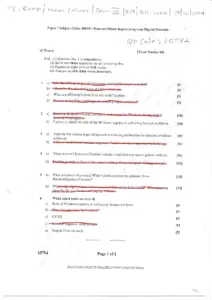
Ql)
a)
E~liiin
the importance
of
algorithms and
pro~s
in computer problem
solving. r
'-
--~
. [3]
b) List different problem
solving~'ate~~f
Explain any one with an
example.
Cc,
(v
[3]
c) Write any four features
of
t~~o~~gramming
Language. [4]
d) Illustrate top-down
design~~
a suitable example. [
4]
~"IO~Oo
""r
Q2) a) Write a pseudo cod
~aR_Ping
two numbers.
[3]
b) What is problem s ? ~i~t down the difficulties for the problem
solving.
~':,-
~]
c) What
is
object oriented
~amming?
List down its features with sui(at,le
t
I\·
examples.
<-;·
~
[4]
d) Explain any four
p~
programming language applications in ~ei¢ls.(4]
(\;;
"c~
Q3) a)
b)
c)
d)
What is dictionary? Mention any two dictionary
o~~tYo~
1
(3]
Explain Loop with flow chart.
~
~
1
[3]
What is difference between 'break' and
'contin~fate~t
in python?[4]
Write a program to test whether a
number~ered
h-y user is positive,
>-.
'-,.
(',
negative or zero.
()
f\"-t)
[4]
OR
~.{f;)
(\~
Q4)
a)
Explain use
of
range
()
function in
fo~p
w,@i
suitable example. [3]
b) Evaluate the importance
of
decision
co~i
statements in program
execution.
1
~I
[3]
c) Differentiate between if-else and
if-elif-e.{se
statement. (4]
d) Demonstrate the use
of
tuple data type
~th
a suitable python program.[4]
P.T.O.
Q5)
a)
b)
c)
Q6)
a)
b)
c)
Q7)
a)
b)
c)
QB) a)
b)
c)
Q9)
a)
b)
c)
QJO)a)
b)
c)
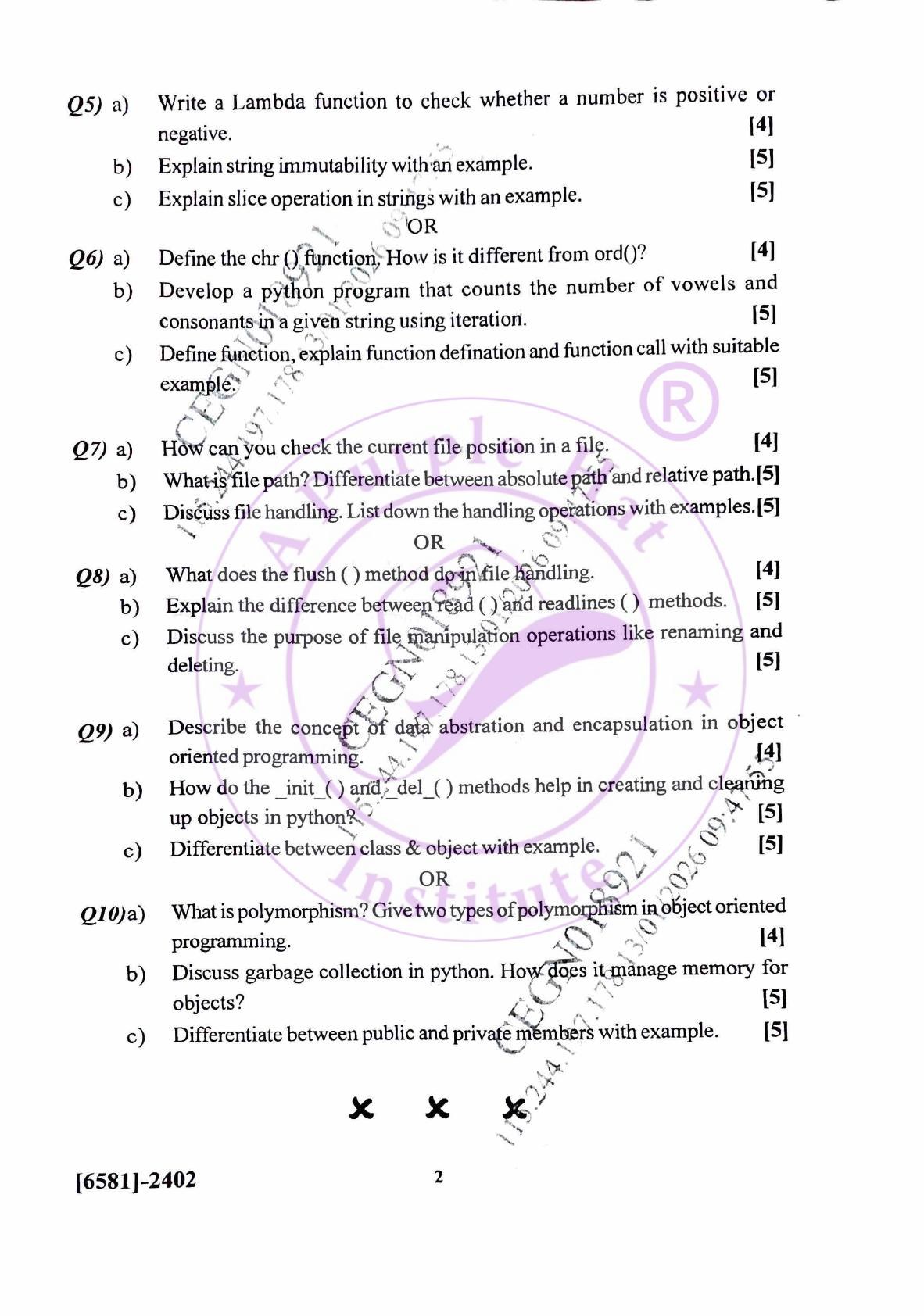
Write a Lambda function to check whether a number is positive or
negative.
(4]
.,
Explain
string immutability
with:an
example.
[5]
f
Explain slice operation
in
strings with
an
example. (5)
•
~
~
'OR
..
Define
the
chr {f~n~ti0tlj Ho,v
is
it
different from ord()? [4]
Develop a
pY~n
Pi-~~am that counts the number
of
vowels and
I
,,._
"'
'\
consonants
~a
given"string using
iteratiof1.
[5]
"-
'"
t\"')'
• •
Define function, explain function defination
and
function call with suitable
examCi~...,
/~
[5]
-P-,--:.,r
,·
~,;
/\
H<;,; can't~u check the current file position in a filr. (4)
~
~~
~~le
path? Differentiate between
absolute~
'and relative path.
(5)
Discuss
file
handling. List down the handling onetations with examples.[5]
...
....
.t')\.
"'
OR
,
~
~
',-
'~
What does the flush
()
method
d&.\lile.~dling.
[4]
Explain the difference betweeR9t')d ( ,J~tld readlines
()
methods. [5]
Discuss the purpose
of
file
~p\U~n
operations like renaming and
deleting.
~
0c
'-- [
5)
0
~\~
Describe the
conceyit~
d~
~bstration and encapsulation in object
• d
·"-)
' 4
onente programming. t~.
~]
How
do
the _init_( )
~n~f
del_( ) methods help
in
creating and
cl~g
up objects
in
python~")
Pt~
[SJ
Differentiate
betwe~
class & object with example.
~"',
I.:)
r;;s
[
5)
OR
°'
I
,~c.&t
What is polymorphism? Give two types
of
polym~m
in.,'06ject
oriented
programming.
~
rf
[4]
Discuss garbage collection in python.
Ho·-~s
i!dB')~age
memory for
r~~:
.~
objects?
.(~
, " [5]
Differentiate between public
and
priv~te
~mi4~'s
·with example. [ 5]
-,.~
'~
"-
\).'
~
~~I
...
.,
'
X
(6581)-2402
2

/ 2
End of Document
115

FAQs

what is programming and problem solving about

Programming and Problem Solving focuses on the fundamental concepts of computer programming and the methodologies used to tackle problems effectively.

  • It covers algorithm design, data structures, and programming languages.
  • Students learn to develop logical thinking and analytical skills.
  • Key topics include debugging, testing, and code optimization.

what are the key features of programming languages in programming and problem solving

The key features of programming languages in Programming and Problem Solving include syntax, semantics, and efficiency.

  • Syntax: The set of rules that defines the combinations of symbols that are considered to be correctly structured programs.
  • Semantics: The meaning of the syntactic elements and how they are interpreted.
  • Efficiency: The performance of the language in terms of speed and resource usage.

how to illustrate top-down design in programming and problem solving

Top-down design is a strategy used in Programming and Problem Solving to break down complex problems into smaller, manageable parts.

  • Start with the main problem and divide it into sub-problems.
  • Each sub-problem is further divided until manageable tasks are created.
  • This method promotes clarity and organization in coding.

what is object-oriented programming in programming and problem solving

Object-oriented programming (OOP) is a programming paradigm used in Programming and Problem Solving that is based on the concept of 'objects'.

  • OOP allows for encapsulation, inheritance, and polymorphism.
  • Encapsulation helps in bundling data and methods that operate on the data.
  • Inheritance allows new classes to inherit properties from existing classes, promoting code reuse.

what are the applications of programming languages in programming and problem solving

Programming languages have numerous applications in Programming and Problem Solving across various fields.

  • Web Development: Creating websites and web applications.
  • Data Analysis: Analyzing large datasets for insights.
  • Game Development: Designing and developing video games.
  • Artificial Intelligence: Implementing algorithms for machine learning.

how to write a pseudo code for swapping two numbers in programming and problem solving

Writing pseudo code for swapping two numbers is a fundamental exercise in Programming and Problem Solving.

  • Start by defining two variables, A and B.
  • Use a temporary variable, Temp, to hold the value of A.
  • Assign the value of B to A.
  • Finally, assign the value of Temp to B.

what is the range() function in programming and problem solving

The range() function is a built-in function in many programming languages used in Programming and Problem Solving.

  • It generates a sequence of numbers, which is often used in loops.
  • For example, range(1, 10) generates numbers from 1 to 9.
  • This function is essential for iterating over a sequence of numbers efficiently.

what is string immutability in programming and problem solving

String immutability is a concept in Programming and Problem Solving where strings cannot be changed after they are created.

  • Any modification results in the creation of a new string.
  • This feature helps in maintaining data integrity and optimization.
  • For example, if you try to change a character in a string, a new string is created instead.

what is the difference between break and continue in programming and problem solving

In Programming and Problem Solving, 'break' and 'continue' are control flow statements used in loops.

  • Break: Exits the loop entirely.
  • Continue: Skips the current iteration and moves to the next one.
  • Understanding these differences is crucial for effective loop control.

what is garbage collection in programming and problem solving

Garbage collection is an automatic memory management feature in Programming and Problem Solving.

  • It helps in reclaiming memory by removing objects that are no longer in use.
  • This process prevents memory leaks and optimizes performance.
  • Different programming languages implement garbage collection in various ways.