Soft Skills Module III focuses on enhancing reading and writing skills essential for academic and professional success. It covers techniques such as skimming, scanning, and churning to improve comprehension and retention. The module also discusses various writing methods, including inductive and deductive approaches, as well as effective business communication strategies. This resource is ideal for first-year B.Tech students aiming to strengthen their communication abilities.

Key Points

  • Explains reading techniques like skimming and scanning for effective comprehension.
  • Covers various writing methods including inductive, deductive, and chronological approaches.
  • Discusses the importance of effective business communication in professional settings.
  • Provides strategies for improving academic performance through enhanced reading and writing skills.
Soniya Kumari
11 pages
Language:English
Type:Lecture Notes
Soniya Kumari
11 pages
Language:English
Type:Lecture Notes
225
/ 11
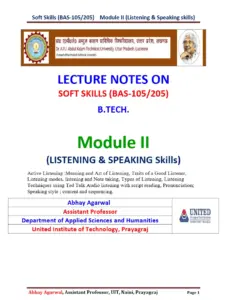
Module III
(Reading &Writing skills)
Abhay Agarwal, Assistant Professor, UIT, Naini, Prayagraj
Page 1
/2
LECTURE NOTES ON
SOFT SKILLs (BAS-105/205)
B.TECH. FIRST YEAR
Module III
(Reading &Writing Skills)
Reading style: Skimming, Scanning, Churning, Assimilation; Effective writing
tools , Writing method: Inductive ,Deductive Chronological ,Spatial, Exposition,
Interrupted, Business letter writing, Agenda, Notices, Minutes of Meeting
Abhay Agarwal
Assistant Professor
Department of Applied Sciences and Humanities
United Institute of Technology, Prayagraj
Module III
(Reading &Writing skills)
Abhay Agarwal, Assistant Professor, UIT, Naini, Prayagraj
Page 2
/2
Reading Style /Comprehension Skill:-
In order to make most of what one is reading or listening one need to improve
communication skill; this may improve student’s academic performance, class
participation and presenting the idea for the other people etc. Similarly,
professional also read number of documents related to their work, they have to
improve comprehension skill so that a better outcome can be expected.
Following are some of the ways through which it can be improved:
1. Read variety of material or books
2. Highlighting or underline keywords
3. Read a long portion of the document because it is difficult to come to
conclusion after reading one or two paragraphs
4. Try to recall as much as possible.
5. Try to answer the question which is related to document.
Techniques for improving comprehension skill:-
As we know our poor comprehension skills are because of lack of interest, lack
of concentration or failure to get words or sentences etc. so we should develop
certain techniques to improve the comprehension skills, following techniques
can be used to improve it:-
Skimming
Scanning
Churning
Assimilation
1)
Skimming: The process of reading quickly without passing to study details or
to have a quick look or glance is called skimming or skims reading. We should
understand the following things while skimming.
a) Identify the audience to which it is addressed
b) What sort of text it is (letter-> present, report->past, proposal->future)
c) Purpose of a document. ( to inform, to make people aware, etc)
d) General content
Module III
(Reading &Writing skills)
Abhay Agarwal, Assistant Professor, UIT, Naini, Prayagraj
Page 3
/2
2)
Scanning: The process of studying in more detail or reading more slowly,
carefully trying to collect some specific information is called scanning.
3)
Churning: Churning is reading process which enables one to grab the core
idea of the content. It is the process, to get the core idea and general gist of the
content with the help of skimming and scanning. Churning a document is very
similar to the activity, chewing the cud or churning out butter. As both require
serious efforts. Churning in reading involves thinking over the idea and words
one has read.
Ingredients of churning process:-
(i) Reading and interpretation
(ii) Reading between the lines
(iii) Inferring word and context
(iv) Inferring discourse coherence ( logical order)
Note: Some words, that provides a logical connection to two or more sentence.
For e.g. But, if, even that, which, or, otherwise, as well as, nevertheless, unless,
until, hence, therefore, yet, on one hand….on another hand, not only….but
also.
4)
Assimilation: The process of comprehending or understanding the text so
that answer can be produces to the question based on the text is called
assimilation. It includes understanding the structure of the text, paragraph,
punctuation, author’s point of view and summary.
/ 11
End of Document
225

FAQs

What are the techniques for improving reading comprehension skills?
The document outlines several techniques to enhance reading comprehension skills, including skimming, scanning, churning, and assimilation. Skimming involves quickly reading to grasp the general idea, while scanning focuses on finding specific information within a text. Churning helps in understanding the core idea by integrating skimming and scanning techniques. Assimilation refers to comprehending the text well enough to answer questions based on it, which includes understanding the structure and author's viewpoint.
What is the difference between skimming and scanning?
Skimming is a technique for fast reading aimed at getting a general idea of the content, while scanning is a more detailed approach focused on locating specific information. When skimming, readers quickly go through headings, the first paragraph, and subheadings to grasp the overall theme. In contrast, scanning requires the reader to be aware of the specific information they are searching for and to use clues such as headings to find that information.
What are the different writing methods discussed in the document?
The document discusses several writing methods, including inductive, deductive, chronological, spatial, linear, exposition, and interrupted methods. The inductive method moves from specific to general ideas, while the deductive method starts with a general statement and narrows down to specifics. Chronological writing organizes sentences based on the order of events, whereas spatial writing arranges sentences according to physical location. Each method has its advantages and disadvantages, influencing how effectively the message is conveyed.
What is the purpose of churning in reading?
Churning is a reading process that enables one to grasp the core idea of the content. It involves a deeper engagement with the text, akin to chewing cud, where the reader reflects on the ideas and words read. The churning process includes reading and interpretation, reading between the lines, and inferring the logical coherence of the discourse. This technique helps in solidifying understanding and retention of the material.
What writing tools are recommended for enhancing writing skills?
The document recommends several writing tools to enhance writing skills, including Microsoft Word for its formatting options, Grammarly for grammar and style improvements, and Twords for tracking writing habits. Evernote is suggested for syncing notes across devices, while Google Docs is highlighted for its collaborative features. These tools can aid writers in improving their productivity and the quality of their writing.
What are the advantages and disadvantages of the deductive writing method?
The deductive writing method organizes sentences from general to specific, providing clarity about the theme right from the beginning. Its advantages include helping readers understand details more easily. However, a disadvantage is that it may be difficult to retain the audience's attention if they are not already familiar with the general facts being presented, potentially leading to boredom.