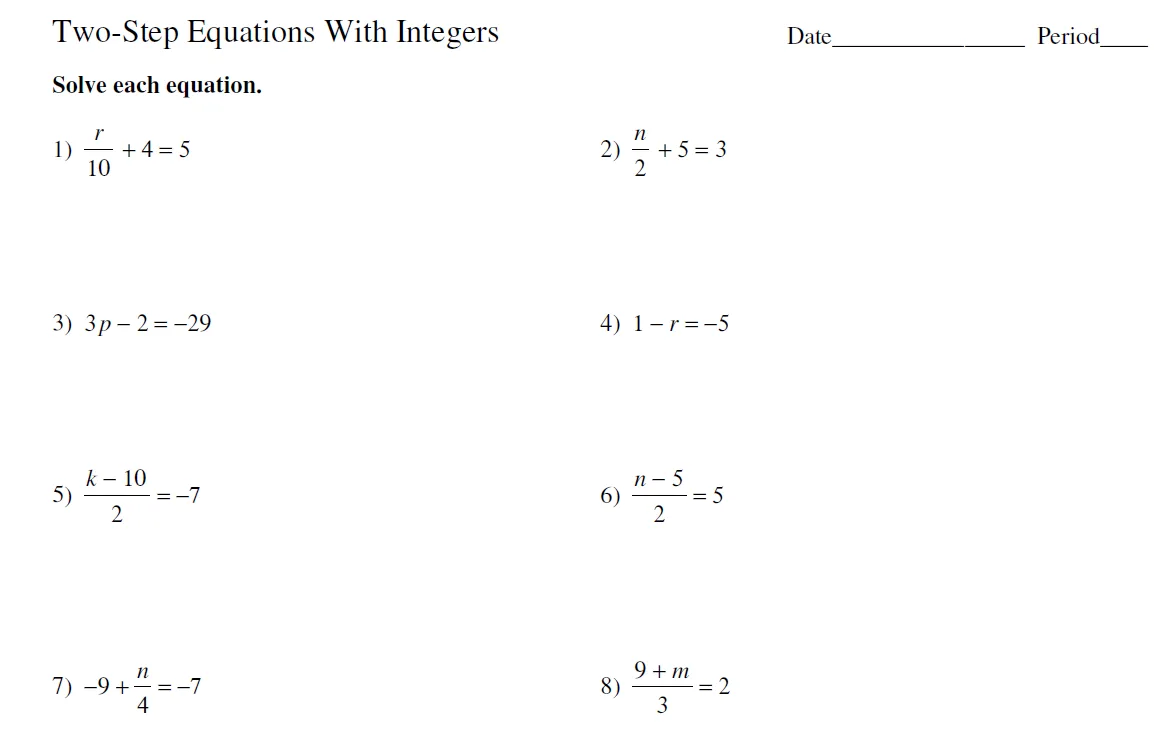
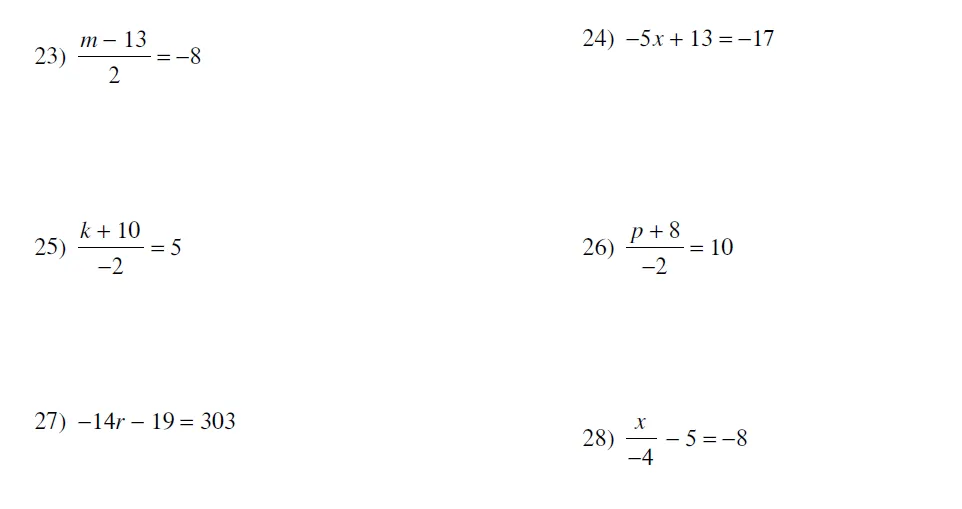
Solving two-step equations is a fundamental concept in algebra, essential for students in grades 6 and 7. This resource provides clear examples and step-by-step instructions for isolating variables and solving equations. It includes practice problems to reinforce understanding, covering various types of equations. Ideal for students preparing for math assessments or seeking to improve their algebra skills, this guide enhances problem-solving abilities and builds confidence in mathematical reasoning.

Key Points

  • Explains the process of solving two-step equations using inverse operations.
  • Includes examples and practice problems for hands-on learning.
  • Covers various types of equations to enhance algebra skills.
  • Designed for middle school students in grades 6 and 7.
newtopiccyclegrowin
4 pages
Language:English
Type:Notes
newtopiccyclegrowin
4 pages
Language:English
Type:Notes
173
/ 4
Math 6/7 NOTES (6.3) Name _____________________________
Solving Two-Step Equations (SOL 7.14)
Example 1 Solve 3x + 1 = 7 CHECK
3x + 1 = 7
Locate the variable term.
3x + 1 = 7
3x + 1 = 7
-1 -1
Use INVERSE OPERATIONS
to isolate the x term.
In Reverse PEMDAS order
3(__) + 1 7
3x = ____
Simplify.
____+ 1 7
To eliminate the coefficient
divide each side by ___.
____ = 7
x = ___
Simplify.
Solve the two-step equation. Check your solution.
12 = 5
7k 14 = 42
12 = 24 + 4b
3g 5 = 17
9 = 4a + 13
13 = 5m 2
5 + 7k = 19
15 = 11 – 2t
13 = 11 – 4x
6
3x
=
r
10 =
𝑠
2
+ 7
6 +
𝑛
5
= –4
4 – 3y = 31
15 – 2b = –9
1
3
y6 = 11
16
𝑟
7
= 21
3(y + 5) = 21
7(p 3) = 35
48 = 6(v + 2)
𝑥 + 3
2
= 5
𝑎 4
3
= –7
𝑘 + 1
−2
= –8
7 – 2y = 3
4 𝑥
3
= –7
15 = 3(w 2)
/ 4
End of Document
173

FAQs

What are the steps to solve a two-step equation?
To solve a two-step equation, first isolate the variable term using inverse operations. This involves performing the opposite operation to eliminate any constants from the equation. For example, if the equation is 3x + 1 = 7, you would subtract 1 from both sides to get 3x = 6. Next, divide each side by the coefficient of the variable to solve for the variable itself. In this case, dividing both sides by 3 gives x = 2.
How do you check the solution of a two-step equation?
To check the solution of a two-step equation, substitute the value of the variable back into the original equation. For instance, if you found x = 2 from the equation 3x + 1 = 7, substitute 2 back into the equation: 3(2) + 1 = 7. If both sides of the equation are equal after substitution, then the solution is verified. This method ensures that the solution is correct.
What is an example of a two-step equation and its solution?
An example of a two-step equation is 7k - 14 = 42. To solve it, first add 14 to both sides to isolate the term with the variable, resulting in 7k = 56. Then, divide both sides by 7 to find k = 8. This process illustrates how to systematically approach solving two-step equations.
What is the purpose of inverse operations in solving equations?
Inverse operations are crucial in solving equations as they help isolate the variable by reversing the operations applied to it. For example, if an equation includes addition, the inverse operation would be subtraction, and vice versa. This allows you to systematically eliminate constants and coefficients to solve for the variable, ensuring that the equation remains balanced throughout the process.
Can you provide a sample equation to practice solving two-step equations?
A sample equation to practice solving two-step equations is 3(y + 5) = 21. To solve it, first divide both sides by 3, yielding y + 5 = 7. Then, subtract 5 from both sides to find y = 2. Practicing with such equations enhances understanding of the two-step solving process.