Ejercicios de Historia for 4th-grade students covers significant events in Spanish history, including the establishment of the Second Republic and the impact of the Franco regime. This resource provides insights into the political, social, and economic aspects of historical periods, including the Spanish Civil War and the subsequent dictatorship. Designed for educational purposes, it includes exercises, discussions on key historical figures, and analysis of political movements. Ideal for teachers and students looking to deepen their understanding of Spanish history.

Key Points

  • Explores the establishment of the Second Republic in Spain and its significance.
  • Analyzes the impact of the Franco regime on Spanish society and politics.
  • Includes exercises on key historical events from the Spanish Civil War.
  • Discusses the role of exiled Spaniards during and after the Civil War.
Alma Martel
5 pages
Language:Spanish
Type:Notes
Alma Martel
5 pages
Language:Spanish
Type:Notes
143
/ 5
ejercicios historia Alma MP 4°B
— PÁGINA 2 POR DETRÁS
8. ¿Por qué en 1931 la mayoría de la población optó por la República?
La mayoría de la población optó por la República porque el sistema de la Restauración
estaba en crisis y la monarquía de Alfonso XIII había perdido mucho apoyo. Había
corrupción política, fraude electoral y grandes desigualdades sociales. Además, la dictadura
de Primo de Rivera empeoró la situación y el rey quedó asociado a ella. Muchos españoles
querían un sistema más democrático, con reformas sociales y más libertades, por eso
apoyaron la proclamación de la Segunda República en 1931.
— PÁGINA 4 POR DETRÁS
16. Carteles del bando republicano
1) El cartel muestra a trabajadores luchando por la revolución. Aparecen símbolos del
trabajo y del pueblo obrero.
Representa la posición anarquista y revolucionaria dentro del republicanismo, porque
defiende la revolución social, las colectivizaciones y la lucha obrera además de la guerra
contra los sublevados.
2) El cartel destaca la importancia del Ejército Popular y de la disciplina militar para ganar la
guerra.
Representa la posición comunista y de quienes defendían organizar primero el Estado y el
ejército para vencer en la guerra antes de hacer la revolución social. Por eso insiste en la
unidad y en la organización militar.
17. Caracteriza el nuevo Estado creado por los sublevados
a) Jefatura:
El nuevo Estado estuvo dirigido por el general Franco, que concentró todos los poderes y se
convirtió en jefe del Estado y del ejército.
b) Partidos políticos:
Se estableció un partido único, la Falange Española Tradicionalista y de las JONS, y se
prohibieron los demás partidos y sindicatos.
c) Modelo social:
Se impuso un modelo autoritario, conservador y católico, basado en la obediencia, el
nacionalismo y la defensa de los valores tradicionales.
d) Políticas llevadas a cabo:
Se eliminó la legalidad republicana, hubo una fuerte represión contra los opositores y se
limitaron las libertades. También se implantó la censura y el control político y social.

ejercicios historia Alma MP 4°B
— PÁGINA 5
19) Los exiliados españoles
Al finalizar la Guerra Civil española en 1939, miles de personas tuvieron que abandonar
España para escapar de la represión franquista. Muchos se refugiaron en Francia, México y
otros países de América Latina. Estos exiliados eran soldados republicanos, políticos,
escritores, artistas y familias enteras.
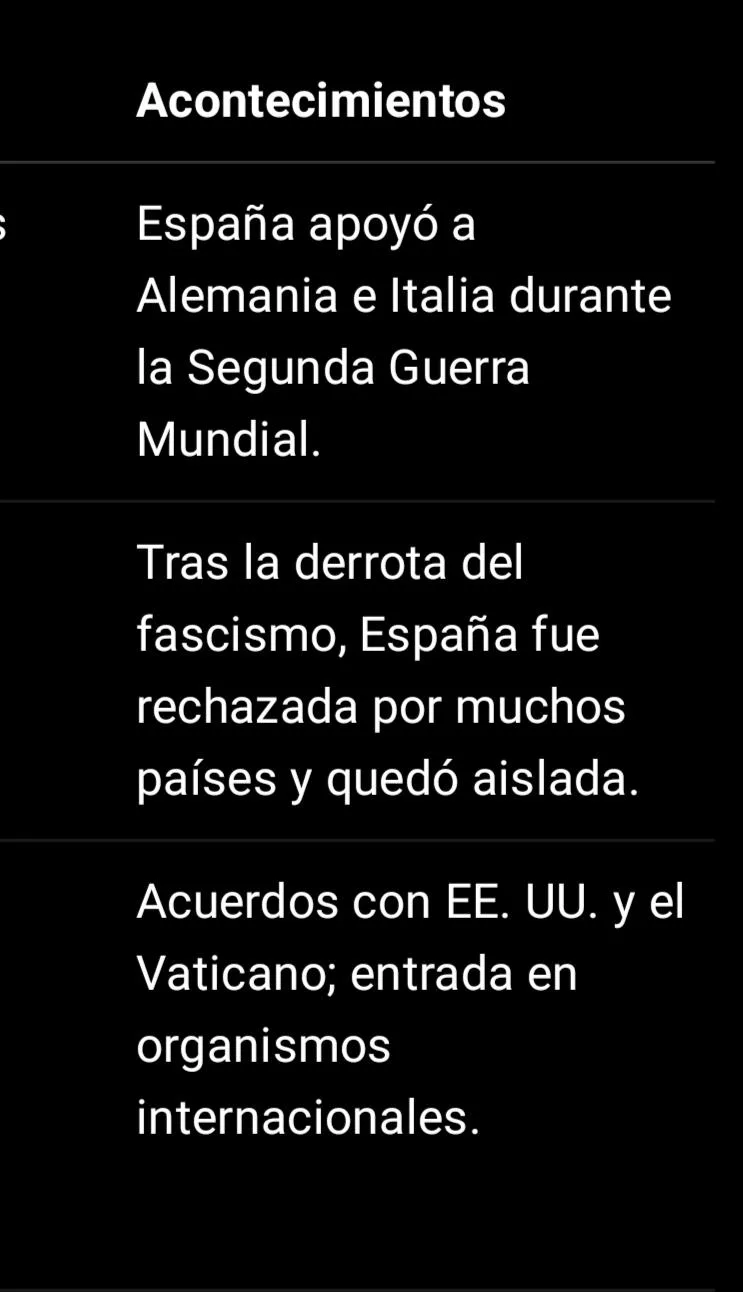
En Francia, algunos españoles participaron en la Resistencia francesa durante la Segunda
Guerra Mundial, luchando contra la ocupación nazi. Otros contribuyeron a la cultura y a la
educación en los países de acogida. Por ejemplo, muchos escritores, profesores y
científicos españoles continuaron allí su trabajo y enriquecieron la vida cultural de esos
países.
El exilio fue una experiencia muy dura porque muchas personas tuvieron que separarse de
sus familias y dejar atrás su hogar. Sin embargo, los exiliados españoles mantuvieron viva
la defensa de la libertad y la democracia.
ejercicios historia Alma MP 4°B
— PÁGINA 5 POR DETRÁS
1. Principales características del sistema político franquista
El franquismo fue una dictadura militar y autoritaria dirigida por Franco. Concentraba todos
los poderes del Estado, eliminó las libertades democráticas y prohibió los partidos políticos y
sindicatos. Existía un partido único y un sindicalismo vertical. El régimen se apoyó en el
Ejército, la Iglesia católica y la gran burguesía. Además, reprimió la oposición y aprobó
leyes fundamentales para aparentar una democracia que en realidad no existía.
2. Intereses de los grupos sociales para apoyar al franquismo
a) Gran burguesía:
Apoyó al régimen porque defendía sus intereses económicos, mantenía el orden social y
frenaba las reivindicaciones obreras.
b) Ejército:
Respaldó a Franco porque el régimen daba gran poder político y prestigio a los militares y
garantizaba la unidad de España.
c) Iglesia católica:
Apoyó al franquismo porque recuperó privilegios, influencia en la educación y la
confesionalidad del Estado.
— PÁGINA 6
4. Seis sustantivos que definan la etapa autárquica
Miseria
Carestía
Racionamiento
Estraperlo
Aislamiento
Autarquía
/ 5
End of Document
143

FAQs

Why did the majority of the population support the Republic in 1931?
In 1931, the majority of the population supported the Republic due to the crisis of the Restoration system and the loss of support for King Alfonso XIII. Political corruption, electoral fraud, and significant social inequalities contributed to this shift. The dictatorship of Primo de Rivera worsened the situation, associating the monarchy with authoritarianism. Many Spaniards sought a more democratic system with social reforms and greater freedoms, leading to the proclamation of the Second Republic.
What characterized the new state created by the rebels during the Spanish Civil War?
The new state established by the rebels was led by General Franco, who centralized power as the head of state and army. It featured a single political party, the Falange Española Tradicionalista y de las JONS, while prohibiting other parties and unions. The regime imposed an authoritarian, conservative, and Catholic model that emphasized obedience, nationalism, and traditional values. Repressive policies were enacted against opponents, including the elimination of republican legality and strict censorship.
What were the main characteristics of the Francoist political system?
The Francoist regime was a military dictatorship that concentrated all state powers in Franco's hands, eliminating democratic freedoms and banning political parties and unions. A single party system was established, supported by the military, the Catholic Church, and the bourgeoisie. The regime repressed opposition and enacted laws to create an illusion of democracy, despite the absence of genuine democratic practices.
What was the significance of the assassination of Carrero Blanco in 1973?
Carrero Blanco's assassination by ETA in 1973 significantly weakened the Francoist regime, as he was Franco's principal collaborator and the figure expected to ensure the continuity of the dictatorship after Franco's death. This event highlighted the growing dissent and resistance against the regime, contributing to the eventual transition towards democracy in Spain.
How did the autarkic economic policy affect Spain during Franco's regime?
The autarkic economic policy aimed for Spain's economic self-sufficiency, controlling the economy and protecting national production while limiting foreign trade. This led to significant issues such as scarcity, rationing, and the emergence of a black market. The policy was characterized by a focus on buying Spanish products and reducing imports, which ultimately resulted in economic difficulties for the country.
What role did Comisiones Obreras play during the Franco regime?
Comisiones Obreras (CCOO) emerged in the 1960s as a clandestine labor movement primarily composed of workers linked to the Communist Party. It was formed to defend labor rights against the official Francoist syndicalism. CCOO employed strategies such as strikes, protests, and infiltrating the vertical syndicate to organize labor movements that demanded better working conditions and democratic freedoms.
What was the purpose of the Junta Democrática established in 1974?
The Junta Democrática, created in 1974, was driven by the Communist Party of Spain and other opposition groups to end the Franco dictatorship. Its objectives included establishing democratic freedoms, calling for free elections, and achieving amnesty for political prisoners. The Junta organized mobilizations and coordinated various sectors of the democratic opposition, playing a crucial role in the push for democratization in Spain.