Units and Measurements Workbook – Practice Problems and Formulas
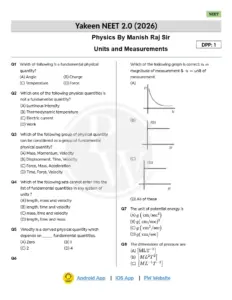
Units and Measurements Workbook offers comprehensive practice problems and formulas essential for mastering physics and mathematics concepts. This workbook is designed for students and educators seeking to enhance their understanding of units, conversions, and measurements in various scientific contexts. Key topics include angle conversions, solid angles, and fundamental physical quantities such as velocity, force, and energy. Ideal for high school and college students preparing for exams or seeking to reinforce their knowledge in physics and mathematics.
Key Points
Covers essential units and measurements in physics, including angles and solid angles.
Includes practice problems for converting between degrees and radians.
Explains fundamental physical quantities like velocity, force, and energy.
Provides a comprehensive list of dimensions for various physical concepts.

This link leads to an external site. We do not know or endorse its content, and are not responsible for its safety. Click the link to proceed only if you trust this site.
Add a Question Tag – English Grammar PracticeWorksheet
PDF
Physics Practice Problems for College Course
PDF
Hardy-Weinberg Equilibrium Practice Problems Solutions
PDF
Genetics Practice Problems and Solutions for AP Biology
PDF
Balancing Chemical Equations Practice Problems and Solutions
PDF
Grade 1 Mixed Subjects Practice Workbook
PDF
Thermodynamics Practice Problems for Chemistry Students
PDF
Electrochemistry Practice Problems for Test 4 Chapter 19
PDF
Solutions to Chapter 10 Electrochemical Cells Practice Problems
PDF
AP Physics C Practice Workbook Book 2 Electricity and Magnetism
PDF
AP Physics 1 – Practice Workbook
PDFWorksheet
Economics Development Worksheet for Class X – Session 2026-27Worksheet
FAQs
What are the conversions for degrees and radians?
The document provides key conversions between degrees and radians. Specifically, it states that 180° is equivalent to π radians, and 1° equals π/180 radians. Additionally, it mentions that 1 radian is equal to approximately 57.2958 degrees. These conversions are essential for understanding angular measurements in various scientific and mathematical contexts.
What are the units for measuring solid angles?
In the document, solid angles are represented by the symbol Ω. The unit of solid angle is the steradian (sr), which is a fundamental unit used in three-dimensional geometry to measure angles. The document emphasizes the importance of understanding solid angles in fields such as physics and engineering.
What are the dimensions of common physical quantities?
The workbook lists the dimensions of various physical quantities. For example, velocity has dimensions of [L][T]⁻¹, acceleration is [L][T]⁻², and force is [M][L][T]⁻². Other quantities include work or energy with dimensions of [M][L]²[T]⁻², and pressure, which has dimensions of [M][L]⁻¹[T]⁻². Understanding these dimensions is crucial for solving problems in physics.
How is angular velocity defined and measured?
Angular velocity is defined in the document as the rate of change of angular displacement with respect to time. It is measured in radians per second (rad/s). The document highlights the significance of angular velocity in rotational motion and its applications in various fields, including mechanics and engineering.
What is the formula for calculating torque?
The document states that torque, often represented by the symbol τ, is calculated using the formula τ = r × F, where r is the distance from the pivot point to the point of force application, and F is the force applied. Torque is a crucial concept in physics, particularly in the study of rotational dynamics, as it determines the effectiveness of a force in causing rotation.
What is the relationship between angle, solid angle, and strain?
According to the document, angle, solid angle, and strain are all related concepts in geometry and physics. An angle is a measure of rotation in two dimensions, while a solid angle measures the extent of an angle in three dimensions. Strain, on the other hand, is a measure of deformation representing the displacement between particles in a material body. Understanding these relationships is important for applications in engineering and materials science.
Related
PDFWorksheet
The New 7 Wonders of the WorldWorksheet
PDFWorksheet
Alphabet Tracing Worksheets for Kids – Educational ResourceWorksheet
PDFWorksheet
Pre Writing Skills Tracing Worksheets in Colorful Wild Animal Cartoon StyleWorksheet
PDFTutorial
Quantum Physics Tutorial 1 – Problems and SolutionsTutorial
PDFStudy Guide
Internet of Things MCQ Practice Questions and AnswersStudy Guide
PDFNotes
Exam Preparation Practice Questions and AnswersNotes
PDFPresentation
CVE 401 Civil Engineering Practice – Case Studies on Highways and PavementsPresentation
PDFPresentation
CVE 401 Civil Engineering Practice: Case Studies on FoundationsPresentation
PDFLecture Notes
Units & Measurement Mind MapsLecture Notes
PDFStudy Guide
ACS Exams Organic Chemistry Practice ItemsStudy Guide