www.asbiology101.wordpress.com
THE CASPARIAN STRIP
The endodermis is a layer of cells which surrounds the xylem. Many of these cells have a waterproof layer in their cell
walls which appears in bands. This band is called the Casparian strip. This blocks the apoplast pathway, because it
means that the water cannot travel along cell walls, so water is forced to follow the symplast pathway.
The purpose of the Casparian strip is to ensure that the water carrying the salts and dissolved mineral ions has to travel
through the plasma membranes to the cellular cytoplasm. To allow this, there are transport proteins (see 1.8
Movement Across Cell Membranes) in the membranes. Certain substances can be actively transported into the xylem
from adjacent cells, including nitrate. This decreases the water potential of the xylem, meaning there is a steep water
potential gradient from the cells surrounding the xylem to the xylem itself, therefore forcing water to move from those
cells into the xylem. This is another result of the Casparian strip blocking the apoplast pathway.
MOVEMENT OF WATER UP THE STEM
There are three processes which aid the movement of water up the stem:
1 Root pressure – the action of the endodermis moving minerals into the xylem by active transport drives water into
the xylem (by osmosis), which in turn pushes water up the xylem as new water enters the vessel
2 Transpirational pull – the loss of water from the leaves must be replaced by water coming up the xylem. Water
molecules are attracted to each other by the forces of cohesion. These forces are strong enough to hold the
molecules together in a long chain or column. As the molecules at the top of the column are lost, the whole chain
is pulled up as one lot, creating the transpirational stream.
3 Capillary action – the same forces also attract the water molecules to the sides of the xylem – this is called
adhesion. Because the xylem are very narrow, these forces can pull the water molecules up the sides of the vessel
LEAVING THE LEAF
Most of the water which leaves the leaf exits through stomata. These are tiny pores in the epidermis. A tiny amount
also leaves through the waxy cuticle. Water evaporates from the cells immediately below the guard cells, lowering the
water potential in those cells, causing water from neighbouring cells to enter them by osmosis.
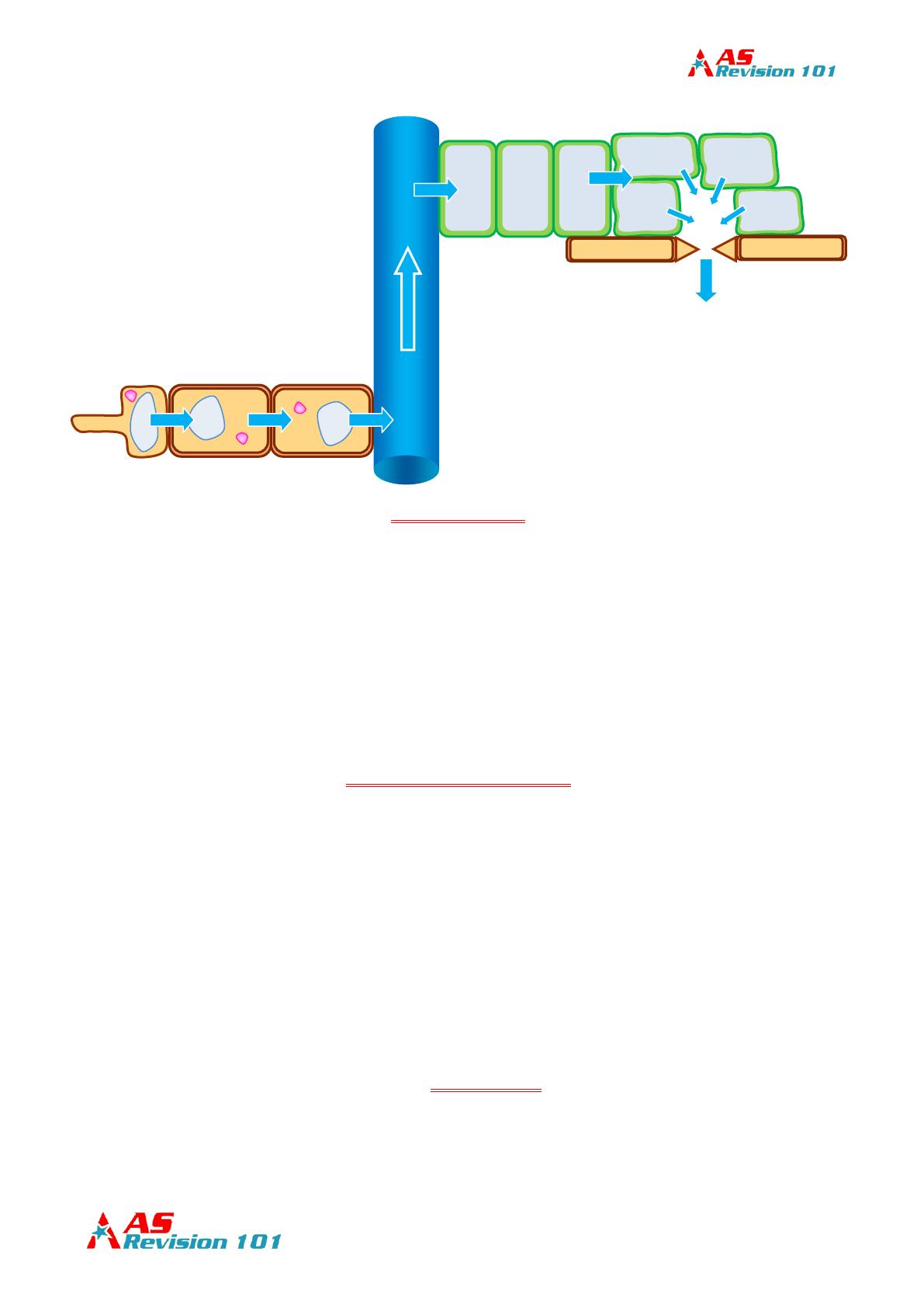
1 - Water osmotically
transported (and minerals
by active transport) into
the root hair cells and
through adjacent cells
3- Water transported
up the xylem due to
transpirational pull
2 - Water enters the xylem to
replace lost water (water potential
lowered as other water molecules
leave the xylem)
4 – Osmosis moves the water
across the leaf cells
5 – Evaporation of water
from cell surfaces
6 – Diffusion of the
water vapour out of the
leaf (transpiration)