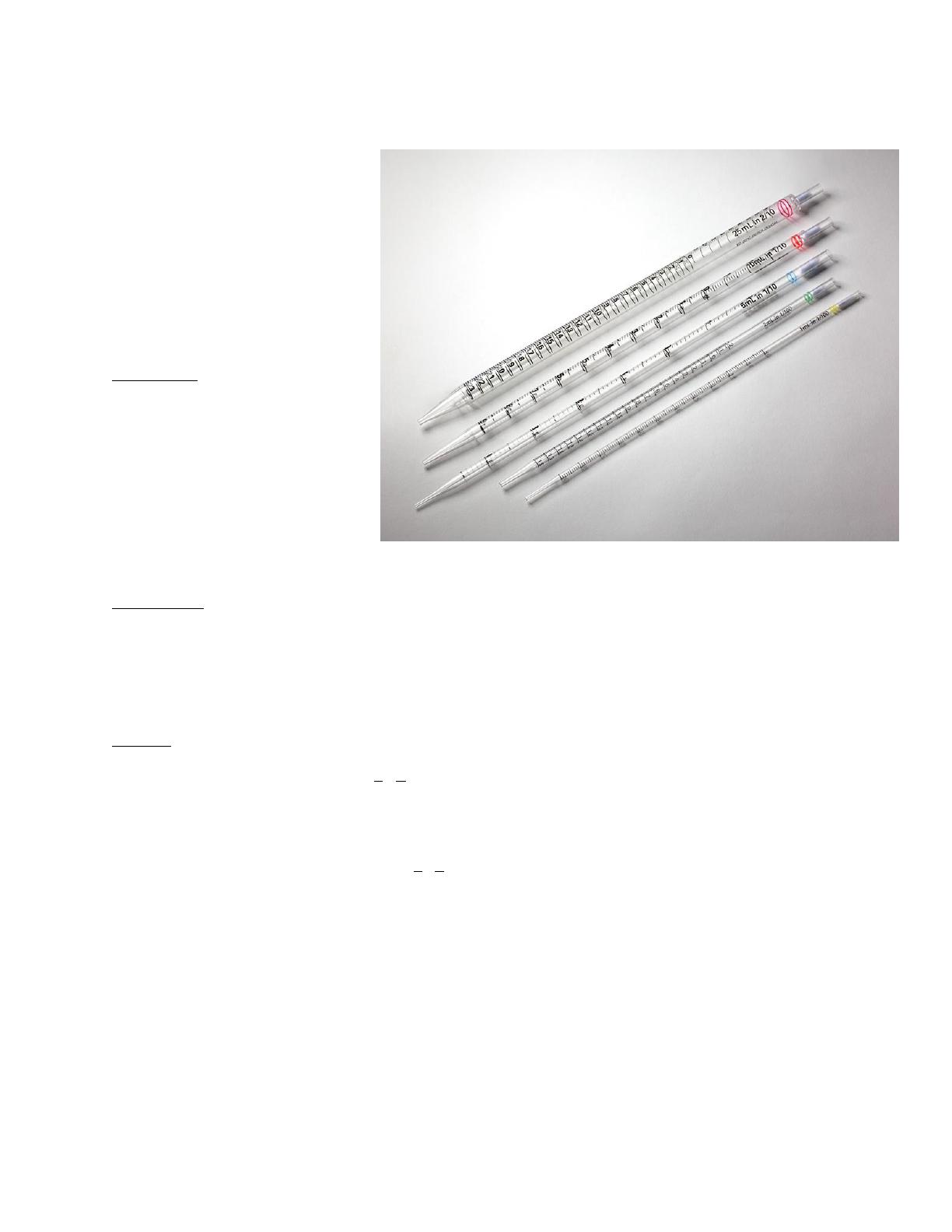
Serological pipette (similar but not identical to a Mohr pipette)
A serological pipette is used for
quantitative transfers. It requires a
vacuum source for transfer –
typically a pipettor or a pipette bulb
is attached to the blunt end.
Mouth-pipetting is always expressly
forbidden! The markings on the end
of the pipette are important to take
note of:
Graduations
The maximum volume of the
pipette and its graduations are
marked such as the following, which
means that the pipette is designed
to deliver a maximum of 10 mL and
that there are graduations to 1/10
th
of a mL. This also lets you know that
the 1/10
th
mL is known, so it is possible to estimate 1/100
th
mL.
Temperature
The glassware is calibrated to deliver accurate volumes at the stated temperature. Most liquids expand
somewhat with increasing temperature and contract with decreasing temperature. This is a very
negligible change for most measurements, so we generally do not consider the calibration temperature
unless the experiment calls for extreme precision.
TD or TC
Pipettes labeled TD (which stands for To Deliver and is sometimes marked as EX) at the upper end are
designed to deliver the volume stated on the pipette. There will always be a small amount of liquid
inside the tip after pipetting. If this liquid is blown out you will have delivered slightly more than the
designed capacity of the pipette. Almost all of our pipettes are TD pipettes. However, other types do
exist: Pipettes labeled TC (which stands for To Contain and is sometimes marked as IN) are designed to
contain the volume stated on the pipette. Therefore, all liquid on a TC pipette should be expelled to
obtain the desired volume. MOST of our pipettes are designed to deliver liquid volumes and as such as
TD pieces. MOST of our beakers and flasks are designed to contain liquids and are marked as TC pieces.
It is still a good idea to double check before using a piece of glassware.