The 1994 Genocide Against the Tutsi provides a comprehensive analysis of the historical, ideological, and structural factors leading to the genocide. It examines the role of propaganda, state control, and the militarization of society in the execution of this tragic event. The document emphasizes that the genocide was a planned and organized act rather than a spontaneous occurrence. It also discusses the failure of international intervention and the consequences of systemic discrimination against the Tutsi population. This analysis is essential for understanding the complexities of genocide and the importance of historical context in preventing future atrocities.

Key Points

  • Analyzes the ideological foundations of the 1994 Genocide Against the Tutsi.
  • Explores the role of propaganda in inciting violence against the Tutsi population.
  • Details the systematic discrimination and exclusion faced by the Tutsi before the genocide.
  • Examines the international community’s failure to intervene during the genocide.
Devy dacker nickson
4 pages
Language:English
Type:Report
Devy dacker nickson
4 pages
Language:English
Type:Report
71
/ 4
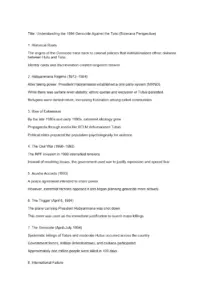
Title: The 1994 Genocide Against the Tutsi — Deep Analysis (Bizimana Perspective)
INTRODUCTION
This document presents a deeper historical and analytical account of the Genocide against the
Tutsi, emphasizing planning, ideology, and execution.
1. IDEOLOGICAL FOUNDATIONS
Colonial policies institutionalized ethnic divisions.
Identity cards fixed categories into law.
Long-term narrative built:
"Tutsi are enemies of the nation."
2. STATE STRUCTURE AND CONTROL (1973–1994)
Under Habyarimana:
- One-party system (MRND)
- Centralized authority
- Administrative control down to villages
Core idea:
Control the population, shape thought, limit dissent.
3. EXCLUSION AND PREPARATION
Policies included:
- Ethnic quotas in education and jobs
- Refugees denied return
This created frustration and fear narratives.
Bizimana emphasizes:
"Discrimination was not accidental. It was systemic."
4. PROPAGANDA MACHINE
Media played a decisive role.
RTLM messaging:
"The graves are not yet full."
"Cut down the tall trees."
Newspapers like Kangura spread ideology.
Message strategy:
- Dehumanize
- Create fear
- Normalize violence
5. MILITARIZATION OF SOCIETY
- Interahamwe militia trained
- Weapons distributed (machetes, clubs)
- Civilian participation prepared
Local leaders mobilized communities.
Quote:
"They prepared the population before the killings began."
6. CIVIL WAR AS JUSTIFICATION (1990–1993)
RPF invasion used to:
- Spread fear of "enemy inside"
- Justify repression
- Intensify propaganda
Narrative:
"All Tutsi are accomplices."
7. FAILURE OF PEACE (ARUSHA ACCORDS)
Power-sharing agreement threatened extremists.
Reaction:
- Secret planning accelerated
- Kill lists prepared
- Militia expanded
Bizimana insight:
"They planned genocide while negotiating peace."
8. TRIGGER EVENT — APRIL 6, 1994
Plane carrying Habyarimana shot down.
Immediate outcome:
- Roadblocks set up
- Targeted killings begin within hours
This shows prior coordination.
9. EXECUTION OF GENOCIDE (APRIL–JULY 1994)
Characteristics:
- Nationwide coordination
- Use of local administration
- Participation of militias and civilians
Testimony:
"They told us who to kill, where to find them."
Scale:
Approximately one million killed in 100 days.
10. ROLE OF INTERNATIONAL COMMUNITY
Warnings ignored.
UN commander Roméo Dallaire:
"I have information that points to a genocide."
Response:
- Limited mandate
- Withdrawal of forces
Failure allowed escalation.
11. STOPPING THE GENOCIDE
RPF advanced and ended killings in July 1994.
/ 4
End of Document
71

FAQs

what is the 1994 genocide against the tutsi

The 1994 Genocide Against the Tutsi was a horrific event in which approximately one million Tutsi and moderate Hutu were systematically killed in just 100 days.

  • Ideological Foundations: The genocide was rooted in long-standing ethnic divisions and propaganda that dehumanized the Tutsi.
  • Execution: The killings were coordinated nationwide, involving local administration and civilian participation.
  • International Response: Warnings about the impending genocide were largely ignored by the international community.

how did the 1994 genocide against the tutsi happen

The genocide was a result of a combination of systemic discrimination, propaganda, and political manipulation.

  • State Control: Under Habyarimana's regime, a one-party system and centralized authority facilitated the control of the population.
  • Militarization: The Interahamwe militia was trained and armed, preparing civilians for participation in the violence.
  • Trigger Event: The assassination of Habyarimana on April 6, 1994, sparked immediate and widespread killings.

what were the causes of the 1994 genocide against the tutsi

The causes of the 1994 Genocide Against the Tutsi are complex, involving historical, social, and political factors.

  • Colonial Legacy: Colonial policies institutionalized ethnic divisions that laid the groundwork for future conflict.
  • Propaganda: Media outlets like RTLM spread messages that dehumanized Tutsi and incited violence.
  • Failure of Peace Accords: The Arusha Accords aimed at power-sharing were met with resistance from extremist factions, leading to secret planning for genocide.

what role did propaganda play in the 1994 genocide against the tutsi

Propaganda played a critical role in the lead-up to and during the 1994 Genocide Against the Tutsi.

  • Media Influence: Radio stations like RTLM disseminated messages that dehumanized Tutsi and incited violence.
  • Fear Tactics: Propaganda created a narrative that portrayed Tutsi as enemies, justifying their extermination.
  • Normalization of Violence: The media's portrayal of violence as acceptable contributed to widespread participation in the genocide.

how many people died in the 1994 genocide against the tutsi

Approximately one million people were killed during the 1994 Genocide Against the Tutsi.

  • Duration: The genocide lasted for about 100 days, from April to July 1994.
  • Targeted Groups: The majority of victims were Tutsi, along with moderate Hutu who opposed the violence.
  • Impact: This mass killing resulted in significant demographic and social changes in Rwanda.

what was the international response to the 1994 genocide against the tutsi

The international response to the 1994 Genocide Against the Tutsi was largely inadequate and ineffective.

  • Warnings Ignored: UN commander Roméo Dallaire warned of impending genocide, but these warnings were largely ignored.
  • Limited Mandate: The UN's response was constrained by a limited mandate, which hindered effective intervention.
  • Withdrawal of Forces: Instead of increasing support, international forces were withdrawn, allowing the genocide to escalate.

what were the outcomes of the 1994 genocide against the tutsi

The outcomes of the 1994 Genocide Against the Tutsi were profound and far-reaching.

  • Humanitarian Crisis: The genocide resulted in a massive humanitarian crisis, with millions displaced and in need of aid.
  • RPF Victory: The Rwandan Patriotic Front (RPF) ended the genocide in July 1994, leading to a new government.
  • International Reflection: The failure to prevent the genocide has led to ongoing discussions about international responsibility and intervention.

what lessons were learned from the 1994 genocide against the tutsi

The 1994 Genocide Against the Tutsi offers critical lessons about the prevention of mass atrocities.

  • Importance of Early Warning: Effective mechanisms for recognizing and acting on early signs of genocide are essential.
  • International Responsibility: There is a need for a stronger international commitment to intervene in cases of genocide.
  • Education and Awareness: Promoting education about genocide can help prevent future atrocities.

how did the genocide against the tutsi end

The genocide against the Tutsi ended in July 1994 when the Rwandan Patriotic Front (RPF) took control of the country.

  • Military Action: The RPF launched a military offensive to stop the killings and restore order.
  • Government Overthrow: The RPF's victory led to the establishment of a new government focused on reconciliation.
  • Continued Challenges: Despite the end of the genocide, Rwanda faced ongoing challenges related to trauma and rebuilding.

what was the significance of the 1994 genocide against the tutsi

The significance of the 1994 Genocide Against the Tutsi lies in its impact on Rwanda and the international community.

  • Human Rights Awareness: It highlighted the need for stronger international human rights protections.
  • Rwandan Reconciliation: The genocide prompted efforts for national healing and reconciliation in Rwanda.
  • Policy Changes: It influenced international policies regarding intervention in humanitarian crises.