GROUP 5
The Power of the Mind: The Whole Brain
Theory
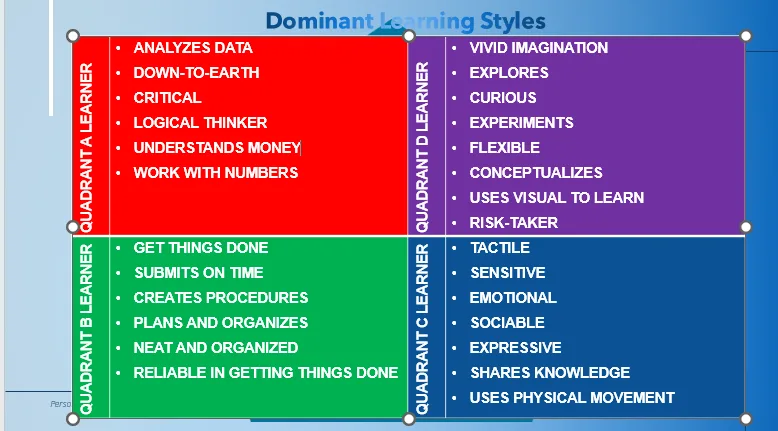
Dominant Learning Styles
Herrmann’s Four Dominant Quadrant
NED HERRMANN – Father of Brain
Dominance Theory.
- His theory is derived from observations and
tests that the human body, although
symmetrical and paired in almost all aspects,
do not necessarily function equally. People
normally have a more dominant part of their
body, like a more dominant leg, eye, or arm,
which a person often prefers to use.
What is Whole Brain Theory?
Scientists, medical doctors, psychologists,
and psychiatrists have always been
fascinated with the brain and how it works.
Studies conducted on the brain often starts
with an attempt to understand a brain-
related disease or malfunction.
In 1861, Paul Broca conducted a study on the
language and left-right brain specialization on
a patient who had problems with language.
After several tests, Broca theorized that some
language functions reside on the left side of
the brain.
Different theories of Whole Brain
1. Split-Brain Theory
- by Dr. Roger Sperry
- Conducted the study of epilepsy.
- Split-Brain Theory.
- Brain has two hemispheres: Left
Hemisphere and Right Hemisphere
- Left Hemisphere performing tasks that were
intuitive, creative, and synthesizing;
- Right Hemisphere is more adept with
analytical, logical, reasoning, and critical
thinking.
2. The Triune Brain Theory
- by Dr. Paul MacLean
- Identified three distinct parts of the brain: (a)
neocortex, (b) limbic system, and (c) reptilian
complex
- The Triune Brain Theory
- neocortex or rational brain is responsible
for intellectual tasks such as language,
planning, abstraction, and perception
- limbic system or the intermediate brain is
responsible for the motivation and emotion
involved in feeding, reproductive behavior,
and parental behavior.
- the primitive brain or the reptilian
complex, which controls the self-
preservation and aggressive behavior of
humans similar to the survival instincts of
animals.
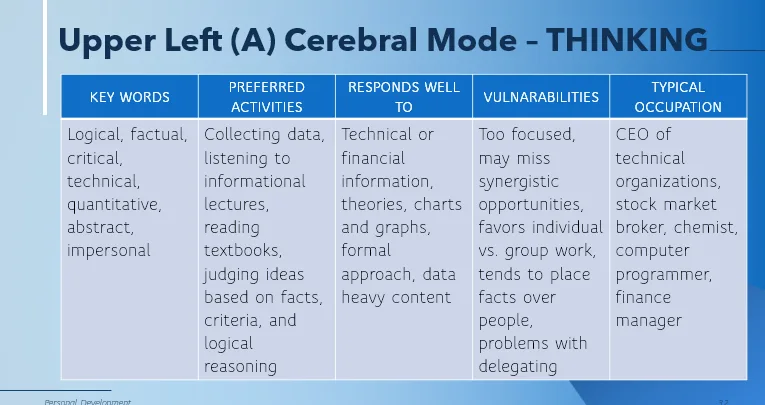
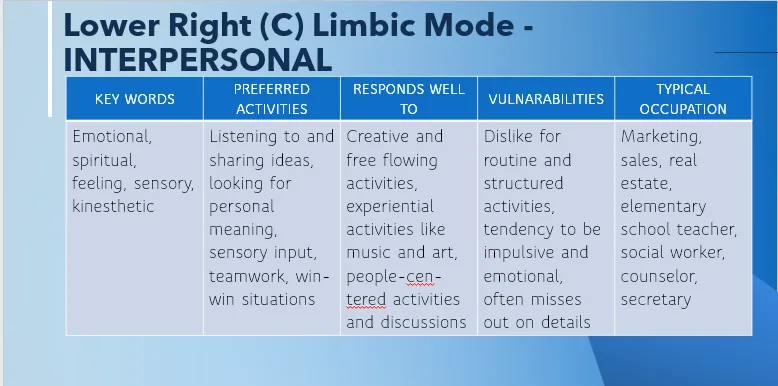
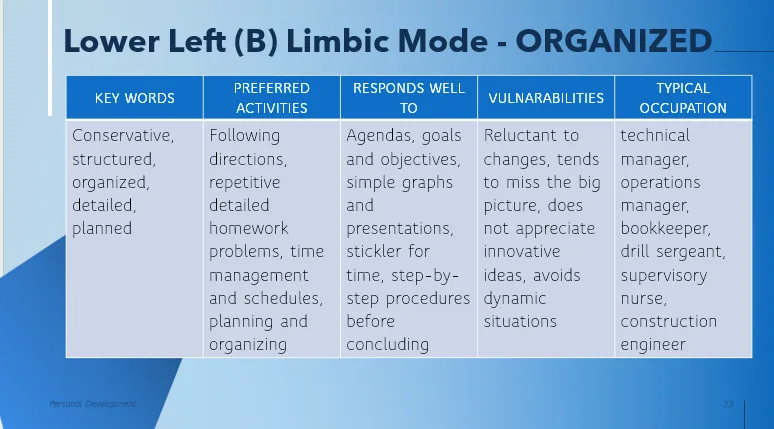
Herrmann labeled the four quadrants of the
brain as:
❑ Upper Left (A) Cerebral Mode - key
word for this quadrant is ANALYTICAL

❑ Lower Left (B) Limbic Mode - key word
for this quadrant is ORGANIZED
❑ Lower Right (C) Limbic Mode - key
word for this quadrant is
INTERPERSONAL
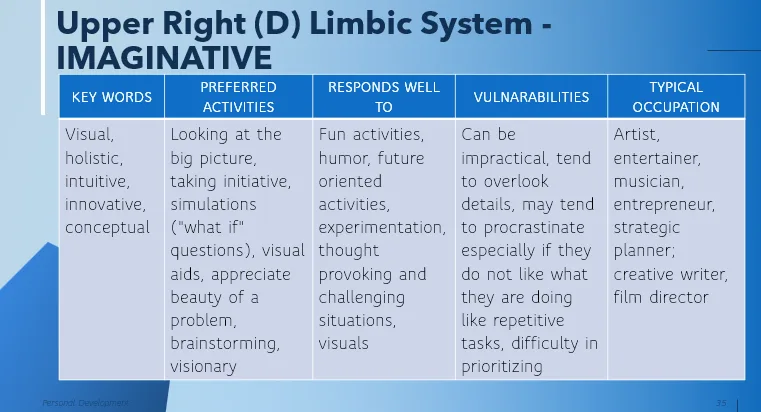
❑ Upper Right (D) Limbic System - key
word for this quadrant is IMAGINATIVE
A & B Leaners (Thinking and Organized)
are often characterized as practical, reality-
based, and down-to-earth.
C & D Learners (Interpersonal and
Imaginative)
are often characterized as fun, flexible, and
open-minded persons.
Learners should always remember that they
do not necessarily belong to just one or two
quadrants, but can find their qualities present
in all the quadrants.
Benefits of knowing the different styles of
learning:
• easily adapt their own learning styles
• appreciation of the diversity
• a better collaborator at work, a very
important skill that is currently in
demand in the workplace
• improved interpersonal relationships
once they understand and accept the
differences in people's learning and
thinking styles
Figures