Mixtures Worksheet 5: Techniques for Separating Mixtures
Explore various techniques for separating mixtures in this comprehensive worksheet focused on mechanical sorting, filtration, evaporation, distillation, and chromatography. Designed for middle school science students, this resource provides clear explanations and examples of each method. Students will learn how to identify appropriate separation techniques for both heterogeneous and homogeneous mixtures. The worksheet includes multiple-choice questions and practical applications to reinforce understanding of separation methods in chemistry.
Key Points
Covers mechanical sorting, filtration, evaporation, distillation, and chromatography techniques.
Includes multiple-choice questions to test understanding of separation methods.
Explains how to separate heterogeneous and homogeneous mixtures effectively.
Provides practical examples for each separation technique to enhance learning.
This link leads to an external site. We do not know or endorse its content, and are not responsible for its safety. Click the link to proceed only if you trust this site.
Phys 1011 Worksheet I: Conceptual Questions and ProblemsWorksheet
PDFLecture Notes
Filtering Techniques in Engineering MeasurementsLecture Notes
PDFWorksheet
Genetic Pedigree Analysis Worksheet for Grade 12Worksheet
PDFNotes
C++ Programming Essentials: Key Concepts and TechniquesNotes
PDFBook
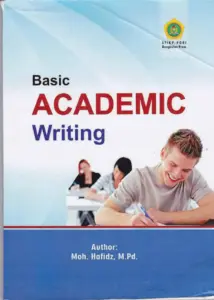
Basic Academic Writing: Techniques for Effective Essay CompositionBook
PDFWorksheet
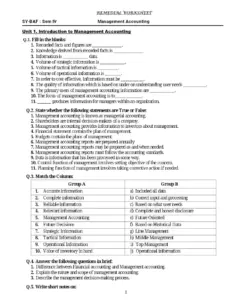
Management Accounting Remedial Worksheet SYBAF Sem IVWorksheet
PDFWorksheet
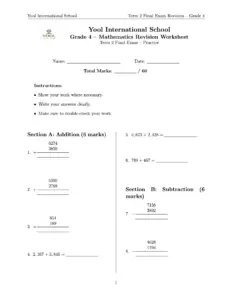
Grade 4 Mathematics Final Exam Revision Worksheet: A Comprehensive GuideWorksheet
PDFWorksheet
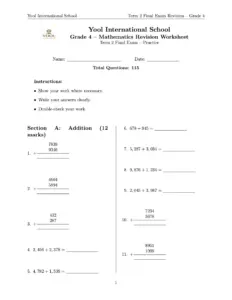
Grade 4 Mathematics Final Exam Revision WorksheetWorksheet
PDFWorksheet
Grade 5 Mathematics Final Exam Revision WorksheetWorksheet
PDFGuide
Eleven Labs: Voice Generation Techniques and ApplicationsGuide
PDFResearch Paper
Theoretical Foundations of Directed Reading Thinking Activity (DRTA), Its Variations and TechniquesResearch Paper
PDFWorksheet
Grade 8 Equations WorksheetWorksheet
FAQs
What are the main techniques for separating mixtures?
The main techniques for separating mixtures include mechanical sorting, filtration, evaporation, distillation, and chromatography. Mechanical sorting involves separating materials based on physical properties like size or shape. Filtration is used to separate solids from liquids by passing the mixture through a porous material. Evaporation recovers solids from solutions by turning the liquid into gas, while distillation separates components based on boiling points. Chromatography separates substances based on their movement across a medium.
How does filtration work in separating mixtures?
Filtration works by passing a mixture through a porous material, allowing the liquid to pass while retaining solid particles. The solid that remains on the filter is called the residue, while the liquid that passes through is known as the filtrate. This method is effective for separating insoluble solids from liquids, such as in the case of muddy water, where the mud is trapped by the filter paper.
What is the difference between evaporation and distillation?
Evaporation is a process that involves heating a liquid until it turns into gas, leaving behind any dissolved solids. It is typically used to recover solid solutes from solutions. Distillation, on the other hand, is a more complex method that separates liquids based on their boiling points. It involves two main processes: evaporation and condensation, allowing for the recovery of both the solvent and solute. Distillation is particularly useful for separating mixtures of liquids.
What role does chromatography play in separating mixtures?
Chromatography is a technique used to separate components of a mixture based on their movement across a stationary phase. In this method, a mixture is usually drawn across chromatography paper or another medium, where different components travel at different rates. This separation occurs due to varying affinities for the stationary phase, allowing for the identification and analysis of individual substances within the mixture.
What are some examples of mechanical sorting techniques?
Mechanical sorting techniques include methods like magnetism, where magnetic materials are separated from non-magnetic ones, and flotation, which separates substances based on their buoyancy in a liquid. These methods rely on physical properties such as size, shape, and density to effectively separate different components of a mixture. For example, using a magnet to remove iron filings from a mixture of sand and iron is a practical application of mechanical sorting.
How can students apply the knowledge of separation techniques?
Students can apply their knowledge of separation techniques in various practical scenarios, such as in laboratory experiments or real-world situations like recycling. Understanding how to choose the appropriate method for separating mixtures helps in fields like chemistry, environmental science, and engineering. For instance, they can use filtration to purify water or distillation to separate essential oils from plant materials.
Why is it important to understand separation techniques in science?
Understanding separation techniques is crucial in science as it enables students to analyze and manipulate mixtures effectively. These techniques are foundational in chemistry, biology, and environmental science, allowing for the extraction and purification of substances. Mastery of these methods supports scientific inquiry and experimentation, fostering critical thinking and problem-solving skills essential for future scientific endeavors.