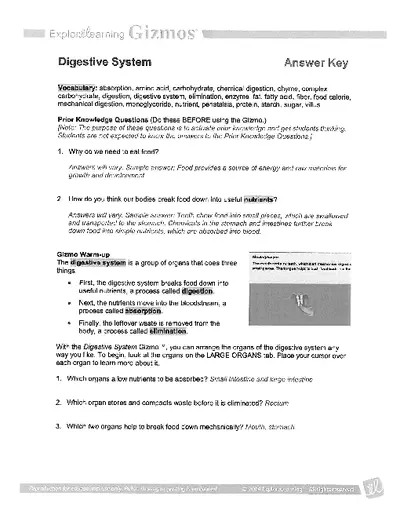


Access an extensive, community-driven archive of digestive system PDFs, gastrointestinal (GI) anatomy worksheets, enzymatic breakdown flowcharts, and clinical physiology study guides curated to maximize your medical grades and nutritional understanding. This dedicated resource library tracks the complex, multi-stage processing network of the human alimentary canal—ranging from the mechanical grinding of the oral cavity and gastric acid-catalyzed hydrolysis in the stomach to the intricate absorption mechanics of the small intestine and the microbiome-driven fermentation of the large intestine. Whether you are troubleshooting the stages of gastric emptying, mapping the neuro-hormonal control of secretin and cholecystokinin ($CCK$), or preparing for an advanced university physiology or histology test bank, these files give you instant, downloadable clarity.
The Digestive System is the high-efficiency, integrated organ apparatus responsible for the mechanical and chemical degradation of ingested food into its fundamental molecular components (amino acids, monosaccharides, fatty acids) for cellular absorption and systemic utilization. Far from a passive transit tube, the GI tract is a highly reactive, hormonally controlled, and autonomously innervated system that balances local tissue requirements with systemic energy needs. Students investigate the system through the lenses of GI Anatomy (the histological layering of the mucosa, submucosa, muscularis externa, and serosa), Gastrointestinal Physiology (the molecular mechanics of enzymatic digestion and transporter-mediated absorption), and Enteric Regulation (the “second brain” network governing motility and secretions). The field demands extreme precision in mapping the pH-dependent activity of enzymes, identifying the diagnostic histological markers of the GI wall, and understanding the homeostatic feedback loops of the hypothalamic-pituitary-gut axis. Studying the digestive system builds advanced competencies in fluid and nutrient modeling, clinical diagnostic reasoning, and multi-system pathology integration—skills foundational to every medical, gastroenterological, and nutritional career.
Our collaborative document network hosts student-shared histology reports, metabolic pathway maps, and comprehensive midterm review packages organized across the fundamental branches of gastrointestinal scholarship:
Layered Organization: Download high-yield gastrointestinal histology diagrams identifying the structural transitions from the esophagus to the colon, including villi, microvilli, and goblet cell distribution.
Wall Integrity: Access specialized GI tract anatomy notes detailing the muscularis externa’s roles in peristalsis and the specialized secretomotor glands of the submucosa.
Molecular Degradation: Download functional enzymatic breakdown worksheets mapping the specific $pH$ ranges and substrates for salivary amylase, pepsin, trypsin, and lipase.
Transport Processes: Access comprehensive nutrient absorption physiology PDFs detailing the active and passive transport mechanisms (e.g., $SGLT1$ glucose transporters) across the intestinal brush border.
The Enteric Brain: Download high-yield enteric nervous system study guides detailing the plexuses ($Myenteric$ vs. $Submucosal$) that autonomously regulate motility and secretion.
Hormonal Feedback: Access dossiers tracking the $CCK$, $Secretin$, and $Gastrin$ feedback loops that orchestrate gastric acid regulation and pancreatic enzyme release.
When analyzing the efficiency of the digestive apparatus, physiologists rely on standardized kinetic indices to quantify processing speed and nutrient uptake. The reference matrix below defines the core variables essential for clinical gastrointestinal assessment:
| GI Variable | Clinical Definition | Primary Regulatory Mechanism |
| Gastric Acid ($HCl$) | Acidification of the stomach lumen for protein denaturation | Parietal cell $H^+/K^+$ ATPase activation |
| Bile Emulsification | The breakdown of fat globules into smaller micelle droplets | Liver production / Gallbladder contraction ($CCK$) |
| Transit Time | The duration taken for food to move through the GI tract | Enteric $Myenteric$ plexus (Peristalsis) |
| Brush Border Absorption | Final breakdown and uptake of nutrients at the microvilli | Membrane-bound disaccharidase activity |
This section addresses the most frequently searched digestive friction points, keyword-targeted physiological prompts, and foundational questions sourced from university medical test banks.
These are the two primary motility patterns of the GI tract. Peristalsis is a series of wave-like muscular contractions—a moving ring of contraction behind the food bolus and relaxation in front of it—designed to propel material forward through the tract. Segmentation, conversely, involves the localized, rhythmic contraction and relaxation of non-adjacent segments of the circular smooth muscle. This creates a “back-and-forth” mixing motion that does not move the contents forward, but instead thoroughly blends the bolus with digestive enzymes, maximizing surface area for absorption.
The stomach possesses a robust “mucosal barrier.” This barrier consists of a thick, bicarbonate-rich mucus layer that acts as a chemical buffer, maintaining a near-neutral $pH$ at the surface of the gastric epithelium even when the stomach lumen has a highly acidic $pH$ of $1.5$ to $2.0$. Additionally, gastric epithelial cells have extremely high turnover rates and are joined by tight junctions, preventing acid from leaking between the cells and damaging the underlying tissue layers.
The enteric nervous system ($ENS$) is a vast, semi-autonomous meshwork of millions of neurons embedded directly into the walls of the entire GI tract. It is arguably the only part of the peripheral nervous system capable of complex, localized reflexes without any input from the Central Nervous System. The $ENS$ independently controls motility, fluid secretion, and blood flow, meaning that even if the Vagus nerve were severed, the digestive tract could continue to process food and maintain basic homeostatic functions.
The surface area of the small intestine is the critical variable for absorption. If the intestine were a smooth tube, it would not have enough contact area to absorb the required amount of nutrients. The villi (finger-like folds of the mucosa) and the microvilli (microscopic protrusions on the surface of individual epithelial cells, the “brush border”) increase the surface area of the small intestine by roughly $600$-fold. This massive expansion is what allows the body to complete the absorption of nutrients before the contents move on to the large intestine.
Yes. Mapping out the hormone cascade for digestion, interpreting brush-border enzyme function, and debugging complex GI motility problems are daily requirements for physiology and medical students. Our global user network frequently uploads complete digestive lecture summaries, downloadable digestion process flowcharts, and practice exam answers to help you streamline your study workflow before assessment deadlines.
Every morphological matrix, hormonal feedback map, and clinical physiology guide across our database is maintained by a global network of students, researchers, and medical trainees who believe in open, decentralized educational tools. To see how these physiological systems connect with broader anatomical, endocrine, or nutritional fields, return to our primary Chesser Resources Browse Directory.
Ready to download premium digestive system study guides or enzymatic breakdown worksheets? Join our shared academic network: navigate to your user dashboard, upload 5 of your own physiology lab reports, GI pathway charts, or clinical rotation logs, and instantly secure unrestricted access to the high-yield PDFs you need to maximize your medical grades today.