

Java is a robust, class-based, object-oriented programming language designed around the foundational engineering philosophy of “Write Once, Run Anywhere” (WORA). Developed to minimize physical platform dependencies, Java abstracts lower-level hardware architectures through an intermediate compilation layer. Instead of compiling source code directly into machine-specific binary formats, Java source strings are translated into a highly optimized, platform-independent instruction set termed bytecode. This architectural insulation makes Java an industry-standard environment for enterprise-scale web backends, distributed microservices, financial transaction frameworks, and cross-platform native software. To assist developers transitioning from junior syntax tracking to senior systems engineering, our Programming library provides a comprehensive ecosystem of university lecture syllabi, design-pattern transcripts, and laboratory code assignments.
The structural backbone of Java’s platform portability is the Java Virtual Machine (JVM). The JVM acts as an abstract computing machine with its own memory management structures, execution loops, and thread registers. When a Java application executes, the JVM’s class loader subsystem dynamically links and loads compiled .class files into runtime data areas. To optimize execution speeds, the JVM utilizes a hybrid model combining standard bytecode interpretation with a Just-In-Time (JIT) Compiler. The JIT compiler monitors application execution profiles in real-time, identifying high-frequency “hot spots” in the code and compiling those bytecode segments directly into native machine code, achieving near-native execution efficiency. Students can explore how these runtime environments integrate into broader computer science paradigms by referencing 100 Multiple Choice Questions on Emerging Trends in Computer Engineering and Information Technology.
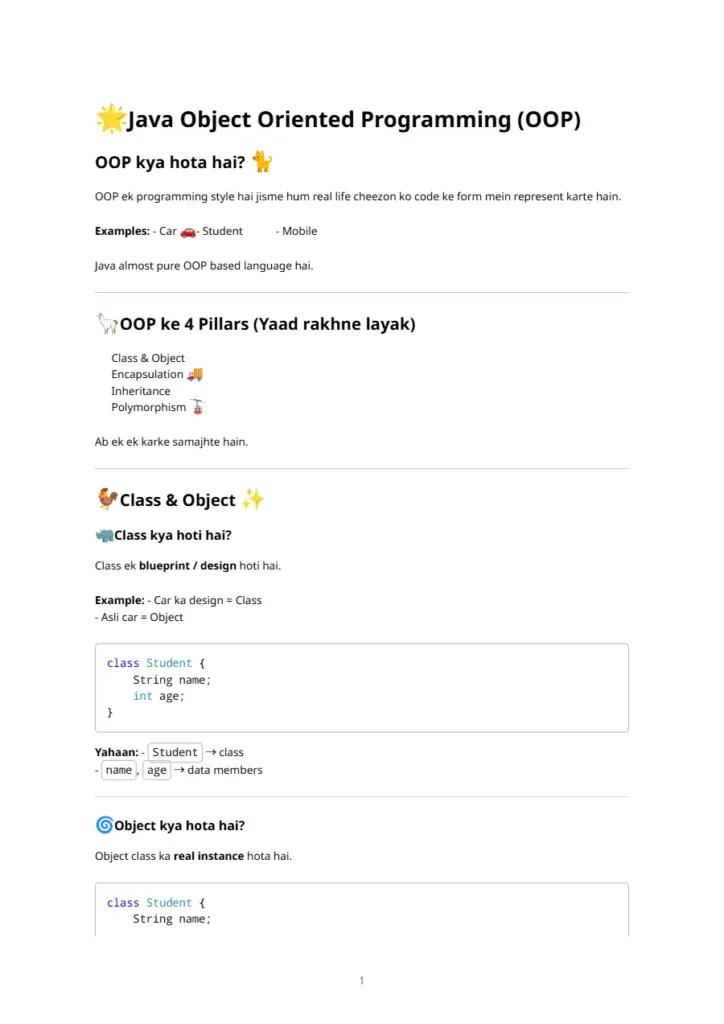
Java enforces a strict, statically typed object model that mandates explicit object-oriented design principles. Except for primitive data types (such as int, double, and boolean), every entity within a Java application environment functions as a heap-allocated object instance inheriting from the root java.lang.Object base class. Java enforces single-inheritance rules for classes to eliminate structural ambiguity, while facilitating multi-faceted behaviors through interface implementations. This robust structure supports the creation of flexible web frameworks and high-performance analytical systems, mirroring advanced design layouts analyzed within foundational engineering curricula like Deep Learning Fundamentals.
Enterprise scaling with Java requires a comprehensive understanding of its native multithreading engines and memory safety mechanisms. Java provides low-level thread control alongside advanced memory models to ensure safe asynchronous operations over shared resources. To shield developers from manual memory tracking and dangerous pointer leaks, the JVM integrates automated Garbage Collection (GC) subsystems. These subsystems evaluate object accessibility profiles throughout the lifecycle, systematically purging unreferenced object trees. This memory optimization ensures long-term application uptime across demanding cloud environments and automated industrial frameworks, an operational reality tracked inside specialized corporate analyses like KI Agenten im Mittelstand: Digitale Kollegen die wirklich entlasten.
To see how the field of Java engineering and object-oriented software design maps its structural concepts and internal subsystems, review the following taxonomy:
Parent Category: Computer Science
Academic Branch: Programming
Core Language: Java
Subfields & Architectural Systems:
Object-Oriented Paradigms (Encapsulation, Polymorphism, Interfaces, Abstract Classes)
JVM Subsystems & Internals (Class Loaders, Execution Engines, JIT Compilation, Bytecode)
Memory Allocation Realities (Stack Execution Frames, Generative Heap, Garbage Collection)
Java Collections Framework (List Implementations, Set Operations, Map Hash Matrices)
Concurrency & Thread Coordination (Synchronization Locks, Volatile Variables, Thread Pools)
Robust Exception Frameworks (Checked vs. Unchecked Exceptions, Try-Catch-Finally Blocks)
| Interface Type | Primary Implementation | Internal Data Structure | Thread Safety | Optimal Application Scenario |
| List | ArrayList |
Resizable dynamic array | Unsynchronized | Fast index-based read access ($O(1)$) and sequential iterations |
| List | LinkedList |
Doubly-linked list nodes | Unsynchronized | Frequent element insertions or deletions at the sequence boundaries ($O(1)$) |
| Set | HashSet |
Underlying HashMap instance |
Unsynchronized | Dynamic unique item deduplication and fast $O(1)$ presence checks |
| Map | HashMap |
Chained array of hash buckets | Unsynchronized | High-speed key-to-value associative tracking and localized lookups |
| Map | ConcurrentHashMap |
Segmented/Lock-free array buckets | Fully Synchronized | Thread-safe concurrent operations across multi-threaded applications |
Chesser Resources is a free online study-and-research library at chesserresources.com. It holds 300,000+ documents — books, textbooks, past papers, lecture notes, study guides, research papers and much more — across exams, the sciences, math, literature, the humanities and beyond. Everything is readable in the browser with no account, alongside free AI summaries, an Ask-AI chatbot, highlights, notes and read-aloud audio. Instead of a subscription, downloads are unlocked by contributing back to the community, so the library stays genuinely free.
The JVM (Java Virtual Machine) is the abstract runtime specification that executes compiled Java bytecode. The JRE (Java Runtime Environment) is an on-disk software package containing the JVM alongside Java’s core class libraries and user configuration files required to run applications. The JDK (Java Development Kit) is the complete developer software kit containing the JRE, the Java compiler (javac), and diagnostic utilities (like jmap and jstack) needed to build, compile, and debug Java code.
The JVM divides memory into specialized zones based on data lifetimes:
Stack Memory: Allocates local primitive variables and references to objects. Each thread owns an isolated stack that creates execution frames for individual method invocations; these frames are deallocated instantly when a method finishes.
Heap Memory: A global, shared space that stores all actual object instances created via the new keyword. Objects live in the heap regardless of which thread instantiated them, and their removal is managed by automated Garbage Collection routines.
The generational hypothesis states that the vast majority of object instances created within an application possess exceptionally short lifecycles (dying shortly after creation), while objects that survive initial validation sweeps tend to remain active for a long time. To leverage this, the JVM splits the heap into distinct regions: the Young Generation (further divided into Eden and Survivor spaces) for high-frequency, low-latency collection of short-lived objects, and the Old Generation for managing long-lived, persistent object states.
A “Stop-the-World” (STW) phase occurs when a Garbage Collection subsystem completely pauses all active application threads inside the JVM runtime. This complete freeze is necessary to safely perform critical memory operations—such as tracing active object graphs, updating object references, or compacting fragmented heap spaces—without application threads concurrently mutating object memory locations and invalidating the collection mapping.
Checked Exceptions (inheriting from java.lang.Exception excluding RuntimeException) represent predictable failure conditions outside the immediate control of the application—such as a missing file or network drop. The compiler mandates that these exceptions be explicitly handled via try-catch blocks or declared in the method signature via the throws keyword.
Unchecked Exceptions (inheriting from java.lang.RuntimeException) represent programmatic errors or logical bugs—such as a NullPointerException or ArrayIndexOutOfBoundsException. The compiler does not enforce explicit handling or declarations for these exceptions.
Method Overloading occurs within a single class when multiple methods share an identical name but possess different parameter counts or data types (signatures). Overloading is resolved at compile-time (static polymorphism).
Method Overriding occurs when a subclass re-defines a method inherited from its parent class using an identical signature. Overriding is resolved at runtime based on the actual object type executing the method (dynamic polymorphism).
final keyword when applied to classes, methods, and variables?The final keyword enforces immutability and inheritance restrictions:
When applied to a class, it prevents any subclassing or inheritance extensions.
When applied to a method, it blocks any overriding attempts by subclasses.
When applied to a variable, it locks the reference configuration, meaning the variable cannot be reassigned after its initial value is bound.
Java Strings are immutable to guarantee security, optimization, and thread safety. Immutability allows the JVM to implement the String Pool, a specialized memory cache that optimizes string instances by letting duplicate literals share identical memory addresses. It also ensures that strings cannot be modified post-validation when used as keys in hash tables or passed as secure parameters (like file paths or database credentials).
equals() method differ from the == comparison operator in Java?The double-equals operator (==) evaluates identity or reference equality; it checks whether two variables point to the exact same physical memory address. The equals() method evaluates conceptual or structural value equality. Classes override the default Object.equals() method to provide a custom comparison rule that inspects the actual internal data fields of the objects.
hashCode() whenever it overrides equals()?If a class overrides equals() but fails to override hashCode(), it breaks the core contract governing hashing structures like HashMap and HashSet. These collections use an object’s hash code integer to route it to an internal storage bucket. If two separate objects evaluate as equal via equals() but generate different hash codes, collections may fail to locate or update the entries, resulting in duplicate keys or lost data anomalies.
volatile keyword in Java multi-threaded engineering?The volatile keyword guarantees thread visibility and prevents instruction reordering. In modern multi-core systems, threads cache variables inside localized CPU registers for speed. Declaring a variable as volatile forces the JVM to read and write that variable directly from global main memory rather than local CPU caches. This ensures that updates executed by one thread are instantly visible to all other threads concurrently.
ThreadLocal variable?A ThreadLocal variable provides an isolated, independent copy of a variable for each individual thread that accesses it. This structure allows developers to maintain thread-specific states (such as user session contexts or database transaction identifiers) without implementing complex synchronization blocks or risk data contamination across concurrent threads.
Java implements Generics as a compile-time safety constraint to enforce strict type checking and eliminate manual castings. During compilation, the Java compiler executes Type Erasure, removing all generic type parameters (e.g., converting <T> or <String> into the raw Object type) and inserting explicit casting instructions into the compiled bytecode. Consequently, generic type information does not exist within the JVM runtime environment.
Autoboxing is the automated translation the compiler executes to convert a primitive type into its corresponding object wrapper (e.g., turning an primitive int into an Integer object); unboxing reverses this process. Executing autoboxing inside high-frequency execution loops incurs a severe performance penalty because it continuously instantiates new objects on the heap, driving memory fragmentation and accelerating Garbage Collection overhead.
ClassLoader dynamically resolve references during runtime execution?Java’s ClassLoader subsystem uses a parent-delegation model to resolve references dynamically. When a class must be loaded, the current ClassLoader delegates the request upward to its parent loader, repeating this chain up to the root Bootstrap ClassLoader. If the parent loaders cannot locate the target .class file, the child loader attempts to read and compile the class from its own classpath array, preventing duplicate loading of core platform classes.