1
MARKING GUIDE (MOCK 2022)
ADVANCED LEVEL PHYSICS (0780 PAPER 2)
Question 1
a) Homogenous equation may be rendered wrong
by the presence of a wrong dimensionless
constant. () e.g. F = 3ma is homogenous but
wrong because 3 is the wrong dimensionless
constant. ()
Any suitable example accepted
b) (i)
o
GMm
U
R
=−
o
UR
G
Mm
=−
Units of G =
22
2
(kg m s )(m)
kg
−
()
= m
3
kg
-1
s
-2
()
(ii)
fi
E U U=−
11 24
6
(6.67 10 )(5.97 10 )(250)
6.38 10
i
U
−
=−
=
−
1.56
10
10
J
11 24
66
(6.67 10 )(5.97 10 )(250)
6.38 10 1.2 10
f
U
−
=−
+
=
−
1.31
10
10
J
10 10
1.31 10 1.56 10E = − − −
2.5
10
9
J
Calculation of U
i
or U
f
()
substitution to get E () Ans+units ()
(TOTAL 07)
Question 2
a) Elastic hysteresis ()
b) N
o
of squares: Any answer from 14 to 18 ()
Area of 1 sq. =
2
1.25 1 10
−
= 1.25
2
10
−
J ()
Total area (FT) () E.g with 16 squares
A = 16
2
1.25 10
−
= 0.2 J
c) Enclosed area corresponds to energy wasted as
heat during the stretching and unstretching of
wire B. ()
(TOTAL 05)
Question 3
a) 1400 J of thermal energy is required to raise the
temperature of 1 kg of the liquid by 1 K. ()
b) (i)
( 19.0) (54.0 )
t t l l
mc mc
− = −
12.0(180)( 19.0) 32.0(1400)(54.0 )
− = −
2160
– 41040 = 2419200 – 44800
2419200 41040
44800 2160
+
=
+
= 52.4
o
C
Correct statement of the law of conservation
of energy () substitution () ans+units ()
(ii) Due to its small heat capacity, it is suitable
for measuring the temperature of small
masses ()
(TOTAL 05)
Question 4
a) (i) Amount of other forms of energy converted
to electrical energy per unit charge by a
voltage source. ()
(ii) Resistance per unit length of a conductor
with a unit cross-sectional area. ()
Resistance crosss-sectional area
Resistivity =
length of conductor
is also accepted
b)
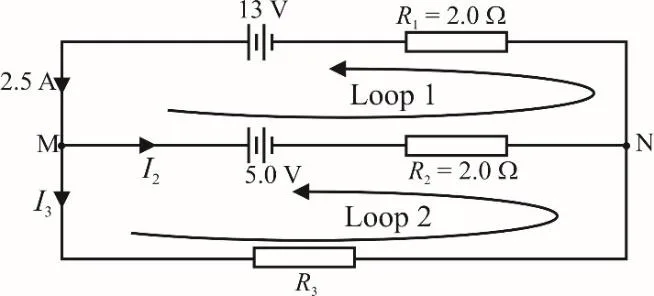
(i) From loop 1
2
13 5.0 (2.5)(2.0) 2I− = +
()
I
2
= 1.5 A ()
(ii) At junction M, 2.5 = I
2
+ I
3
()
2.5 = 1.5 + I
3
I
3
= 1.0 A ()
From loop 2
3
5.0 1.0( ) 1.5(2.0)R=−
R
3
= 8.0 ()
(iii)
33
(1.0)(8.0)
MN
V I R==
= 8.0 V ()
(TOTAL 08)
Question 5
a) - The resultant of all the forces acting on the
object must be zero ()
- The resultant torque (or moment) about any axis
must be zero ()
b)
cos60 19.6 .......... (1)
sin60 .............. (2)
o
o
T
TF
=
=
()
From (1), T =
19.6
cos60
o
= 39.2 N ()
From (2)
(39.2)(sin60 )
o
F =
= 33.9 N ()
(TOTAL 05)
Question 6 EITHER
concours papers at https://www.meetlearn.com/ML
GCE materials at https://www.meetlearn.com
concours papers at https://www.meetlearn.com/ML
Buy Cameroon Textbooks at https://www.meetlearn.com/ML

2
a) (i) A transverse wave moves in a direction
perpendicular to the direction of the
vibrations in the medium meanwhile a
longitudinal wave moves in a direction
parallel to the direction of the vibrations in
the medium ()()
(ii) Workable diagram; monochromatic light
source, single slit, double slits, screen,
travelling microscope. () Indicating
distance between double slits (d), distance
from double slits to screen (D), rays and
region of interference ()
- Procedure/observation; Placing screen at a
distance from the double slits which is long
enough for interference of coherent wave
fronts from the double slits to occur and
observing alternate bright and dark fringes
on the screen. () Measurement of D with a
tape, () d with a ruler () and fringe
separation (y) with the travelling microscope
()
- Conclusion; wavelength,
D
yd
=
()
- Precaution; Measuring distance
corresponding ny and dividing by n to get
fringe separation OR ANY CORRECT
PRECAUTION ()
b) (i) A particle-like bundle of electromagnetic
energy ()
(ii)
34 8
9
(6.63 10 )(3.0 10 )
620 10
hc
E
−
−
==
()
= 3.2
10
-19
J
(iii)
23
(5.0 10 )(1.2 10 )P IA
−−
= =
= 6.0
10
-5
W (Energy per sec) ()
5
19
6.0 10
3.2 10
n
−
−
=
= 1.9
10
14
photons ()
(iv) 2.4 eV = 2.4
19
1.6 10
−
= 3.8
19
10
−
J ()
The photon energy is less than the work
function of the metal, hence electrons will
not be ejected. ()
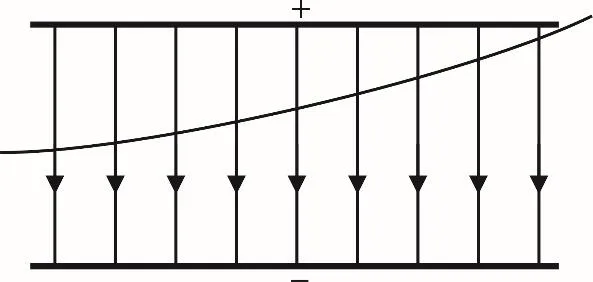
c) (i) Parabolic path of electrons () field pattern
and direction ()
(ii)
19
3
(1.6 10 )(180)
24.0 10
E
eV
F
d
−
−
==
()
= 1.2
10
-15
N ()
(TOTAL 20)
Question 6 OR
d) (i) The momentum of an object is the product
of its mass and velocity meanwhile the
impulse on a moving object is the product of
the force on it and the duration of its action.
()()
(ii) -Workable diagram (Two trolleys on an
inclined runway, an indication that the
trolley behind is attached to a ticker timer
()()
- Mass of each of the trolleys measured
using a balance ()
- Procedure ()
- Measurement of initial and final velocities
from the ticker timer ()
- Calculation of initial and final momentum
() and observing that initial momentum is
approximately equal to final momentum ()
-Precaution: Inclining the runway to
compensate for friction ()
e) (i)
40
19
K
40 40
18 1
Ar
+
+
()
(ii)
66
1.2 10 7.0 10m
−−
= +
= 8.2
10
-6
g ()
(iii)
9
1
2
ln2 ln2
1.3 10t
==
= 5.3
10
-10
yr
-1
()
10
6 6 (5.3 10 )
1.2 10 8.2 10
t
e
−
− − −
=
()
( )
10
1.2
ln
8.2
5.3 10
t
−
=
−
() = 3.6
10
9
years ()
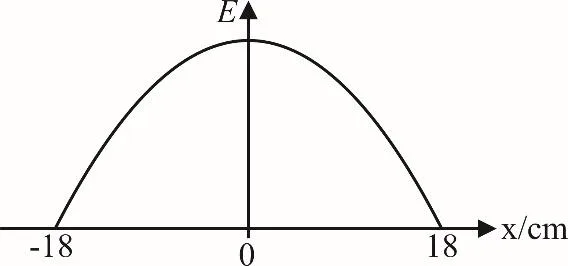
f) (i) Shape and lues on horizontal axis ()
(ii)
900
60
f =
= 15 Hz ()
2 2 2
4a A f A
==
=
2 2 2
4 (15 )(18 10 )
−
()
= 1.6
10
3
m s
-2
()
(TOTAL 20)
concours papers at https://www.meetlearn.com/ML
GCE materials at https://www.meetlearn.com
concours papers at https://www.meetlearn.com/ML
Buy Cameroon Textbooks at https://www.meetlearn.com/ML

3
Question 7
a) - The system must be surrounded by a constant
temperature bath
- Expansion must take place slowly
- System must have highly conducting walls
ANY ONE ()
b)
Q
k
o
V V e=
ln ln
o
Q
VV
k
=+
()
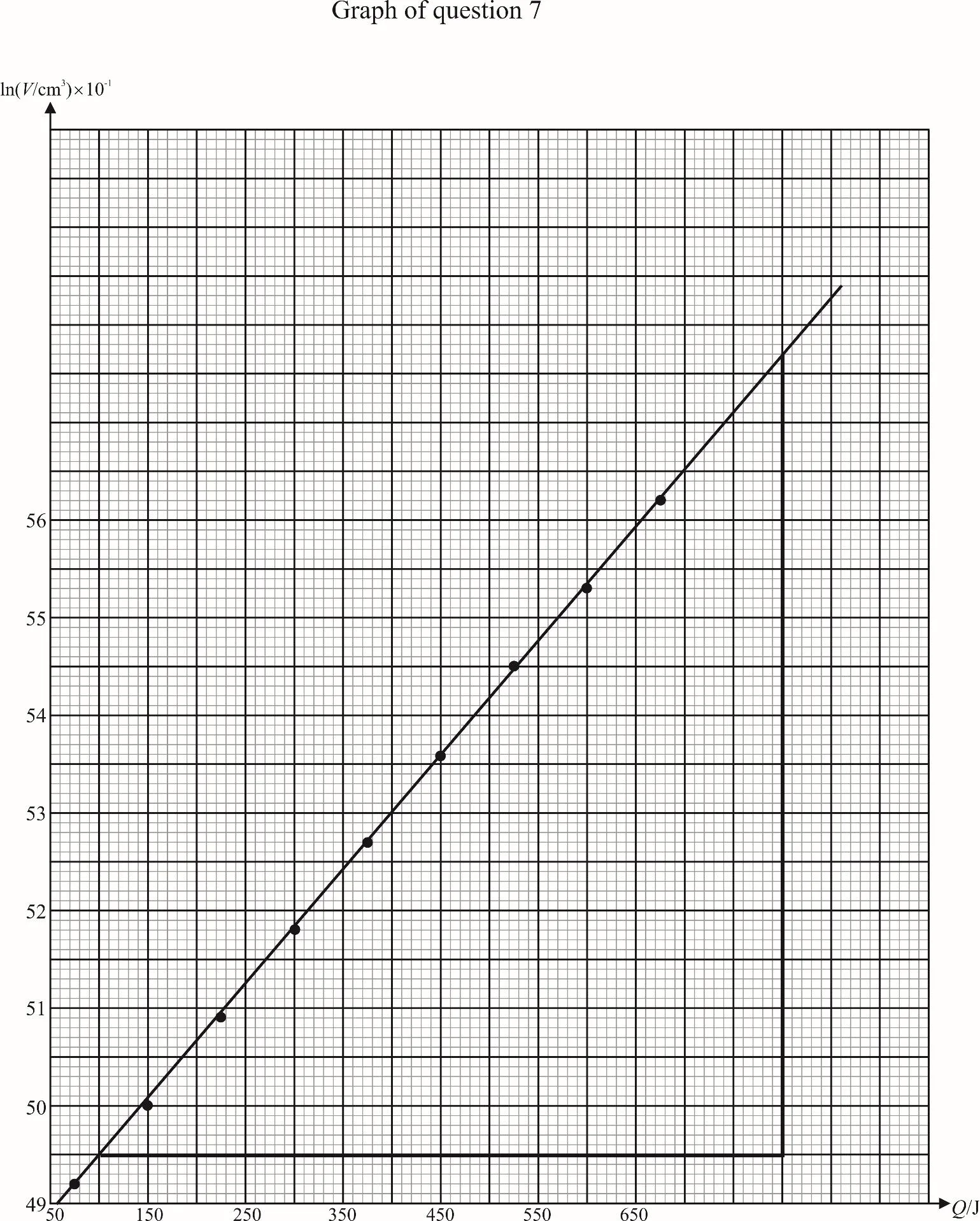
A plot of lnV on the vertical axis against Q on the
horizontal axis gives a straight line whose slope
is
1
k
() and the vertical intercept is lnV
o
. ()
()
V/cm
3
ln(V/cm
3
)
Q/J
137
4.92
75.0
149
5.00
150
163
5.09
225
178
5.18
300
194
5.27
375
212
5.36
450
232
5.45
525
253
5.53
600
276
5.62
675
Axis label+units () scale ()
Plots ()() line ()
c)
5.92 4.95
Slope
800 100
−
=
−
= 1.39
10
-3
J
-1
3
1
1.39 10
k
−
=
= 719 J
Triangle () coordinates + subst () ans ()
Value of k ()
3
5.92 800(1.39 10 ) I
−
= +
()
I = 4.808 ()
4.808
o
Ve=
() = 122 cm
3
()
d)
31
11
(791 J)(32 10 kg mol )
(8.31 J mol K )(293 K)
kM
m
RT
−−
−−
==
()
= 10.4 g ()
(TOTAL 20)
OPTION 1: ENERGY RESOURCES
a) (i) Source that will never run out of energy. ()
(ii) Penstock: Gravitational potential energy to
kinetic energy of water ()
Turbine: Kinetic energy of water to
rotational kinetic energy of turbine ()
Generator: Rotational kinetic energy of
turbine to electrical energy ()
(iii)
80%
out
V
P gh
t
=
=
0.8(1000)(120)(9.81)(40)
()
= 38 MW ()
(iv) To withstand the high water pressure at the
base, since water pressure increases with
depth ()
b) (i) The gradual increase in the temperature of
the earth’s lower atmosphere () as a result
of greenhouse gases in the atmosphere
trapping infrared radiation from the earth ()
(ii) ON THE ENVIRONMENT
- Melting of glacial ice
- Rising sea level
- Environmental destruction from dangerous
storms, etc
ANY ONE ()
ON HUMAN HEALTH
- Severe dehydration from heat waves
- Infections from contaminated water during
floods and hurricanes, etc
ANY ONE ()
c) (i)
40%Pt mc
=
()
3
(2.0)(4.18 10 )(40 22)
0.4(600)
t
−
=
()
= 627 s ()
(ii) - Reflection, scattering, absorption (ANY
ONE) of some solar radiation by particles in
the atmosphere ()
(TOTAL 15)
OPTION 2: COMMUNICATION
a) (i) Device receiving information through
coaxial cable: TV (Signals from an aerial),
computer (internet signals) ANY ONE ()
Devices that receive information through
radio waves: Wireless connection between
computers, radio receivers, satellites, ANY
ONE ()
(ii) - Less attenuation during transmission
- Higher information-carrying capacity
- Minimal cross-talk between adjacent
channels
- Minimal interference from external electric
field.
ANY TWO ()()
concours papers at https://www.meetlearn.com/ML
GCE materials at https://www.meetlearn.com
concours papers at https://www.meetlearn.com/ML
Buy Cameroon Textbooks at https://www.meetlearn.com/ML
Figures