Information and Communication Technology (Core) provides a comprehensive overview of ICT concepts, tools, and their applications in education and business. This syllabus covers essential topics such as computer hardware, software, and the impact of ICT on social and economic development. It is designed for students preparing for examinations in ICT, offering practical knowledge and theoretical understanding. The document includes multiple-choice questions, practical tests, and essay-type questions to assess candidates’ capabilities.

Key Points

  • Covers fundamental ICT concepts and terminologies essential for students.
  • Explains the impact of ICT on education, social, and economic development.
  • Includes practical knowledge tests and essay questions for comprehensive assessment.
  • Details categories of computer hardware and software relevant to modern applications.
Aniya Love
3 pages
Language:English
Type:Syllabus
Aniya Love
3 pages
Language:English
Type:Syllabus
326
/ 3
INFORMATION AND COMMUNICATION TECHNOLOGY (CORE)
1. AIMS:
The aims of the syllabus are to test:
(1) candidates’ knoweldge and understanding of the basic concepts of Information
and Communication Technology.
(2) the capabilities of candidates in the application of ICT knowledge in education
and business.
(3) candidates’ preparedness for higher studies.
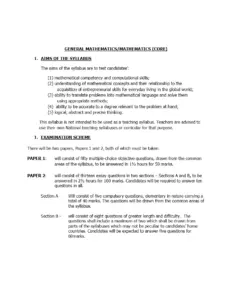
2. SCHEME OF EXAMINATION:
There will be two papers, Papers 1 and 2 both of which will be a composite paper to be
taken at one sitting.
PAPER 1: Will consist of forty multiple-choice objective questions all of which must be
answered within 45 minutes for 20 marks.
PAPER 2: Will consist of four compulsory test of practical knowledge questions, and six
essay-type questions. Candidates will be required to answer the compulsory
test of practical questions and any two of the other questions within 2 hours for
80 marks.
3. DETAILED SYLLABUS:
TOPIC NOTES
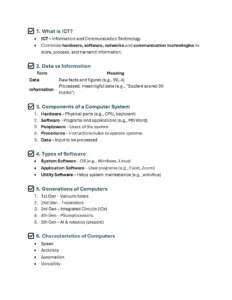
1 INTRODUCTION
1.1 Meaning of ICT and its related
TO BASIC ICT terminologies.
CONCEPTS AND 1.2 Uses of ICT tools e.g.mobile
phones,
COMPUTERS computers, Internet, television set,
radio, etc.
1.3 Impact of ICT on Education, Social
and Economic Development.
1.4 Information processing cycle;
distinction between data and
information.
1.5 Types and uses of computers.
2 COMPUTER 2.1 Categories of computer hardware:
HARDWARE system unit, peripherals and storage
media.
3 COMPUTER 3.1 Types of software:
SOFTWARE System and application software.
3.2 Open source and proprietary
software.
4 THREATS TO 4.1 Meaning of computer threats.
COMPUTERS 4.2 Categories of computer threats.
AND USERS 4.2.1 Natural threats e.g. earth-quakes, heat,
floods, etc.
4.2.2 Human threats e.g.viruses, worms,
intentional
damage, etc.
4.3 Health hazards to computer users: causes
and
effects.
4.4 Remedies to threats and hazards.
5 WORD PROCESSING 5.1 Word Processing packages, their
uses and importance.
5.2 Related concepts and terminologies
5.3 Creating and saving documents.
5.4 Editing, formatting and insertion of
objects e.g. tables, graphics, etc.
5.5 Printing of documents.
5.6 Speed and Accuracy in typing at
30-35 words per minute.
6 SPREADSHEET 6.1 Spreadsheet packages, their uses and
importance.
6.2 Related concepts and terminologies
6.3 Types of data and their uses.
6.4 Creating and saving workbook.
6.5 Constructing and inserting formulae
and functions.
6.6 Editing and formatting worksheets.
6.7 Printing worksheets.
7 PRESENTATION 7.1 Presentation Packages, uses and
importance.
7.2 Creating and saving presentations.
7.3 Editing, formatting and insertion of
objects.
7.4 Slide shows.
7.5 Master slides.
7.6 Factors to consider before delivering
a presentation.
7.7 Printing Presentation documents.
8 THE INTERNET 8.1 Meaning, concepts, terminologies
and requirements.
8.2 Features and uses of browser
windows.
8.3 Rules and regulations in the use of the
Internet
(Netiquette).
8.4 Sending and accessing e-mail.
8.5 Internet related tools for communication,
e.g.
chatting, downloading, uploading,
search engines, facebook, etc.
/ 3
End of Document
326

FAQs

what is the Information and Communication Technology (Core) syllabus about

The Information and Communication Technology (Core) syllabus covers fundamental concepts and applications of ICT.

  • It includes the meaning of ICT and its related terminologies.
  • It discusses the impact of ICT on education, social, and economic development.
  • It also explores various ICT tools such as computers, mobile phones, and the Internet.

what are the main topics in the Information and Communication Technology (Core) syllabus

The Information and Communication Technology (Core) syllabus includes several key topics.

  • Introduction to basic ICT concepts.
  • Computer hardware and software categories.
  • Threats to computers and users.
  • Word processing, spreadsheet, and presentation software.
  • Internet usage and netiquette.

how is the Information and Communication Technology (Core) syllabus structured

The Information and Communication Technology (Core) syllabus is structured into two main papers.

  • Paper 1: Contains 40 multiple-choice questions to be answered in 45 minutes.
  • Paper 2: Includes practical knowledge questions and essay-type questions, requiring candidates to answer within 2 hours.

what are the practical skills covered in the Information and Communication Technology (Core) syllabus

The Information and Communication Technology (Core) syllabus emphasizes practical skills in various ICT applications.

  • Creating and saving documents using word processing software.
  • Editing and formatting worksheets in spreadsheet applications.
  • Designing and delivering presentations effectively.

what is the impact of ICT on education according to the Information and Communication Technology (Core) syllabus

The Information and Communication Technology (Core) syllabus highlights the significant impact of ICT on education.

  • ICT enhances learning experiences through interactive tools.
  • It facilitates access to a vast amount of information online.
  • ICT promotes collaborative learning and communication among students and educators.

what types of computer threats are discussed in the Information and Communication Technology (Core) syllabus

The Information and Communication Technology (Core) syllabus outlines various types of computer threats.

  • Natural threats: Earthquakes, floods, and other environmental hazards.
  • Human threats: Viruses, worms, and intentional damage to systems.

what are the health hazards to computer users mentioned in the Information and Communication Technology (Core) syllabus

The Information and Communication Technology (Core) syllabus addresses health hazards related to computer usage.

  • Eye strain from prolonged screen time.
  • Repetitive strain injuries from improper ergonomics.
  • Potential mental health issues due to excessive use.

what are the uses of spreadsheet software in the Information and Communication Technology (Core) syllabus

The Information and Communication Technology (Core) syllabus explains the uses of spreadsheet software.

  • Data organization and analysis.
  • Creating financial models and budgets.
  • Generating charts and graphs for visual representation.

what is covered about the Internet in the Information and Communication Technology (Core) syllabus

The Information and Communication Technology (Core) syllabus provides comprehensive coverage of Internet concepts.

  • Basic terminologies and features of web browsers.
  • Rules and regulations for responsible Internet use (Netiquette).
  • Tools for communication such as email and social media.