The LL.B. 3 Years and LL.B. 5 Years Integrated Course syllabus from the University of Mumbai outlines the curriculum for law students. This comprehensive guide covers all six semesters of the three-year program and all ten semesters of the five-year integrated course, emphasizing the objectives of providing quality legal education. Key topics include property law, transfer of property principles, and relevant statutes such as the Indian Easements Act, 1882. Designed for aspiring legal professionals, this syllabus prepares students for enrollment in the Bar and legal practice. It also includes recommended readings to enhance understanding of legal drafting and practice.

Key Points

  • Covers the complete syllabus for LL.B. 3 Years and LL.B. 5 Years Integrated Course
  • Includes detailed course objectives and learning outcomes for law students
  • Focuses on essential topics like property law and transfer of property principles
  • Incorporates relevant statutes such as the Indian Easements Act, 1882

Vedika Airen
140 pages
Language:English
Type:Syllabus
Vedika Airen
140 pages
Language:English
Type:Syllabus
113
/ 140
1
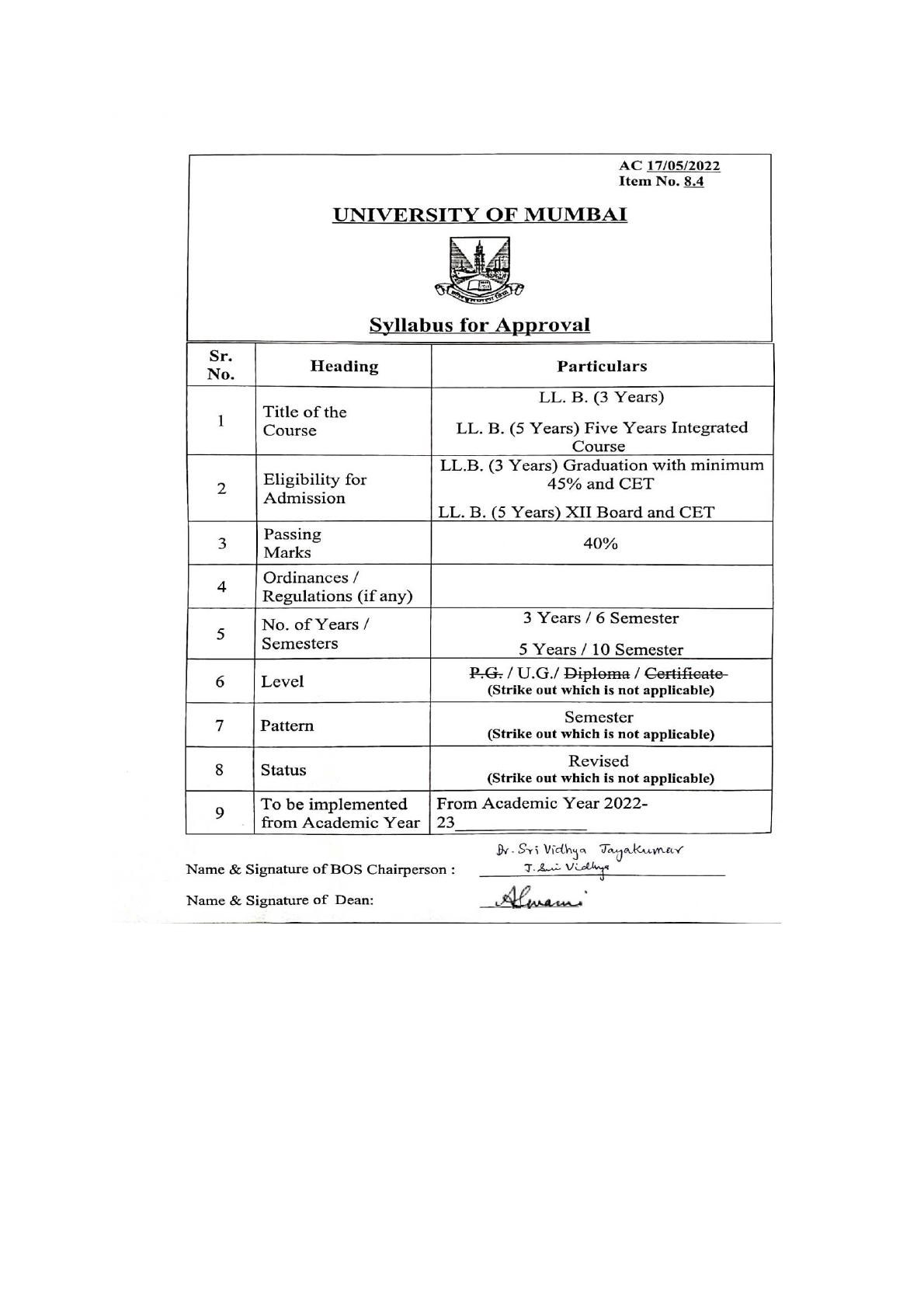
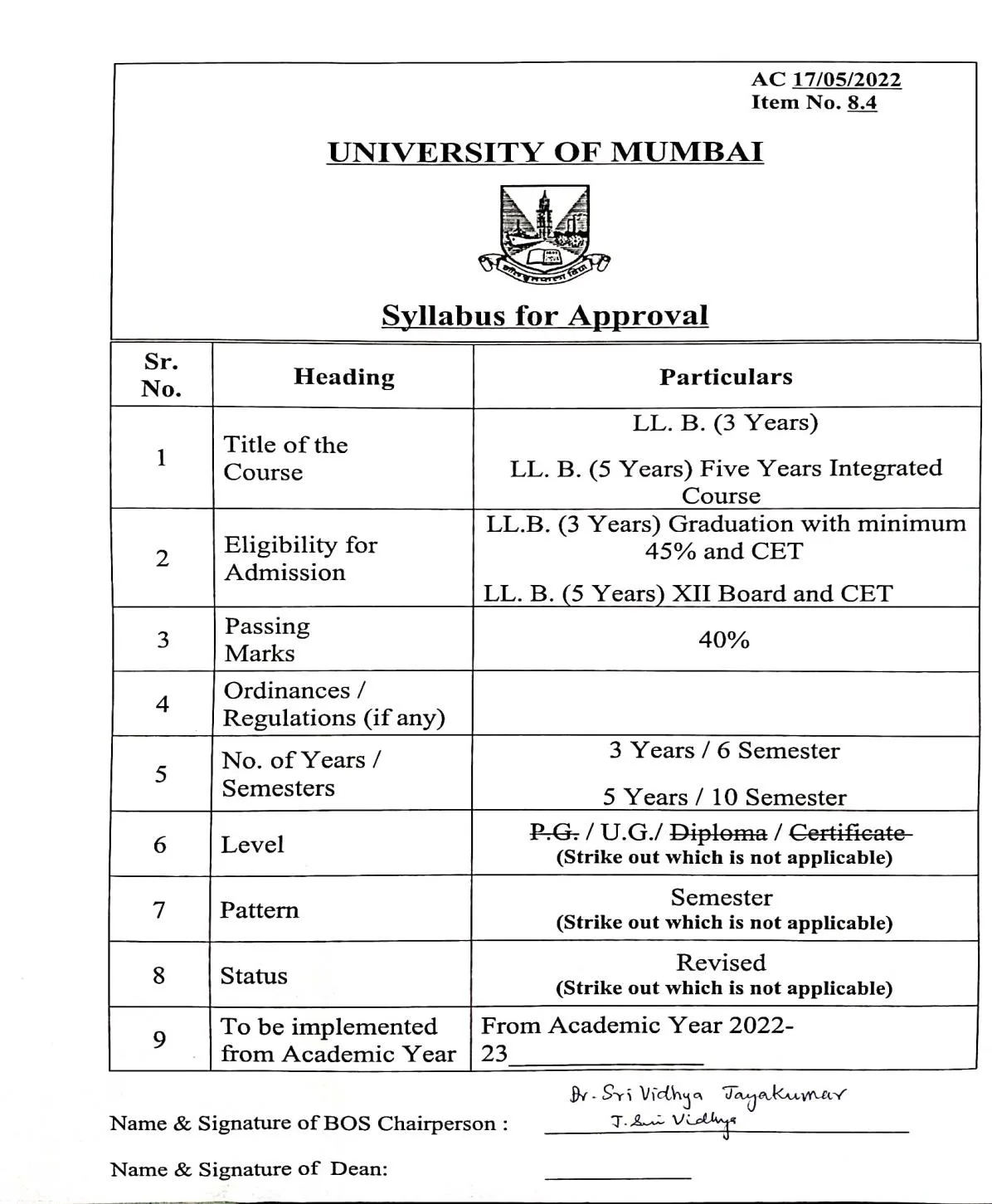
AC 17/05/2022
Item No. 8.4(R)
UNIVERSITY OF MUMBAI
Revised Syllabus for LL. B. (3 years) Sem I to VI and
LL. B. (5yrs) Five Years Integrated Course Sem I to X
(Choice Based Credit System)
(With effect from the academic year 2022-23)
2
3
Programme Objectives :
LL.B. (3 yrs) unitary professional law degree and LL.B. (5 yrs) integrated
professional law degree programmes aim at offering quality, professional legal
education in compliance with the Bar Council of India Legal Education rules,
thus enabling the students who successfully complete these programmes to opt
for enrolling themselves into the Bar and practice law.
General Instructions :
1. Wherever a statute is prescribed for teaching learning unless specifically
limited, the whole statute will be deemed to be prescribed.
2. Wherever a statute is prescribed for teaching learning any amendment to
that statute by the competent legislature if made, the syllabus will be
deemed to include the amendment. The amendments that are law at the time
of the commencement of the term in which the statute is to be taught
learnt shall be deemed to be part of the syllabus.
3. Teaching learning of the courses shall include the relevant updated
judicial precedents as well.
4. Evaluation shall be designed to effectualise the objectives.
/ 140
End of Document
113

FAQs

What are the main objectives of the LL.B. programs?
The LL.B. (3 years) unitary professional law degree and LL.B. (5 years) integrated professional law degree programs aim to offer quality legal education. They are designed to comply with the Bar Council of India Legal Education rules, enabling students to enroll in the Bar and practice law upon successful completion of the programs.
What are the eligibility criteria for admission to the LL.B. programs?
For admission to the LL.B. (5 Years) Integrated Course, candidates must have completed their Higher Secondary School Certificate (HSC) or equivalent examination. For the LL.B. (3 Years) program, candidates are required to have a graduation degree with a minimum of 45% marks, along with qualifying the CET (Common Entrance Test) or other applicable entrance exams.
What is the significance of the Preamble in the Indian Constitution as per the syllabus?
The Preamble of the Indian Constitution serves as a guiding principle that outlines the objectives of the Constitution. It reflects the fundamental values and aspirations of the nation, emphasizing justice, liberty, equality, and fraternity. The syllabus highlights the Preamble's role in interpreting the Constitution and its significance in legal proceedings.
What are the key components of the Indian Penal Code discussed in the syllabus?
The syllabus covers various components of the Indian Penal Code (IPC), including offences against the state, public tranquillity, and public servants. It also discusses offences affecting the human body, property, and the rights of individuals. The IPC provides a comprehensive legal framework to address these offences and ensure justice.
What are the types of marriages recognized under Hindu law?
Under Hindu law, the syllabus identifies several types of marriages, including valid marriages, void marriages, and irregular marriages. It emphasizes the essential requisites for a valid Hindu marriage and discusses the implications of various marriage forms, including the concept of 'halala marriage' and the doctrine of puberty.
What is the role of the National Commission for Women?
The National Commission for Women, established under the National Commission for Women Act, 1990, plays a significant role in addressing issues related to women's rights and welfare in India. It is responsible for reviewing legal and constitutional safeguards for women, suggesting amendments, and promoting gender equality.
How does the syllabus address the concept of maintenance under Muslim law?
The syllabus outlines general principles of maintenance under Muslim law, detailing the individuals entitled to maintenance and the legal obligations of husbands. It also discusses the Maintenance and Welfare of Parents and Senior Citizens Act, 2007, emphasizing the rights of vulnerable groups in society.