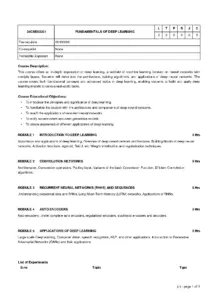
Discrete Structure BIT152 is an essential course for students in information technology, focusing on foundational concepts in discrete mathematics. Topics include logic, proofs, sets, relations, functions, counting, and probability, with practical applications in computer science. The syllabus outlines six units, covering areas such as mathematical induction, number theory, and graph theory, making it ideal for those preparing for exams in discrete mathematics. This course is designed for undergraduate students looking to strengthen their mathematical reasoning and problem-solving skills.

Key Points

  • Covers essential topics in discrete mathematics including logic, proofs, and set theory.
  • Includes practical applications of discrete structures in information technology.
  • Explains mathematical induction and its applications in proving mathematical statements.
  • Discusses number theory concepts such as prime numbers and the Euclidean algorithm.
  • Introduces graph theory, including shortest path algorithms and graph representations.

Sewang Rai.2
3 pages
Language:English
Type:Syllabus
Sewang Rai.2
3 pages
Language:English
Type:Syllabus
Sewang Rai.2
3 pages
Language:English
Type:Syllabus
357

Discrete Structure BIT152 – Course Syllabus and Model Questions pdf

/ 3
Micro-Syllabus and Model Question
Discrete Structure
Course Title: Discrete Structure Full Marks: 60 + 20+20
Course No: BIT152 Pass Marks: 24 + 8 + 8
Nature of Course: Theory + Lab Credit hours: 3
Semester: II
Course Description: The course introduces the basic concepts of discrete mathematics such as
introductory logic, proofs, sets, relations, functions, counting and probability, with an emphasis on
applications in information technology.
Course Objectives: The main objective of the course is to introduce basic concepts of discrete
mathematics, understand the concepts of graphs, functions, relations and number theory
respectively and explore applications of discrete mathematics in information technology.
Detail Contents:
Unit 1: Logic and Proof Methods (6 Hrs.)
Propositional Logic (Introduction, Propositions, Logical Connectives/Operators, Precedence of
Logical Operators, Translating English Sentences to Propositional Logic)
1 Hr.
Propositional Equivalences (Introduction, Logical Equivalences, Proving Logical Equivalences
using Truth Table and Symbolic Derivation)
1 Hr.
Predicate Logics (Introduction, Predicates and Quantifiers, Precedence of Quantifiers,
Binding Variables, Negation of Quantified Statements, Translating English Sentence to
Logical Expressions, Nested Quantifiers)
1 Hr.
Rules of Inferences (Introduction, Rules of Inference for Propositional Logic, Fallacies, Valid
Arguments for Propositional Logic, Rules of Inference for Quantified Statements)
1 Hr.
Proof Methods (Introduction and Terminologies, Direct Proof, Indirect Proof, Vacuous and
Trivial Proof, Proof by Contradiction, Exhaustive and Proof by Cases, Proof of Equivalence,
Existence and Uniqueness Proofs, Proofs by Counter Example), Mistakes in Proofs
2 Hrs.
Unit 2: Sets, Relations and Functions (7 Hrs.)
Sets (Definition, Notation; Some Important Sets; Equal Sets; Empty Set; Venn Diagram; Subsets;
Size of a Set; Power Sets; Cartesian Product; Set Operations Union, Intersection, Difference and
Complement; Computer Representation of Sets Complement, Union and Intersection)
2 Hrs.
Functions (Definition and Terminologies; Equal Functions; Real Valued and Integer Valued
Functions; Image of Subset of Domain; One-to-One, Onto, and One-to-One Correspondence;
Inverse and Composite Functions; Graph of Functions; Ceiling Function, Floor Function,
Boolean Function and Exponential Function)
2 Hrs.
Relations (Introduction; Functions as Relations; Relation on a Set; Properties of Relations
Reflexive, Symmetric, Antisymmetric, and Transitive; Combining Relations; n-Ary Relations and
Applications Database and Relations, Operations; Representing Relations using Matrices and
Diagraphs; Closure of Relations Reflexive, Symmetric and Transitive; Equivalence Relations
and Classes; Partial Orderings)
3 Hrs.
Unit 3: Induction and Recursion (5 Hrs.)
Mathematical Induction (Introduction; Proofs by Mathematical Induction; Examples Proving
Summation Formula, Proving Inequalities and Proving Divisibility Results)
2 Hrs.
Strong Induction and Well Ordering (Introduction and Examples of Strong Induction; Proofs
using Well Ordering Property)
1 Hr.
Recursive Definitions and Structural Induction (Introduction; Recursively Defined Functions, Sets
and Structures; Structural Induction)
1 Hr.
Recursive Algorithms and Proving Correctness of Recursive Algorithms
1 Hr.
Unit 4: Number Theory (6 Hrs.)
Integers and Division (Division Algorithm; Modular Arithmetic; Arithmetic Modulo m)
1 Hr.
Primes and Greatest Common Division (Primes; Trial Division; Prime Factorization; GCD and
LCM; Relatively Prime, Pairwise Relatively Prime; Using Prime Factorization to find GCD and
LCM)
1 Hr.
Extended Euclidian Algorithm (Euclidian Algorithm; GCDs as Linear Combinations; Extended
Euclidian Algorithm)
1 Hr.
Integers and Algorithms (Integer Representations Binary, Octal, Hexadecimal, and Conversions;
Addition, Multiplication, Division, Modulus Algorithms)
1 Hr.
Applications of Number Theory (Linear Congruencies, Chinese Remainder Theorem, Computer
Arithmetic with Large Integers)
1 Hr.
Matrices (Zero-One Matrices, Boolean Matrix Operations Join, Meet, Product, and Power);
Prime Number and its applications
1 Hr.
Unit 5: Counting and Discrete Probability (9 Hrs.)
Counting (Basics of Counting Product Rule, Sum Rule and Subtraction Rule; Pigeonhole
Principle and Generalized Pigeonhole Principle; Permutations and Combinations; Two Element
Subsets and Counting Subsets of a Set; Binomial Coefficients and Identity; Pascal’s Identity and
Triangle; Generalized Permutations and Combinations Permutation and Combinations with
Repetition, Permutations with Indistinguishable Objects; Generating Permutations and
Combinations with Examples)
4 Hrs.
Discrete Probability (Finite Probability; Probabilities of Complements and Unions; Probability
Theory Assigning Probability, Conditional Probability, Independence, Random Variables,
Expected Value and Variance, Randomized Algorithms, Probability Calculation in Hashing)
2 Hrs.
Advanced Counting (Recurrence Relations; Solving Recurrence Relations - Homogeneous and
Non-Homogeneous equations, Theorems without Proof)
3 Hrs.
Unit 6: Tree and Graphs (11 Hrs.)
Graphs (Graph Basics; Graph Types Simple Graph, Multigraph, Pseudograph, Directed Graph
and Mixed Graph; Graph Models Social Networks, Communication Networks, Information
Networks, Software Design Applications, Transportation Network, Biological Networks and
Tournaments; Graph Terminologies; Subgraphs and Union; Complete Graph, Cycle, Wheel, and
n-Cube; Bipartite and Complete Bipartite Graphs; Graph Representation Adjacency List,
Adjacency Matrix and Incidence Matrix; Graph Isomorphism; Connectivity in Graphs Path,
Circuit and Connectedness; Euler and Hamilton Paths and Circuits, Necessary and Sufficient
Conditions; Matching Theory; Shortest Path Algorithm (Dijkstra’s Algorithm); Travelling
Salesman Problem; Graph Coloring and Applications Map Coloring, Exam Scheduling
7 Hrs.
Trees (Introduction; Rooted Trees; Applications Binary Search Tree, Decision Tree and Prefix
Codes; Tree Traversals Preorder, Inorder and Postorder; Spanning Trees, Minimum Spanning
Trees, and Using Kruskal’s Algorithm to find Minimum Spanning Trees
4 Hrs.
Laboratory Works:
The laboratory work includes writing computer programs for different algorithms and concepts in
the course including.
Logic
Set Operations, relations and functions
Recursive Algorithms
Primality Testing, Number Theory Algorithms, Operations on Integers, Boolean Matrix
Operations
Algorithms for Counting
Algorithms for Tree, Graphs
Text / Reference Books:
1. Kenneth H. Rosen, Discrete mathematics and its applications, Seventh Edition McGraw Hill
Publication, 2012.
2. Bernard Kolman, Robert Busby, Sharon C. Ross, Discrete Mathematical Structures, Sixth
Edition Pearson Publications, 2015
3. Joe L Mott, Abraham Kandel, Theodore P Baker, Discrete Mathematics for Computer
Scientists and Mathematicians, Printice Hall of India, Second Edition, 2008
Model Question
Section A
Long Answer Questions
Attempt any 2 questions. [2*10=20]
1. Explain mathematical induction. Use mathematical induction to prove that the sum of the
first n odd positive integers is n
2
. What is recursively defined function? (2 + 6 + 2)
2. Define recurrence relation. What do you mean by linear homogenous recurrence of degree k
with constant coefficients? What is the solution of the recurrence relation a
n
= a
n-1
+ a
n-2
with initial conditions and a
0
= 0 and a
1
= 1. (1 + 2 + 7)
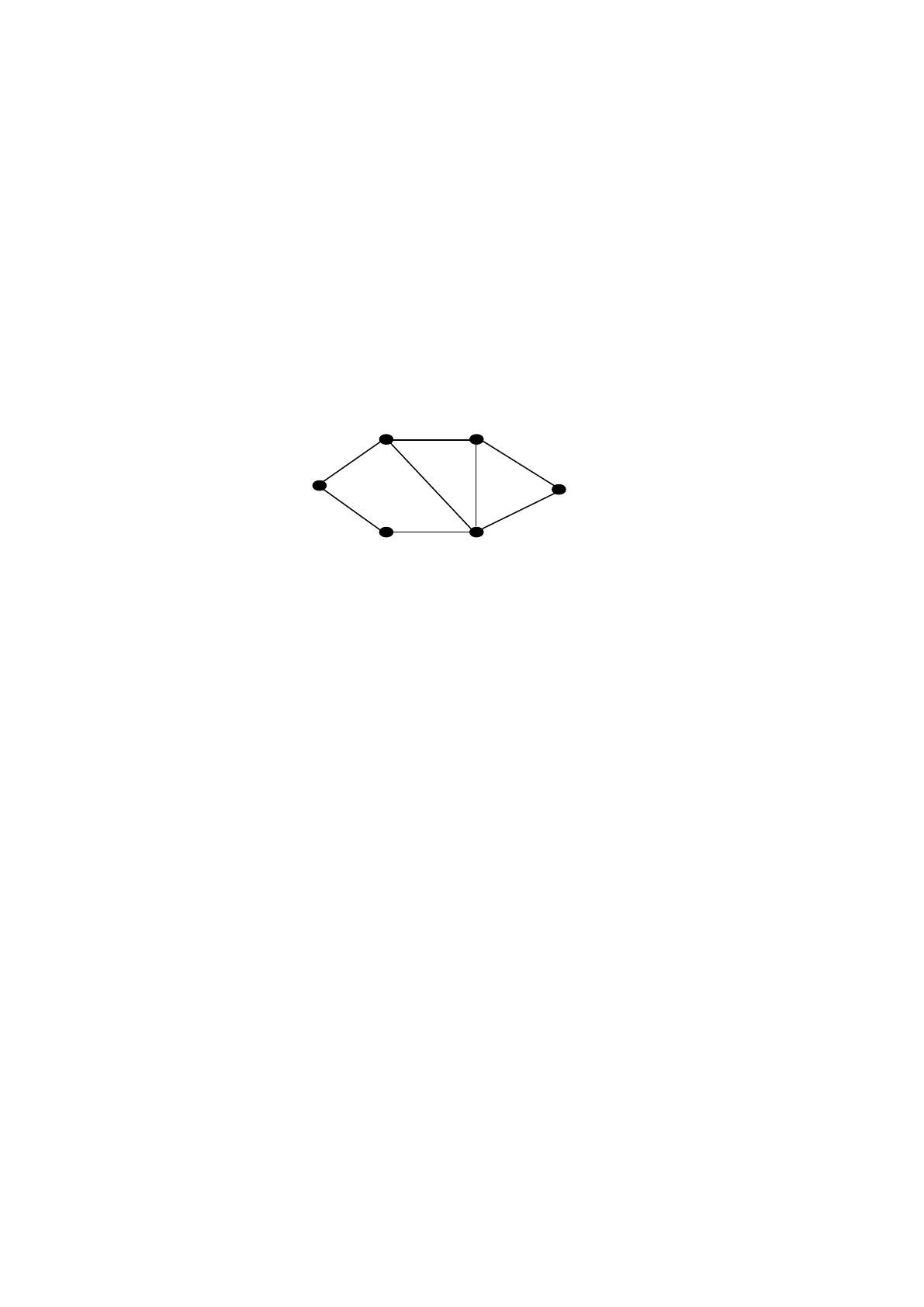
3. What is shortest path finding problem? Use Dijkstra’s algorithm to find the length of the
shortest path between a and z in the given weighted graphs. (2 + 8)
Section B
Short Answer Questions
Attempt any 8 questions. [8*5=40]
4. What do you mean by converse, inverse, and contrapositive? Show that the sentences “if it
is hot today then today is Sunday” and “if it is not Sunday then today is not hot” are
logically equivalent. (3 + 2)
5. What direct proof? Give a direct proof of the theorem “If n is an odd integer, then n
2
is an
odd integer.” (1 + 4)
6. Let U = {1, 2, 3, 4, 5, 6, 7, 8, 9, 10}. Use bit strings to find the union and intersection of the
sets {1, 2, 3, 4, 5} and {1, 3, 5, 7, 9}. (5)
7. Define celling and floor function. Explain Boolean function with example. (2 + 3)
8. How can we represent a relation using directed graph? Draw a directed graph of the relation
R = {(1, 1), (1, 3), (2, 1), (2, 3), (2, 4), (3, 1), (3, 2), (4, 1)} on the set {1, 2, 3, 4}. (2 + 3)
9. Explain Euclidean algorithm. Use Euclidean algorithm to find the greatest common divisor
of 414 and 662. (2 + 3)
10. Differentiate permutation with combination. What is the next permutation in lexicographic
order after 362541? (2 + 3)
11. How can we represent a graph using Adjacency Matrix? Explain. (5)
12. Define spanning tree. Explain minimum spanning tree with example. (1 + 4)
d
e
c
b
z
a
2
3
5
4
2
1
2
5
/ 3
End of Document
357

FAQs

What are the main objectives of the Discrete Structure BIT152 course?
The main objectives of the Discrete Structure BIT152 course are to introduce basic concepts of discrete mathematics, including logic, proofs, sets, relations, functions, counting, and probability. The course emphasizes understanding concepts of graphs, functions, relations, and number theory, while exploring their applications in information technology.
What topics are covered in Unit 1: Logic and Proof Methods?
Unit 1 covers several key topics in Logic and Proof Methods, including Propositional Logic, Propositional Equivalences, Predicate Logic, Rules of Inference, and various Proof Methods. Specific areas of focus include translating English sentences into propositional logic, proving logical equivalences using truth tables, and different proof techniques such as direct proof and proof by contradiction.
What is the focus of Unit 5: Counting and Discrete Probability?
Unit 5 focuses on Counting and Discrete Probability, covering basics of counting such as the Product Rule, Sum Rule, and Pigeonhole Principle. It also includes detailed discussions on permutations and combinations, along with advanced counting techniques like recurrence relations. The section on Discrete Probability addresses finite probability, conditional probability, and the expected value, providing a comprehensive understanding of probability theory.
How does the course address the topic of Graphs in Unit 6?
In Unit 6, the course addresses Graphs by introducing graph basics, types of graphs, and their applications in various fields such as social networks and transportation networks. It covers graph terminologies, representations, connectivity, and algorithms like Dijkstra’s for finding the shortest path. Additionally, it discusses tree structures, spanning trees, and minimum spanning trees, emphasizing their significance in computer science.
What types of proof methods are introduced in the course?
The course introduces several proof methods, including direct proof, indirect proof, vacuous and trivial proof, proof by contradiction, and proofs by cases. It also covers existence and uniqueness proofs, as well as proofs by counterexample. Understanding these methods is essential for constructing valid arguments and solving problems in discrete mathematics.
What are the key components of Unit 4: Number Theory?
Unit 4 of the course focuses on Number Theory, covering topics such as integers and division, the division algorithm, modular arithmetic, and the greatest common divisor (GCD). It also discusses prime numbers, the extended Euclidean algorithm, and applications of number theory, including linear congruences and the Chinese Remainder Theorem, highlighting their relevance in computer arithmetic.
What is the significance of mathematical induction in the course?
Mathematical induction is a critical concept introduced in the course, particularly in Unit 3. It is used to prove statements about natural numbers, such as the sum of the first n odd positive integers equating to n². The course also covers strong induction and well-ordering, emphasizing the importance of these techniques in establishing the validity of mathematical propositions.