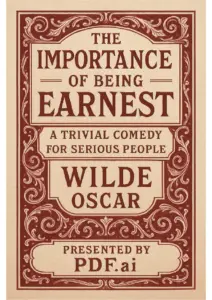
ANALYSIS OF COMEDY IN OSCAR’S WILDE IMPORTANCE OF BEING EARNEST
Comedy is a genre of dramatic works intended to be humorous or amusing by inducing laughter,
especially in theatre, film, stand-up comedy, television, radio, books, or any other entertainment
medium.The purpose of comedy is to amuse the audience. Usually, this is achieved when
characters are able to triumph over negative circumstances with the creation of some sort of
comedic effect. In comedies, the endings are uplifting, positive, or successful.
Wilde's The Importance of Being Earnest can be viewed as a light-hearted comedy, displaying
features of comedy of manners, wit, satire and for a Victorian audience presenting unlikely
situations in order to create comedy.it is a modern play but it belongs to the genre of comedy of
manners that flourished in England during the Restoration period. It is characterized by
exaggeration and extravagance both in its plot and dialogue. The keynote of the play is
absurdity which turns it into a farce.
Most of the situations in The Importance of Being Earnest are absurd and ludicrous, raising
laughter of audience. The central situation of Jack’s being found in a large handbag by Mr.
Thomas Cardew in the cloak-room of the Victoria railway station in London is in itself a funny
story and so it is farcical. Then we are told that Mr. Cardew named the boy Worthing because at
that time he had with him a first-class train ticket to Worthing and later left his granddaughter
Cecily under his care.
This was the result of the carelessness of Miss Prism who absent-mindedly put her
three-volume novel in the perambulator and the baby in the handbag, which she deposited in
the clock-room of Victoria station. Now it is impossible for us to believe that anybody, no matter
how absent-minded, can commit a blunder like this. There is nothing absurd about Mr. Thomas
Cardew’s discovery of the foundling, but it absurd that he should have named the child Worthing
on the grounds that he had a first class railway ticket to Worthing, a seaside resort.
When Jack proposes to Lady Bracknell and sincerely says that he has no parents because he
was found in a handbag, the situation is hilarious. Lady Bracknell then advises him “to produce
at any rate one parent of either sex”. When Jack expresses his inability to manage that, Lady
Bracknell turns down his proposal of marriage to Gwendolen.
When Miss Prism gives an account of how she had mistakenly deposited the handbag
containing the infant in the cléakroom of Victoria station, Jack jumps to the conclusion that he is
the illegitimate son of Miss Prism. He is ready to forgive his mother, for her indiscretion in her
youth and forgives her. Here we cannot suppress our hilarious laughter.
Further, Cecily is fascinated by the wild reputation that the fictitious Ernest enjoys and his curly
hair. The situation is undoubtedly absurd but it gives rise to witty remarks and evokes laughter,
but laughter only of the superficial kind. Thus absurd and trivial issues give rise to momentous
occasions in the life of London’s high society. Thus the entire play is light-hearted, full of banter
and verbal skirmishes, sarcasm, wit, epigrams and humour.