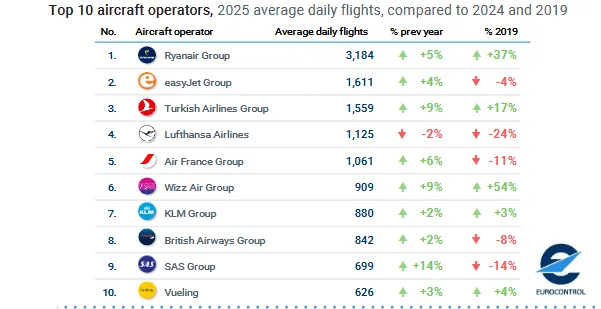
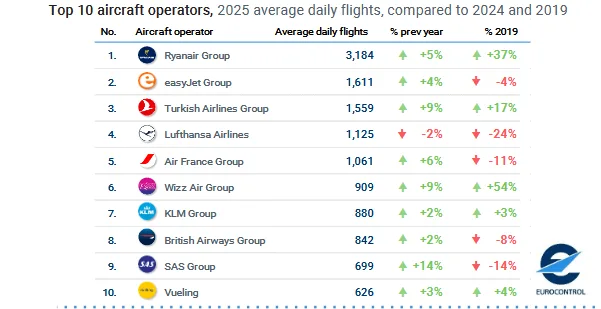
Behind it, Lufthansa Group holds around 10–12%, followed by International Airlines Group with
about 9–10%. Air France-KLM has a slightly smaller share, at around 8–9%, while low-cost
airlines like easyJet and Wizz Air account for approximately 7–8% and 4–5% respectively. The
remaining 30% or so is made up of many smaller airlines, which shows that although one
company dominates, the market is still shared among several important competitors. Overall,
this creates a balance between concentration and competition in the European airline industry.
3. Pricing strategies
Airlines compete primarily on price, with ticket costs varying depending on factors such as
travel dates, routes, booking timing, and service class. In the Airline industry, pricing is highly
dynamic and largely driven by competition rather than coordination. Airlines frequently engage
in fare wars, where one carrier reduces prices and others quickly follow. These situations can
lead to significant price drops—around 32% on average, and in extreme cases up to 79%—
especially when competition intensifies on specific routes or demand is uncertain.
Although most competition is legal and market-driven, there have been notable exceptions. A
key example is the Air cargo cartel case, where more than 20 airlines colluded on fuel
surcharges, leading to fines of nearly €800 million by the European Commission. Despite this,
airlines do not usually divide markets formally. Instead, segmentation occurs naturally, as
competition tends to be route-based, with airlines focusing on specific origin–destination pairs.
Customer behavior also plays an important role. Loyalty programs and switching costs
encourage passengers to stay with certain airlines, while differences between business and
leisure travelers lead to varied pricing strategies. In addition, airlines operate across multiple
routes and markets at the same time, which influences how aggressively they compete.
Overall, pricing in the airline industry is complex, competitive, and constantly evolving.
4. Agreements and concentrations
The Airline industry has several characteristics that can facilitate collusion and therefore
require antitrust monitoring. Factors such as multi-market contact between airlines, the role of
International Air Transport Association (IATA), and the use of advanced pricing platforms like
ATPco or OAG increase transparency and make it easier for airlines to coordinate, even
informally. In practice, this has led not only to explicit cartels—such as the Air cargo cartel
case—but also to more subtle forms of coordination, like signaling pricing strategies or limiting
capacity to keep fares high.
Mergers and acquisitions have further increased market concentration. Evidence shows that
after mergers, flight frequency can fall by around 8.7% to 12.2%, reflecting reduced
competition, especially on routes where the airlines previously competed directly. However, the
impact varies: it is stronger on competitive routes and weaker where one airline already
dominated. In some cases, mergers can also improve efficiency when airlines operate
complementary networks.
At the same time, airlines benefit from strong economies of scale due to their high fixed costs.
Large carriers like American Airlines or Lufthansa spread costs over more passengers, use
fuel-efficient aircraft such as the Boeing 787 or Airbus A350, and gain advantages from bulk
purchasing. Productivity is also improved through high aircraft utilization, quick turnaround