Kinematics in Newtonian Mechanics – Cambridge O Level Physics
Kinematics in Newtonian Mechanics is an essential study guide for students preparing for the Cambridge O Level Physics examination. This resource covers key concepts such as speed, velocity, acceleration, and the laws of motion. It includes various problem-solving techniques and practice questions to help reinforce understanding. Ideal for O Level Physics students, this guide provides a comprehensive overview of kinematics principles and their applications in real-world scenarios.
Key Points
Covers fundamental concepts of kinematics including speed, velocity, and acceleration.
Includes practice problems and solutions to enhance understanding of motion.
Explains the laws of motion as they apply to various physical scenarios.
Provides graphical representations of motion to aid visual learning.
This link leads to an external site. We do not know or endorse its content, and are not responsible for its safety. Click the link to proceed only if you trust this site.
Cambridge O Level Physics 5054/12 Past Paper May/June 2024Past Paper
PDFPast Paper
Cambridge O Level Physics 5054 2025 Winter Paper 1 Multiple ChoicePast Paper
PDFPast Paper
Cambridge IGCSE Physics 0972/41 October/November 2022Past Paper
PDFPast Paper
Cambridge IGCSE Physics 0972/04 Specimen Paper 2023Past Paper
PDFPast Paper
Pearson Edexcel International Advanced Level Physics Mark Scheme Summer 2025Past Paper
PDFPast Paper
Cambridge O Level Biology 5090/12 Past Paper May/June 2025Past Paper
PDFPast Paper
Cambridge O Level Biology 5090/42 Paper 4 Alternative to Practical October/November 2025Past Paper
PDFPast Paper
Cambridge O Level Biology 5090/12 Paper 1 Multiple Choice October/November 2025Past Paper
PDFPast Paper
Physical Quantities, Units, and Measurements – O Level PhysicsPast Paper
PDFPast Paper
Grade 11 Physics Exam Preparation – Practice Questions and NotesPast Paper
PDFPast Paper
Cambridge IGCSE Mathematics 0580/22 Past Paper February/March 2021Past Paper
PDFPast Paper
Cambridge IGCSE Mathematics 0580/42 Past Paper October/November 2021Past Paper
FAQs
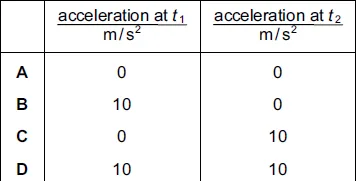
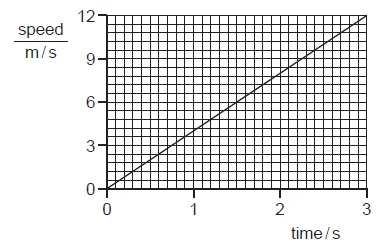
What is the correct statement about the acceleration of a car between 10s and 20s?
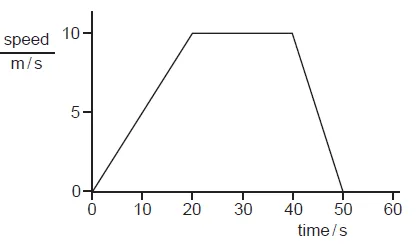
According to the document, the acceleration of the car between 10s and 20s is constant, but not zero. This is derived from the speed-time graph provided, which indicates that the speed is increasing steadily during this time interval.
How far does a student walk in 50 seconds at a constant speed?
The document states that a student walks at a constant speed, taking 100 seconds to walk 160 paces, with each pace measuring 0.80 m. Therefore, in 50 seconds, the student would walk 80 meters, calculated by determining the speed and then applying it to the shorter time frame.
What happens to the velocity and acceleration of an object falling under gravity?
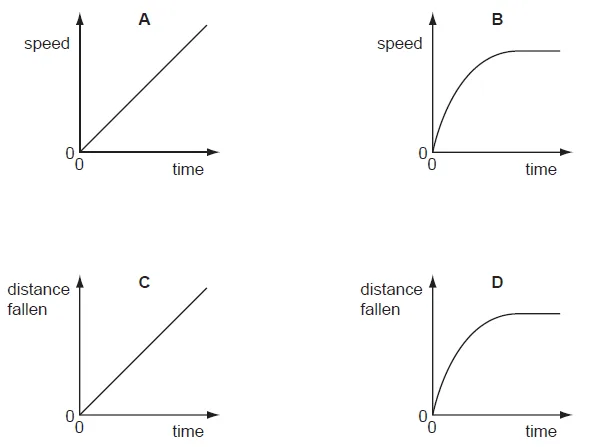
When an object falls from rest, its velocity increases until it reaches terminal velocity. Initially, the acceleration is constant due to gravity, but as the object falls, air resistance increases, eventually balancing the weight of the object, resulting in zero acceleration at terminal velocity.
What is the average speed of a cyclist over a 25-second ride?
The document presents a scenario where a cyclist's distance from the starting position is plotted against time. To find the average speed for the entire ride, one must calculate the total distance traveled and divide it by the total time taken, which is 25 seconds.
What is the total distance traveled by an object accelerating from 10 m/s to 20 m/s?
The document describes an object that travels at a constant speed of 10 m/s for 10 seconds, then accelerates uniformly to 20 m/s over the next 5 seconds. The total distance can be calculated by finding the distance covered at constant speed and the distance covered during acceleration.
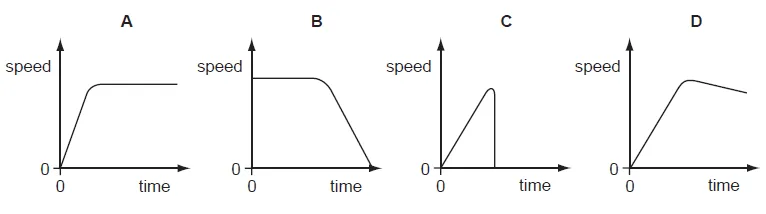
How does the speed-time graph indicate non-uniform acceleration?
In the document, a speed-time graph illustrates different sections of a car's journey. Non-uniform acceleration is represented by sections of the graph where the slope is changing, indicating that the acceleration is not constant throughout those intervals.
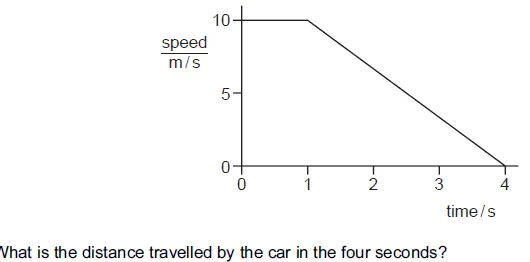
What is the average deceleration of a car brought to rest from 10 m/s in 5 seconds?
The document states that if a car is brought to rest from a speed of 10 m/s over a duration of 5 seconds, the average deceleration can be calculated using the formula for acceleration. In this case, the average deceleration would be 2 m/s².