Explore key quotes from F. Scott Fitzgerald's classic novel, The Great Gatsby. This collection highlights pivotal moments and themes, including the pursuit of the American Dream, illusion versus reality, and the complexities of love and wealth. Ideal for students, literature enthusiasts, and anyone seeking deeper insights into the characters and narrative. The quotes span various chapters, providing context and analysis for each significant line.

Key Points

  • Includes notable quotes from The Great Gatsby, focusing on themes of ambition and disillusionment.
  • Highlights character insights and pivotal moments from F. Scott Fitzgerald's narrative.
  • Explores the symbolism of the green light and its significance in Gatsby's quest.
  • Analyzes the social commentary on wealth and morality present in the text.
newtopiccyclegrowin
Author:F. Scott Fitzgerald
5 pages
Language:English
Type:Book Summary
newtopiccyclegrowin
Author:F. Scott Fitzgerald
5 pages
Language:English
Type:Book Summary
171
/ 5
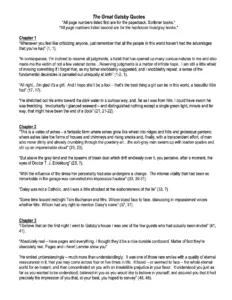
The Great Gatsby Quotes
*All page numbers listed first are for the paperback, Scribner books.*
*All page numbers listed second are for the hardcover blue/gray books.*
Chapter 1
―Whenever you feel like criticizing anyone, just remember that all the people in this world haven‘t had the advantages
that you‘ve had‖ (1, 1).
In consequence, I‘m inclined to reserve all judgments, a habit that has opened up many curious natures to me and also
made me the victim of not a few veteran boresReserving judgments is a matter of infinite hope. I am still a little afraid
of missing something if I forget that, as my father snobbishly suggested, and I snobbishly repeat, a sense of the
fundamental decencies is parceled out unequally at birth‖ (1-2, 1).
―All right…I‘m glad it‘s a girl. And I hope she‘ll be a fool – that‘s the best thing a girl can be in this world, a beautiful little
fool‖ (17, 17).
He stretched out his arms toward the dark water in a curious way, and, far as I was from him, I could have sworn he
was trembling. Involuntarily I glanced seaward and distinguished nothing except a single green light, minute and far
way, that might have been the end of a dock‖ (21, 21-22).
Chapter 2
―This is a valley of ashes a fantastic farm where ashes grow like wheat into ridges and hills and grotesque gardens;
where ashes take the forms of houses and chimneys and rising smoke and, finally, with a transcendent effort, of men
who move dimly and already crumbling through the powdery airthe ash-gray men swarm up with leaden spades and
stir up an impenetrable cloud‖ (23, 23).
―But above the gray land and the spasms of bleak dust which drift endlessly over it, you perceive, after a moment, the
eyes of Doctor T. J. Eckleburg‖ (23, ?).
―With the influence of the dress her personality had also undergone a change. The intense vitality that had been so
remarkable in the garage was converted into impressive hauteur‖ (30, 30-31).
―Daisy was not a Catholic, and I was a little shocked at the elaborateness of the lie‖ (33, ?).
Some time toward midnight Tom Buchanan and Mrs. Wilson stood face to face, discussing in impassioned voices
whether Mrs. Wilson had any right to mention Daisy‘s name‖ (37, 37).
Chapter 3
―I believe that on the first night I went to Gatsby‘s house I was one of the few guests who had actually been invited‖ (41,
41).
Absolutely real have pages and everything. I thought they‘d be a nice durable cardboard. Matter of fact they‘re
absolutely real. Pages and—here! Lemme show you‖
―He smiled understandingly – much more than understandingly. It was one of those rare smiles with a quality of eternal
reassurance in it, that you may come across four or five times in life. It faced or seemed to face the whole eternal
world for an instant, and then concentrated on you with an irresistible prejudice in your favor. It understood you just as
far as you wanted to be understood, believed in you as you would like to believe in yourself, and assured you that it had
precisely the impression of you that, at your best, you hoped to convey‖ (48, 48).
―I see I have given the impression that the events…were all that absorbed me. On the contrary, they were merely casual
events in a crowded summer, and, until much later, they absorbed me infinitely less than my personal affairs‖ (55-56, ?).
―Everyone suspects himself of at least one of the cardinal virtues, and this is mine: I am one of the few honest people
that I have ever known‖ (59, 60).
Chapter 4
―He‘s a bootlegger…One time he killed a man who had found out that he…‖ (61, ?)
―He was never quite still; there was always a tapping foot somewhere or the impatient opening and closing of a hand‖
(64, 64).
―He looked at me sideways – and I knew why Jordan Baker had believed he was lying…‖ (65)
―She took it into the tub with her and squeezed it up into a wet ball, and only let me leave it in the soap-dish when she
saw that is was coming to pieces like snow‖ (76, ?).
Chapter 5
―Well, this would interest you. It wouldn‘t take up much of your time and you might pick up a nice bit of money. It
happens to be a rather confidential sort of thing‖ (83, 83).
―But there was a change in Gatsby that was simply confounding. He literally glowed; without a word or a gesture of
exultation a new well-being radiated from him and filled the little room‖ (89, 90).
―It makes me sad because I‘ve never seen such – such beautiful shirts before‖ (92, 93-94).
―If it wasn‘t for the mist we could see you home across the bay…You always have a green light that burns all night at the
end of your dock‖ (92, ?).
He seemed absorbed in what he had just said. Possibly it had occurred to him that the colossal significance of that light
had now vanished forever. Compared to the great distance that had separated him from Daisy it had seemed very near
to her, almost touching her. It had seemed as close as a star to the moon. Now it was again a green light on a dock.
His count of enchanted objects had diminished by one‖ (93, 94).
―They had forgotten me, but Daisy glanced up and held out her hand; Gatsby didn‘t know me now at all. I looked once
more at them and they looked back at me, remotely, possessed by intense life‖ (96, 97).
Chapter 6
―I wonder where in the devil he met Daisy. By God, I may be old-fashioned in my ideas, but women run around too
much these days to suit me. They meet all kinds of crazy fish‖ (103, 104).
―Tom was evidently perturbed at Daisy‘s running around alone, for on the following Saturday night he came with her to
Gatsby‘s party‖ (103-104, 105).
―He wanted nothing less of Daisy than that she should go to Tom and say: ‗I never loved you. After she had obliterated
four years with that sentence they could decide upon the more practical measures to be taken‖ (109, 111).
―‗Can‘t repeat the past?‘ he cried incredulously. ‗Why of course you can!‘ He looked around him wildly, as if the past
were lurking here in the shadow of his house, just out of reach of his hand. ‗I‘m going to fix everything just the way it was
before,‘ he said, nodding determinedly. ‗She‘ll see‘‖ (110, 111).
―He talked a lot about the past, and I gathered that he wanted to recover something, some idea of himself perhaps, that
had gone into loving Daisy‖ (110, 111).
Chapter 7
Gatsby has dismissed every servant in his house a week ago and replaced them with half a dozen others…‗I wanted
somebody who wouldn‘t gossip. Daisy comes over quite often in the afternoons‘‖ (113-114, 113-114).
―‗Her voice is full of money‘…That was it. I‘d never understood before. It was full of money that was the inexhaustible
charm that rose and fell in it, the jingle of it, the cymbals‘ song of it…High in a white palace the king‘s daughter, the
golden girl…‖ (120, 120).
―‗She never loved you, do you hear?‖ he cried. ‗She only married you because I was poor and she was tired of waiting
for me. It was a terrible mistake, but in her heart she never loved any one except me!‘‖ (130, 131).
―I found out what your‘ ‗drug-stores‘ were…He and this Wolfsheim bought up a lot of side-street drug-stores here and in
Chicago and sold grain alcohol over the counter. That‘s one of his little stunts. I picked him for a bootlegger the first
time I saw him, and I wasn‘t far wrong…That drug-store business was just small change…but you‘ve got something on
now that Walter‘s afraid to tell me about‖ (133-134, 134).
―You two start on home, Daisy…In Mr. Gatsby‘s car…Go on. He won‘t annoy you. I think he realizes that his
presumptuous little flirtation is over‖ (135, 135-136).
Chapter 8
―I felt that I had something to tell him, something to warn him about and morning would be too late‖ (147, 147).
―He wouldn‘t consider it. He couldn‘t possible leave Daisy until he knew what she was going to do. He was clutching at
some last hope and I couldn‘t bear to shake him free‖ (148, 148).
―It excited him, too, that many men had already loved Daisy – it increased her value in his eyes‖ (149, 148).
―She vanished into her rich house, into her rich, full life, leaving Gatsby nothing. He felt married to her, that was all‖
(149, 149).
―Gatsby was overwhelmingly aware of the youth and mystery that wealth imprisons and preserves, of the freshness of
many clothes, and of Daisy, gleaming like silver, safe and proud above the hot struggles of the poor‖ (150, 150).
―‗They‘re a rotten crowd…You‘re worth the whole damn bunch put together.‘ I‘ve always been glad I said that. It was
the only compliment I ever gave him, because I disapproved of him from beginning to end‖ (154, 154).
―I told her she might be able to fool me but she couldn‘t fool God. I took her to the window…and I said ‗God knows what
you‘ve been doing, everything you‘ve been doing. You may fool me, but you can‘t fool God!‘…he was looking at the eyes
of Doctor T.J. Eckleburg, which had just emerged, pale and enormous, from the dissolving night‖ (159, 160).
―No phone message arrived…I have an idea that Gatsby himself didn‘t believe it would come, and perhaps he no longer
cared. If that was true he must have felt that he had lost the old warm world, paid a high price for living too long with a

/ 5
End of Document
171

FAQs

What are some key themes in The Great Gatsby?
The Great Gatsby explores several significant themes, including the tension between the past and the future, the illusion versus reality, and the pursuit of dreams and goals. The novel emphasizes that one cannot move forward without letting go of the past, highlighting the dangers of dwelling on previous experiences. Additionally, it critiques the notion that wealth leads to happiness, illustrating how materialism can lead to the decay of the American Dream. Characters like Gatsby exemplify the obsession with unattainable dreams, ultimately leading to their downfall.
What does Gatsby's green light symbolize?
In The Great Gatsby, the green light at the end of Daisy's dock symbolizes Gatsby's hope and the elusive nature of his dreams. Initially, it represents his desire for Daisy and the life he envisions with her. However, as the story progresses, the significance of the green light shifts. It becomes a reminder of the unattainable, as Gatsby realizes that his dream is forever out of reach. The light embodies the broader theme of the American Dream, suggesting that what one strives for may ultimately remain elusive.
How does the character of Daisy Buchanan reflect the theme of wealth?
Daisy Buchanan's character in The Great Gatsby embodies the theme of wealth and its impact on personal relationships. Her voice is described as being 'full of money,' which signifies the allure and charm of her social status. However, Daisy's wealth also highlights her moral emptiness and carelessness, as she retreats into her affluent life after causing chaos in the lives of others. This duality illustrates how wealth can create a facade of happiness while masking deeper issues, ultimately leading to disillusionment and tragedy.
What is the significance of the valley of ashes in the novel?
The valley of ashes in The Great Gatsby serves as a stark contrast to the opulence of East Egg and West Egg, symbolizing the moral and social decay resulting from the uninhibited pursuit of wealth. It represents the desolation faced by those who are left behind in the wake of the American Dream. The imagery of ashes growing like wheat emphasizes the bleakness of this area, where the hopes and dreams of the working class are crushed. The valley also introduces the eyes of Doctor T.J. Eckleburg, which symbolize the loss of spiritual values in a materialistic society.
How does Fitzgerald portray the American Dream in the novel?
Fitzgerald critiques the American Dream in The Great Gatsby by illustrating its inherent flaws and the disillusionment it brings. The novel suggests that the pursuit of wealth and status often leads to moral decay and emptiness. Characters like Gatsby strive for success and happiness through material means, yet they find themselves unfulfilled and ultimately doomed. The idea that one can achieve their dreams through hard work is undermined by the reality that social class and privilege play a significant role in one's success, revealing the darker side of the American Dream.
What role does Nick Carraway play in the story?
Nick Carraway serves as the narrator and moral center of The Great Gatsby. His perspective provides insight into the lives of the other characters, particularly Gatsby and Daisy. As an outsider to the wealthy elite of East Egg, Nick offers a unique viewpoint that highlights the superficiality and moral decay of their world. His judgments and observations help to frame the narrative, allowing readers to understand the complexities of the characters and the themes of the novel. Ultimately, Nick's disillusionment with the East Coast elite reflects the broader critique of the American Dream.
What does the ending of The Great Gatsby signify?
The ending of The Great Gatsby signifies the ultimate failure of Gatsby's dreams and the futility of the American Dream itself. After Gatsby's tragic death, Nick reflects on the disillusionment that permeates the lives of the characters. The final lines emphasize the idea that despite their efforts, they are 'borne back ceaselessly into the past,' suggesting that the pursuit of dreams can lead to inevitable disappointment. This conclusion encapsulates the novel's themes of hope, loss, and the unattainable nature of the American Dream.