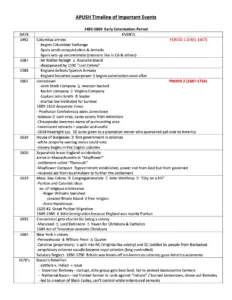
The APUSH Timeline of Important Events outlines key historical milestones from early colonization to the modern era. It covers significant events such as the establishment of Jamestown, the American Revolution, and the Civil War, providing a comprehensive overview for AP U.S. History students. This timeline serves as a valuable study aid for understanding the chronological progression of American history. It includes critical dates, legislation, and social movements that shaped the nation, making it an essential resource for exam preparation.

Key Points

  • Highlights major events from 1492 to 2000 in U.S. history for APUSH students.
  • Covers significant milestones like the Declaration of Independence and Civil War.
  • Includes key legislation and social movements that influenced American society.
  • Serves as a chronological guide for understanding U.S. historical context.
newtopiccyclegrowin
8 pages
Language:English
Type:Notes
newtopiccyclegrowin
8 pages
Language:English
Type:Notes
261
/ 8
APUSH Timeline of Important Events
1492-1650 Early Colonization Period
DATE
EVENTS
1492
Columbus arrives PERIOD 1 (1491-1607)
-begins Columbian Exchange
-Spain sends conquistadors & Armada
-Spain sets up encomiendas (missions like in CA & others)
1587
-Sir Walter Raleigh Roanoke Island
-disappeared by 1590 “Lost Colony”
1588
-England defeats Spanish Armada
-England becomes superpower begins colonization soon after
1607
Jamestown PERIOD 2 (1607-1754)
-Joint Stock Company investor-backed
-backer company Virginia Company
-Captain John Smith leader
-martial law instituted for survival
1609-1610 desperate times
- Powhatan Confederacy aides Jamestown
-tobacco cash crop, saves colony from extinction
-Chesapeake becomes name of surrounding area
-indentured servants popular and useful
-1618 headright sys. 50 acres given to a plantation owner who sponsored ppl over to America
1619
House of Burgesses first government in colonies
-white property-owning males could vote
-slavery begins in the English colonies
1620
Separatists leave England accidentally
arrive in Massachusetts in “Mayflower”
-settlement called “Plymouth”
-Mayflower Compact government established, power not from God but from governed
-received aid from local Indians to further the settlement
1629
Mass. Bay Colony Congregationalists John Winthrop “City on a hill”
-Puritan and Calvinist ideas
ex. of religious intolerance
-Roger Williams banished
-created Rhode Island free religion
-Anne Hutchinson
1629-42 Great Puritan Migration
1649-1660 little immigration because England was mainly Puritan
1635
Connecticut gets charter for being a colony
-Maryland Lord Baltimore haven for Christians & Catholics
1649 Act of Toleration protects Christians
1685
New York = colony
-Pennsylvania William Penn Quaker
-Carolina (proprietary) split into NC (Virginia-like colony) and SC (settled by people from Barbados)
-proprietary colonies usually became royal colonies (king-controlled)
Salutary Neglect 1650-1750 Britain was hands-off on American colonies; gave America autonomy
1670’s
Bacon’s Rebellion
-settlers v. Indian = issue
- Governor Berkeley - corrupt, elite group gets best land, fail to protect backcountry farmers
- Nathanial Bacon - led frontier farmer in raids against "Indians" / burned Jamestown, drove out Berkeley
-led to creation of Black Codes, can't control white indentured servants

1692
Salem Witch Trials
-many executions
-unrest in religion, politics and gender led to the witch hysteria
1730’s
to
1740’s
Great Awakening
-Jonathan Edwards: Congregationalist, “sinners in hands of angry God”, fire & brimstone
-message was about Hell and predestination
-George Whitefield: Methodist, Christianity, evangelical movement (emotionalism and spirituality)
- sermons outside of traditional church (outdoors)
- scaled the length of the colonies becoming a shared experience for colonies (building a shared identity)
Enlightenment = rationalism & science (John Lock: natural rights, Montesquieu: separation of powers)
-Ben Franklin ex of enlightenment man
Independence 1750 1781
1754
Albany Plan by Ben Franklin PERIOD 3 (1754-1800)
-inter-colonial government plans
-for defense
-not accepted
1754 - 1763
7 Years War “French-Indian War”
-Britain wins leads to anti-British sentiment
1763
Proclamation of 1763
-forbids colonial settlement past Appalachian Mountains
-angered colonists
-end of salutary neglect
-turning point of British-Colonial relations
1764
Sugar Act to stop smuggling
Currency Act colonists can’t make paper money
1765
Stamp Act
-direct tax for revenue
-broad tax covered legal documents too
-affected almost everyone, especially literate and lawyers
-taxed goods made in the colonies
“No taxation without representation”
British response - virtual representation
1766
Stamp Act Congress formed, boycotts - Act repealed
Declaratory Act passed - Parliament can tax and legislate in all cases anywhere in the colonies
1767
Townshend Act
-taxed goods imported from Britain
-paid for government officials’ salaries
-more vice-admiralty courts created
-suspended NY legislation
-“writ of assistance” British can search anywhere; soldiers sent to Boston to keep peace, March 5, 1770
Colonists protest
1769 Townshend Duties repealed
Mar 5, 1770
Boston Massacre
Dec 16, 1773
Boston Tea Party - tea tax protest
early 1774
Coercive Acts (“Intolerable Acts”)
-closed Boston port; except for essentials
-colonists had to house soldiers
late 1774
First Continental Congress = all but Georgia
goals -determine grievances
-address actions to grievances such as boycotts
-Parameters which were considered Parliamentary interference
April 1775
Battles of Lexington (first battle) and
Concord (American colonists held off British “shot heard ‘round the world”)
1775
2
nd
Continental Congress
-established continental army
-printing $
-established government offices for policies
-George Washington - leader of army
July 5, 1775
Olive Branch Petition
-America wants reconciliation with Britain
-last attempt to avoid armed conflict
-King George III ignored it
January 1776
Common Sense - Thomas Paine
-“Why should an island rule a continent?”, Colonists have suffered abuses by British gov.
June 1776
Thomas Jefferson commissioned to write Declaration of Independence
July 4, 1776
Declaration of Independence signed
1778
Franco-American Alliance
-negotiated by Ben Franklin
-brings French into war on the colonists side
-because of battle of Saratoga
1783
Treaty of Paris
-gave US land and independence
1777
Articles of Confederation
-1
st
central government
-lacked ability to tax, declare war, form a military
summer
1787
Constitutional Convention
-NJ plan support small states, equal representation
-Virginia plan checks & balances, support large states, representation based on population
-Great Compromise - bicameral
-House of Representatives - representation according to population
-Senate - equal, 2 per state
-3/5ths Compromise (count 3/5 of slave population toward representation, empower Southern states)
1789
Constitution is effective
1791
Bill of Rights added
1789
Election of Washington
-cabinet Jefferson (Secretary of State), Hamilton (Treasury)
events
-National Bank created
-Hamilton’s financial plan to reduce debt
-Neutrality Proclamation
-Pinckney’s treaty 1796
-no third term
1797
Farewell Address neutrality championed
1797
John Adams
-XZY affair
-Alien & Sedition Acts
-VA & KY resolutions nullification
-midnight appointments Adams placed more judges in judicial positions with Federalists
leads to Marbury v. Madison
/ 8
End of Document
261

FAQs

What were key events during the Early Colonization Period (1492-1650)?
Key events during the Early Colonization Period include Columbus's arrival in 1492, which initiated the Columbian Exchange, and the establishment of Spanish encomiendas. In 1587, Sir Walter Raleigh's Roanoke Island settlement disappeared by 1590, becoming known as the 'Lost Colony.' The defeat of the Spanish Armada by England in 1588 marked a shift in power, allowing England to begin its colonization efforts, culminating in the founding of Jamestown in 1607.
What was the significance of the Mayflower Compact in 1620?
The Mayflower Compact, established by the Separatists who arrived on the Mayflower in 1620, was significant as it created a government based on the consent of the governed, rather than divine right. This document laid the groundwork for self-governance in the New World and emphasized the principles of democracy, as it was signed by the male passengers aboard the ship before they disembarked in Plymouth.
How did the Great Awakening influence American society in the 1730s and 1740s?
The Great Awakening, occurring in the 1730s and 1740s, significantly influenced American society by promoting a wave of religious revivalism. Preachers like Jonathan Edwards and George Whitefield emphasized emotional spirituality and personal connections to faith, moving sermons outdoors and reaching wider audiences. This movement helped foster a shared identity among the colonies and encouraged questioning of traditional religious authority, setting the stage for future democratic ideals.
What were the main causes of the American Revolution outlined in the document?
The main causes of the American Revolution included a series of British acts that angered colonists, such as the Stamp Act of 1765, which imposed direct taxes on legal documents and goods. The phrase 'No taxation without representation' emerged as a rallying cry against British policies. Events like the Boston Massacre in 1770 and the Boston Tea Party in 1773 further escalated tensions, leading to the formation of the First Continental Congress in 1774 to address grievances.
What were the main outcomes of the Treaty of Paris in 1783?
The Treaty of Paris in 1783 marked the official end of the American Revolutionary War and recognized the independence of the United States. The treaty granted the U.S. significant territorial gains, including land from the Atlantic coast to the Mississippi River. It also established boundaries for the new nation and set the stage for future westward expansion, fundamentally altering the political landscape of North America.
What was the significance of the Louisiana Purchase in 1803?
The Louisiana Purchase in 1803 was significant as it doubled the size of the United States, acquiring approximately 828,000 square miles of territory from France. This acquisition opened up vast lands for exploration and settlement, leading to the Lewis and Clark expedition. It also set a precedent for future territorial expansion and demonstrated the U.S. government's commitment to westward growth.
What were the key features of the Compromise of 1850?
The Compromise of 1850 included several key features aimed at resolving tensions between slave and free states. It admitted California as a free state, established stronger fugitive slave laws, and allowed the territories of Utah and New Mexico to decide on slavery through popular sovereignty. This compromise was an attempt to maintain the balance between free and slave states but ultimately heightened sectional tensions leading up to the Civil War.