The judgment from the Supreme Court of India addresses the legal implications of land acquisition under the Tamil Nadu Acquisition of Land for Industrial Purposes Act, 1997. It examines whether parties to a concluded contract can seek further relief under statutory provisions. The case involves the Government of Tamil Nadu and various landowners, focusing on compensation for acquired land and the applicability of interest payments. This judgment is crucial for understanding land acquisition laws and the rights of landowners in Tamil Nadu.

Key Points

  • Analyzes the legal framework of the Tamil Nadu Acquisition of Land for Industrial Purposes Act, 1997.
  • Explores the implications of concluded contracts in land acquisition cases.
  • Discusses the determination of compensation and interest payments for landowners.
  • Highlights the Supreme Court’s interpretation of statutory provisions in relation to contractual agreements.
Yashvi Anchalia
12 pages
Language:English
Type:Case Study
Yashvi Anchalia
12 pages
Language:English
Type:Case Study
115
/ 12
MANU/SC/1556/2025
Equiv alent/Neutral Citation: 2026(1)C ivilC C (S.C .)270, 2026(1)IC C 578, 2025 INSC 1332, (2025)6MLJ577
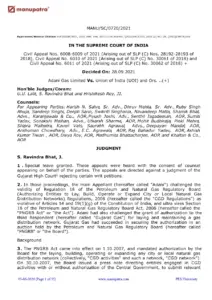
IN THE SUPREME COURT OF INDIA
Civil Appeal Nos. 13839-13852 of 2025 (Arising out of SLP (C) Nos. 12770-83 of 2020)
+
Decided On: 19.11.2025
The Government of Tamil Nadu, Transport Department and Ors. Vs. P.R. Jaganathan
and Ors. ..(+)
Hon'ble Judges/Coram:
M.M. Sundresh and N. Kotiswar Singh, JJ.
Counsels:
For Appellant/Petitioner/Plaintiff: Balaji Subramaniam, AAG/Adv., G. Indira, AOR, P.
Gandepan, Akash Kundu, Anjali Singh, Raniba Pangnila, Amrit Kaur, Anurag Kashyap,
Advs. and D. Kumanan, AOR
For Respondents/Defendant: Ashwarya Sinha, AOR, Surbhi Kumari, Aditya Malhotra,
Sankalp Mahindru, Advs., S. Gowthaman, AOR, S. Nagamuthu, Sr. Adv., C.
Paramasivam, Adv., M.P. Parthiban, AOR, Priyaranjani Nagamuthu, Shalini Mishra, Bilal
Mansoor, Shreyas Kaushal, S. Geyolin Selvam, Alagiri K., Shivansh Sharma, Rohan
Singh, Abhishek S., Saurabh Jain, Prayag Jain, Advs., Kaushik Poddar, Rajinder Singh,
AORs, R. Sharath and Arjun Sharma, Advs.
JUDGMENT
M.M. Sundresh, J.
1. Leave granted.
2. We have heard Dr. Abhishek Manu Singhvi, the learned Senior Counsel appearing for
the Appellants and Ms. Aishwarya Bhati, the learned Additional Solicitor General (ASG),
Mr. S Nagamuthu, the learned Senior Counsel and other learned Counsel appearing for
the Respondents. We have perused the written arguments and the documents filed by
the parties.
3 . The issue for consideration in these appeals is: Whether a party to a concluded
contract, voluntarily and statutorily entered into, can seek further relief by taking refuge
under the statutory provisions?
4. Sections 7 and 12 of The Tamil Nadu Acquisition of Land for Industrial Purposes Act,
1997 (hereinafter referred to as the "1997 Act"), read as under:
Section 7 of the 1997 Act
"7. Determination of amount
(1) Where any land is acquired by the Government under this Act, the
Government shall pay an amount for such acquisition which shall be determined
in accordance with the provisions of this section.
03-06-2026 (Page 1 of 12) www.manupatra.com PES University
(2) Where the amount has been determined by agreement between
the Government and the person to whom the amount has to be paid, it
shall be paid in accordance with such agreement.
(3) Where no such agreement can be reached, the Government shall
refer the case to the Collector for determination of the amount to be
paid for such acquisition as also the person or persons to whom such
amount shall be paid:
Provided that no amount exceeding such amount as the Government may, by
general order, specify to be paid for such acquisition shall be determined by the
Collector without the previous approval of the Government officer as the
Government may appoint in this behalf.
(4) Notwithstanding anything contained in Sub-section (3), after the
case is referred to the Collector under that Sub-section, but before he
has finally determined the amount, if the amount is determined by
agreement between the Government and the person to whom the
amount has to be paid, such amount shall be paid by the Collector in
accordance with such agreement.
(5) Before finally determining the amount, the Collector shall give an
opportunity to every person to whom the amount has to be paid to state his
case as to the amount.
(6) In determining the amount, the Collector shall be guided by the provisions
contained in sections 23 and 24 and other relevant provisions of the Land
Acquisition Act, 1894, (Central Act I of 1894) subject to modifications that-
(a) in the said section 23, the references to the date of publication of
the notification Under Section 4, Sub-section (1) and the time of
publication of the declaration Under Section 6 of the said Act shall be
construed as references to the date of publication of notice Under Sub-
sections (2) and (1), respectively, of section 3 of this Act; and
(b) in the said section 24, the references to the date of publication of
notification Under Section 4, Sub-section (1) and the date of
publication of the declaration Under Section 6 of the said Act shall be
construed as references to the date of publication of notice Under Sub-
sections (2) and (1), respectively, of section 3 of this Act.
(7) For the purpose of determining the amount-
(a) the Collector shall have power to require any person to deliver to
him such returns and assessments as he considers necessary;
(b) the Collector shall also have power to require any person known or
believed to be interested in the land to deliver to him a statement
containing as far as may be practicable, the name of every other person
interested in the land as co-owner, mortgagee, tenant or otherwise,
and the nature of such interest, and of the rents and profits, if any,
received or receivable on account thereof for three years next preceding
the date of the statement.
(emphasis supplied)
03-06-2026 (Page 2 of 12) www.manupatra.com PES University
Section 12 of the 1997 Act
"12. Payment of interest.
When the amount is not paid or deposited on or before taking
possession of the land, the Government shall pay the amount
determined with interest thereon at the rate of [nine per cent]
[Substituted for the expression, four per cent.' by the Tamil Nadu Acquisition of
land for Industrial Purposes (Amendment) Act, 1999 (Tamil Nadu Act 2 of
2000).] per annum from the time of so taking possession until it shall
have been so paid or deposited.
(emphasis supplied)
5. Section 7 of the 1997 Act is an exhaustive provision dealing with the determination
of amount of compensation to be paid to the landowner or person interested over an
acquired land. Sub-section (2) of Section 7 of the 1997 Act encourages and facilitates
the determination of the amount payable to the owner or person interested through an
agreement with the Government. It further stipulates that upon such an agreement, the
resultant amount will have to be paid only as per the terms agreed, thereunder. Under
Sub-section (3) of Section 7 of the 1997 Act, a reference would be warranted to the
Collector, only on the failure to reach such an agreement.
6. Sub-section (4) of Section 7 of the 1997 Act gives one more opportunity towards an
amicable settlement between the parties. Thus, even after the issue pertaining to the
determination of compensation is referred to the Collector Under Sub-section (3), an
agreement can be entered into between the Government and the concerned individual.
Upon such an agreement, the Collector shall make due compliance.
7 . Therefore, after an agreement is entered into, the terms and conditions mentioned
thereunder, along with the amount duly arrived at, alone would govern the parties. In
other words, the agreement becomes sacrosanct, leading to the termination of the
umbilical cord which connects the agreement to the other provisions pertaining to the
passing of the award under the 1997 Act. The object of these provisions is to arrive at a
settlement by negotiation, while ensuring timely payment, by avoiding the circuitous
route involving the procedure for passing of the award, reference and appeal.
8. Section 12 of the 1997 Act speaks of payment of interest at the rate of nine per cent
per annum, from the time of taking possession until the compensation is either paid or
deposited. Therefore, this provision gets triggered only after possession is taken and,
thereafter, continues to be in force till the amount is paid or deposited. To make the
aforesaid position clear, Section 12 of the 1997 Act has no application to a case where
an agreement has been entered into between the parties. This is for the reason that a
concluded contract Under Section 7 of the 1997 Act, voluntarily entered into between
the parties, would exclude itself from purview of the 1997 Act, thereafter.
FACTUAL BACKGROUND
9 . Lease agreements for the lands situated in villages Singanallur and Kalapatti of
Coimbatore District were entered into between the land owners and the Department of
Defence way back in the year 1942, pursuant to which possession of the respective
lands were handed over to the Department of Defence. These lands were used as an
aerodome and later on transferred to the Department of Civil Aviation in the year 1947.
Subsequently, they were transferred to the Airport Authority of India (AAI), who was

03-06-2026 (Page 3 of 12) www.manupatra.com PES University
/ 12
End of Document
115

FAQs

What is the main issue addressed in the Tamil Nadu Transport Department judgment?
The main issue in the judgment is whether a party to a concluded contract, voluntarily and statutorily entered into, can seek further relief under statutory provisions. The court examined the implications of Sections 7 and 12 of The Tamil Nadu Acquisition of Land for Industrial Purposes Act, 1997, particularly focusing on agreements made regarding compensation and the subsequent claims for interest.
What do Sections 7 and 12 of the Tamil Nadu Act state about compensation?
Section 7 of the Tamil Nadu Acquisition of Land for Industrial Purposes Act, 1997, outlines how compensation for acquired land is determined, emphasizing that it should be based on agreements between the government and the landowners. Section 12 specifies that if the amount is not paid by the time of taking possession, the government must pay interest at a specified rate until payment is made. These sections are crucial in understanding the contractual obligations and rights of the parties involved.
How did the court interpret the agreement between the government and landowners?
The court interpreted the agreement as a complete package that included all claims regarding compensation, thereby preventing the landowners from seeking additional amounts such as solatium. It emphasized that once an agreement is reached, it becomes sacrosanct, terminating any statutory claims under the 1997 Act. This interpretation highlights the importance of contractual agreements in land acquisition cases.
What was the outcome of the High Court's judgment regarding interest payments?
The High Court ruled that the landowners were entitled to interest from the date of taking possession until the date of the impugned judgment. This decision was based on their interpretation of Section 12 of the 1997 Act, despite the earlier agreement that was deemed comprehensive. The court's judgment ultimately led to appeals regarding the substantial interest amount claimed.
What legal principles did the Supreme Court apply in this case?
The Supreme Court applied the principles of contract law, particularly focusing on the doctrine of approbate and reprobate, which prevents parties from accepting benefits while simultaneously rejecting the terms of the agreement. The court highlighted that once the landowners accepted the compensation without protest, they could not later claim additional amounts or invoke statutory provisions.