Development has many aspects. The
purpose of this chapter is to enable
students to understand this idea. They
have to understand that people have
different perspectives on development and
there are ways by which we can arrive at
common indicators for development. To
do this, we have used situations that they
can respond to in an intuitive manner; we
have also presented analysis that is more
complex and macro in nature.
How can countries or states be
compared using some selected
development indicators is another
question that students would read about
in this chapter. Economic development
can be measured and income is the most
common method for measuring
development. However, the income
method, though useful, has several
weaknesses. Hence, we need newer ways
of looking at development using indicators
of quality of life and environmental
sustainability.
It is necessary for you to expect the
students to respond actively in the
classroom and on a topic such as the
above, there would be wide variation in
opinion and possibility of debate. Allow
students to argue their point of view. At
the end of each section there are a few
questions and activities. These serve two
purposes: first, they recap the ideas
discussed in the section and second, they
enable better understanding of the themes
discussed by bringing the learners closer
to their real-life situations.
There are certain terms used in this
chapter that would require clarification —
Per Capita Income, Literacy Rate, Infant
Mortality Rate, Attendance Ratio, Life
Expectancy, Gross Enrolment Ratio, and
Human Development Index. Though data
pertaining to these terms are provided,
these would need further explanation. You
may also need to clarify the concept of
purchasing power parity that is used to
calculate per capita income in Table 1.6.
It is necessary to keep in mind that these
terms are used as an aid to the discussion
and not something to be memorised.
Sources for Information
The data for this chapter is taken from
reports published by the Government of
India (Economic Survey, Report of the
National Family Health Survey and
Handbook of Statistics on the Indian
Economy), United Nations Development
Programme (Human Development Report)
and World Bank (World Development
Indicators). These reports are being
published every year. It may be interesting
to look up these reports if they are available
in your school library. If not, you may log
on to the websites of these institutions
(www.budgetindia.nic.in, www.undp.org,
www.worldbank.org). Data is also available
from the Reserve Bank’s Handbook of
Statistics on Indian Economy, (available at
www.rbi.org).
2019-20
The idea of development or progress
has always been with us. We have
aspirations or desires about what we
would like to do and how we would
like to live. Similarly, we have ideas
about what a country should be like.
What are the essential things that we
require? Can life be better for all? How
should people live together? Can there
be more equality? Development
involves thinking about these
questions and about the ways in
which we can work towards achieving
these goals. This is a complex
task and in this chapter we shall
make a beginning at understanding
development. You will learn more
about these issues in greater depth
in higher classes. Also, you will find
answers to many of these questions
not just in economics but also in your
course in history and political science.
This is because the way we live today
is influenced by the past. We can’t
desire for change without being aware
of this. In the same way, it is only
through a democratic political
process that these hopes and
possibilities can be achieved in
real life.
CHAPTER I
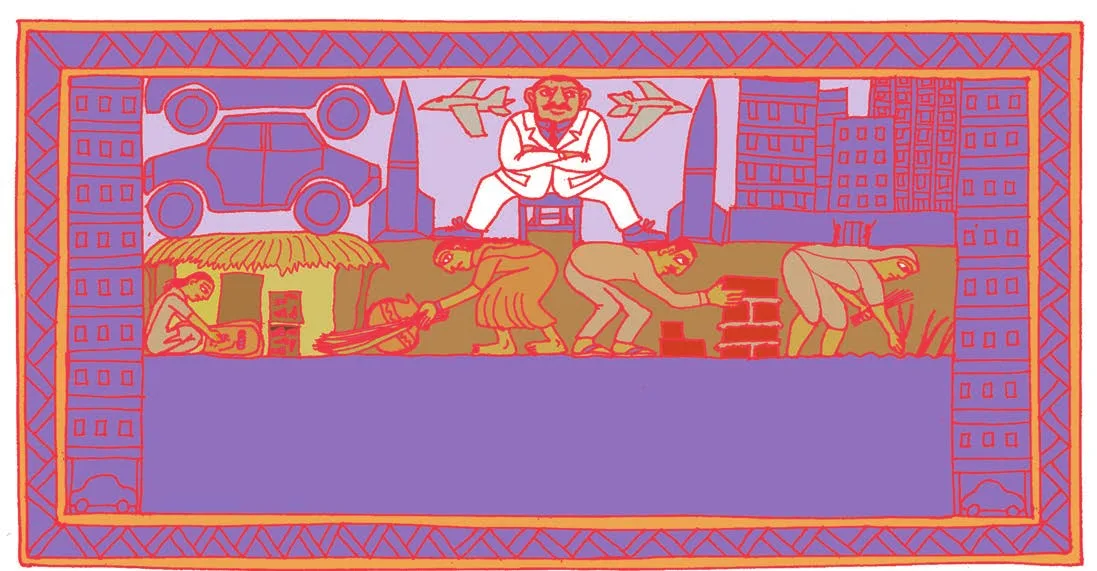
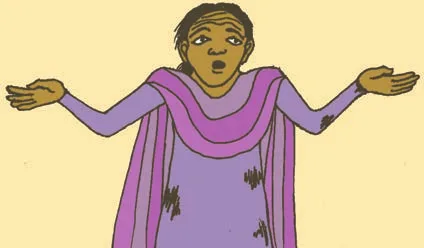
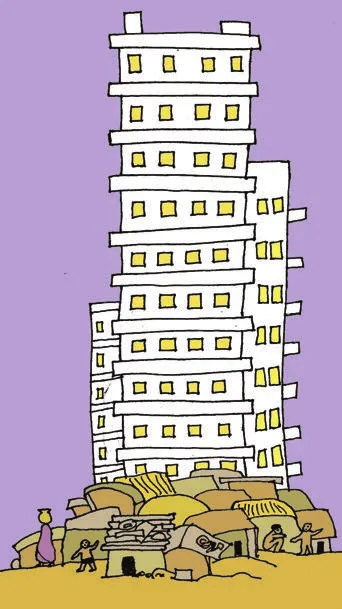
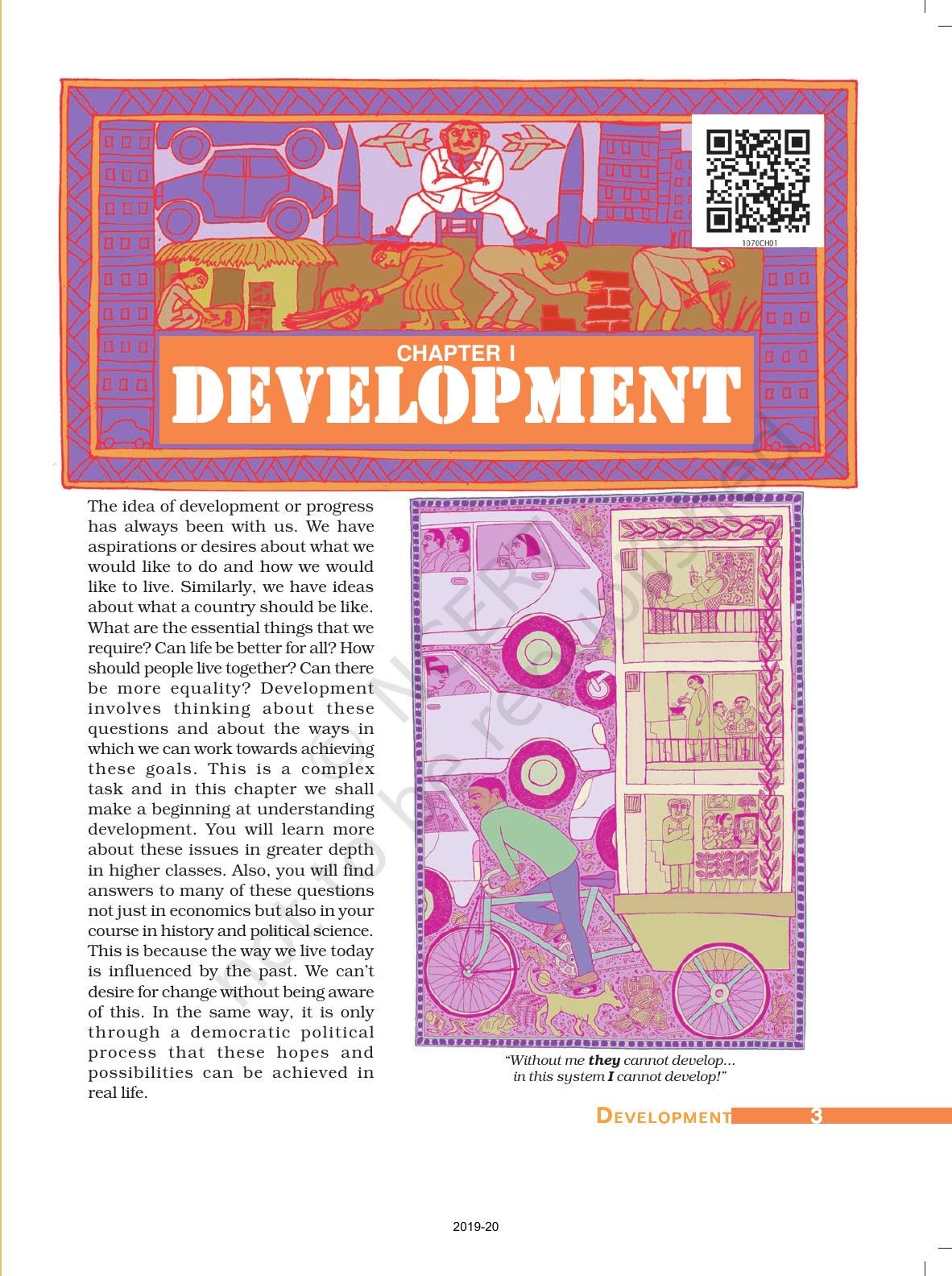
“Without me they cannot develop...
in this system I cannot develop!”
2019-20
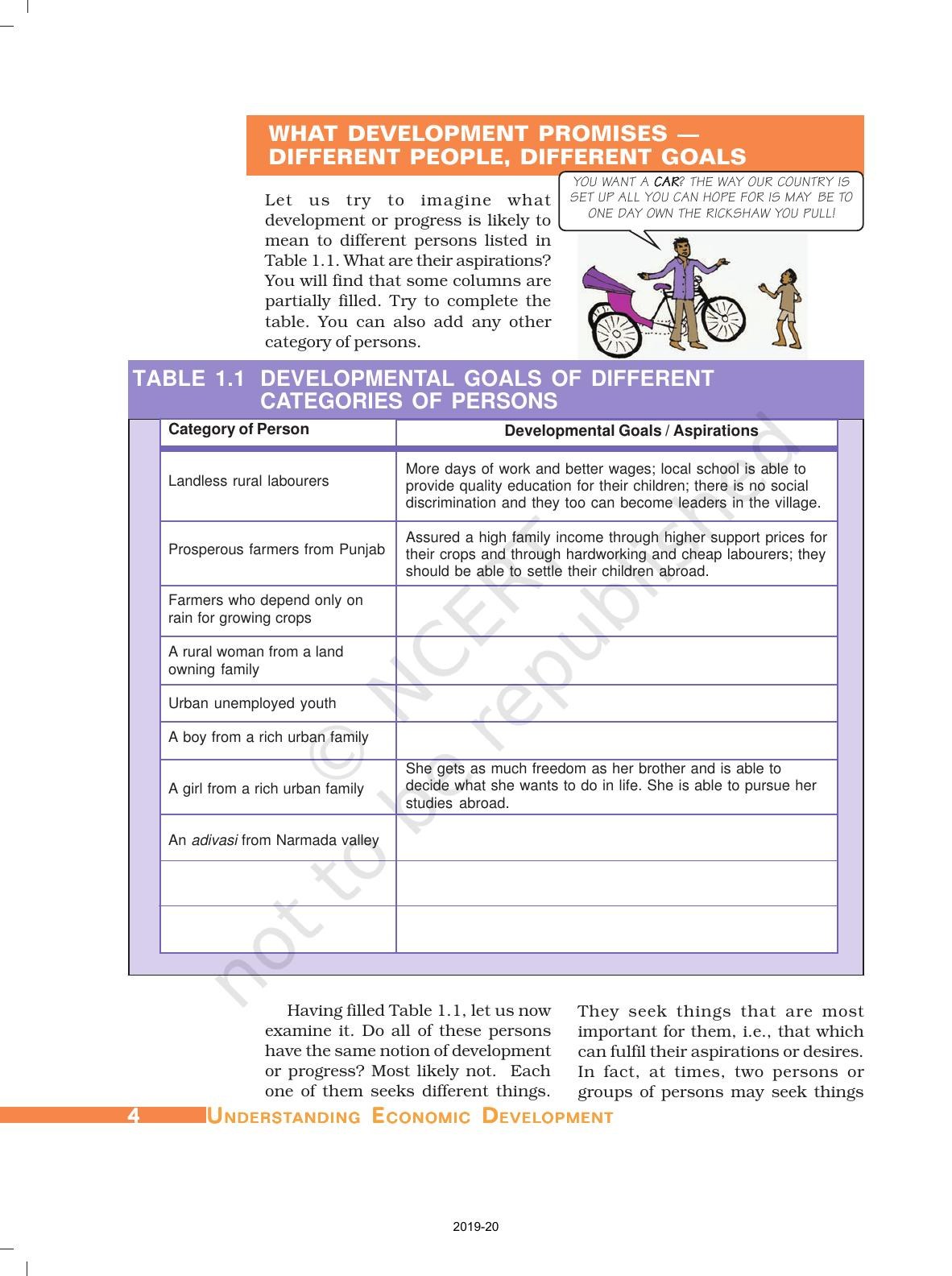
Let us try to imagine what
development or progress is likely to
mean to different persons listed in
Table 1.1. What are their aspirations?
You will find that some columns are
partially filled. Try to complete the
table. You can also add any other
category of persons.
Category of Person
Landless rural labourers
Prosperous farmers from Punjab
Farmers who depend only on
rain for growing crops
A rural woman from a land
owning family
Urban unemployed youth
A boy from a rich urban family
A girl from a rich urban family
An adivasi from Narmada valley
Having filled Table 1.1, let us now
examine it. Do all of these persons
have the same notion of development
or progress? Most likely not. Each
one of them seeks different things.
They seek things that are most
important for them, i.e., that which
can fulfil their aspirations or desires.
In fact, at times, two persons or
groups of persons may seek things
TABLE 1.1 DEVELOPMENTAL GOALS OF DIFFERENT
CATEGORIES OF PERSONS
Developmental Goals / Aspirations
More days of work and better wages; local school is able to
provide quality education for their children; there is no social
discrimination and they too can become leaders in the village.
Assured a high family income through higher support prices for
their crops and through hardworking and cheap labourers; they
should be able to settle their children abroad.
She gets as much freedom as her brother and is able to
decide what she wants to do in life. She is able to pursue her
studies abroad.
2019-20
Figures