Adding and subtracting fractions is a fundamental math skill essential for students. This worksheet provides clear explanations and practice problems for mastering these concepts. It includes step-by-step solutions for each problem, making it ideal for eighth-grade students preparing for exams. Topics covered include common denominators, mixed numbers, and simplification techniques. Perfect for classroom use or self-study, this resource helps reinforce fraction operations.

Key Points

  • Explains how to find common denominators for adding and subtracting fractions.
  • Includes practice problems for both proper and improper fractions.
  • Covers mixed numbers and how to convert them for operations.
  • Provides detailed answer keys with step-by-step solutions.
Blessing Ruvimbo
2 pages
Language:English
Type:Worksheet
Blessing Ruvimbo
2 pages
Language:English
Type:Worksheet
318
/ 2
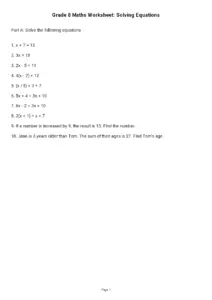
Grade 8 Maths Worksheet: Solving Equations
Part A: Add or Subtract the Following Fractions
1. 1/4 + 2/4
2. 5/6 - 1/6
3. 2/3 + 1/6
4. 3/8 + 1/4
5. 7/10 - 2/5
6. 1 1/2 + 2 2/3
7. 4 1/4 - 2 2/5
8. 3/5 + 7/10
9. 2/3 - 5/6
10. 1 3/4 + 2 1/8
Page 1
Grade 8 Maths Worksheet: Solving Equations
Detailed Answer Key with Explanations
1. Same denominators: 1 + 2 = 3, so answer is 3/4
2. Same denominators: 5 - 1 = 4, so answer is 4/6 = 2/3 (simplified)
3. LCM of 3 and 6 is 6, convert: 2/3 = 4/6, so 4/6 + 1/6 = 5/6
4. Convert 1/4 = 2/8, so 3/8 + 2/8 = 5/8
5. Convert 2/5 = 4/10, so 7/10 - 4/10 = 3/10
6. Convert to improper: 3/2 + 8/3, LCM = 6, so 9/6 + 16/6 = 25/6 = 4 1/6
7. Convert to improper: 17/4 - 12/5, LCM = 20, so 85/20 - 48/20 = 37/20 = 1 17/20
8. Convert 3/5 = 6/10, so 6/10 + 7/10 = 13/10 = 1 3/10
9. Convert 2/3 = 4/6, so 4/6 - 5/6 = -1/6
10. Convert to improper: 7/4 + 17/8, so 14/8 + 17/8 = 31/8 = 3 7/8
Page 2
/ 2
End of Document
318

FAQs

how to add and subtract fractions explained

Adding and subtracting fractions involves finding a common denominator.

  • Identify the least common multiple (LCM) of the denominators.
  • Convert each fraction to an equivalent fraction with the common denominator.
  • Add or subtract the numerators while keeping the common denominator.
  • Simplify the result if possible.

what are the steps in adding and subtracting fractions explained

The steps in adding and subtracting fractions are straightforward.

  1. Determine the LCM of the denominators.
  2. Rewrite each fraction with the common denominator.
  3. Add or subtract the numerators.
  4. Simplify the resulting fraction if necessary.

adding and subtracting fractions with different denominators explained

When adding and subtracting fractions with different denominators, a common denominator is essential.

  • Find the LCM of the different denominators.
  • Convert each fraction to have this common denominator.
  • Add or subtract the numerators accordingly.
  • Simplify the final answer if needed.

how to simplify fractions after adding or subtracting explained

Simplifying fractions after adding or subtracting is crucial for clarity.

  • Identify the greatest common divisor (GCD) of the numerator and denominator.
  • Divide both by the GCD to simplify the fraction.
  • Ensure the fraction is in its simplest form.

examples of adding and subtracting fractions explained

Examples help clarify the process of adding and subtracting fractions.

  • For example, to add 1/4 and 2/4, simply combine the numerators: 1 + 2 = 3, resulting in 3/4.
  • For subtraction, 5/6 - 1/6 equals 4/6, which simplifies to 2/3.

what is the importance of a common denominator in adding and subtracting fractions explained

A common denominator is vital for accurately adding or subtracting fractions.

  • It ensures that the fractions represent the same size parts.
  • Without a common denominator, you cannot directly combine the numerators.
  • This step is essential for maintaining the integrity of the mathematical operation.

how to convert mixed numbers to improper fractions explained

Converting mixed numbers to improper fractions is a key step in fraction operations.

  • Multiply the whole number by the denominator.
  • Add the numerator to this product.
  • Place the result over the original denominator to form the improper fraction.

adding and subtracting fractions with whole numbers explained

Adding and subtracting fractions with whole numbers involves a few extra steps.

  • Convert the whole number to a fraction by using a denominator of 1.
  • Find a common denominator with the fraction.
  • Add or subtract as usual, then simplify if necessary.

how to solve word problems involving adding and subtracting fractions explained

Solving word problems with fractions requires careful reading and setup.

  • Identify the fractions involved in the problem.
  • Determine if you need to add or subtract based on the context.
  • Follow the steps for adding or subtracting fractions, then interpret the result in the context of the problem.