C programming
Storage Class in C
C storage classes define the scope (visibility) and lifetime
of variables and/or functions within a C Program.
Basic Concepts
Before diving into storage classes, let’s understand a few essential terms:
1. Scope
Defines where the variable is accessible.
It’s a block or region where the variable is declared
Types:
o Local Scope: Inside a block or function.
o Global Scope: Available throughout the file or program.
2. Storage
Refers to where in memory the variable is stored:
o Stack: Temporary memory for local variables.
o Heap: Dynamically allocated memory.
o Data Segment (Static/Global Area): Memory for static and global variables.
o CPU Register: Very fast, small storage.
3. Lifetime
Determines how long the variable exists in memory.
o Temporary: Removed after function/block execution.
o Persistent: Exists for the program’s entire execution.
Storage Classes in C
C has four main storage classes: auto, extern, static, and register.
They control a variable’s scope, lifetime, storage location, and default initialization.
✅
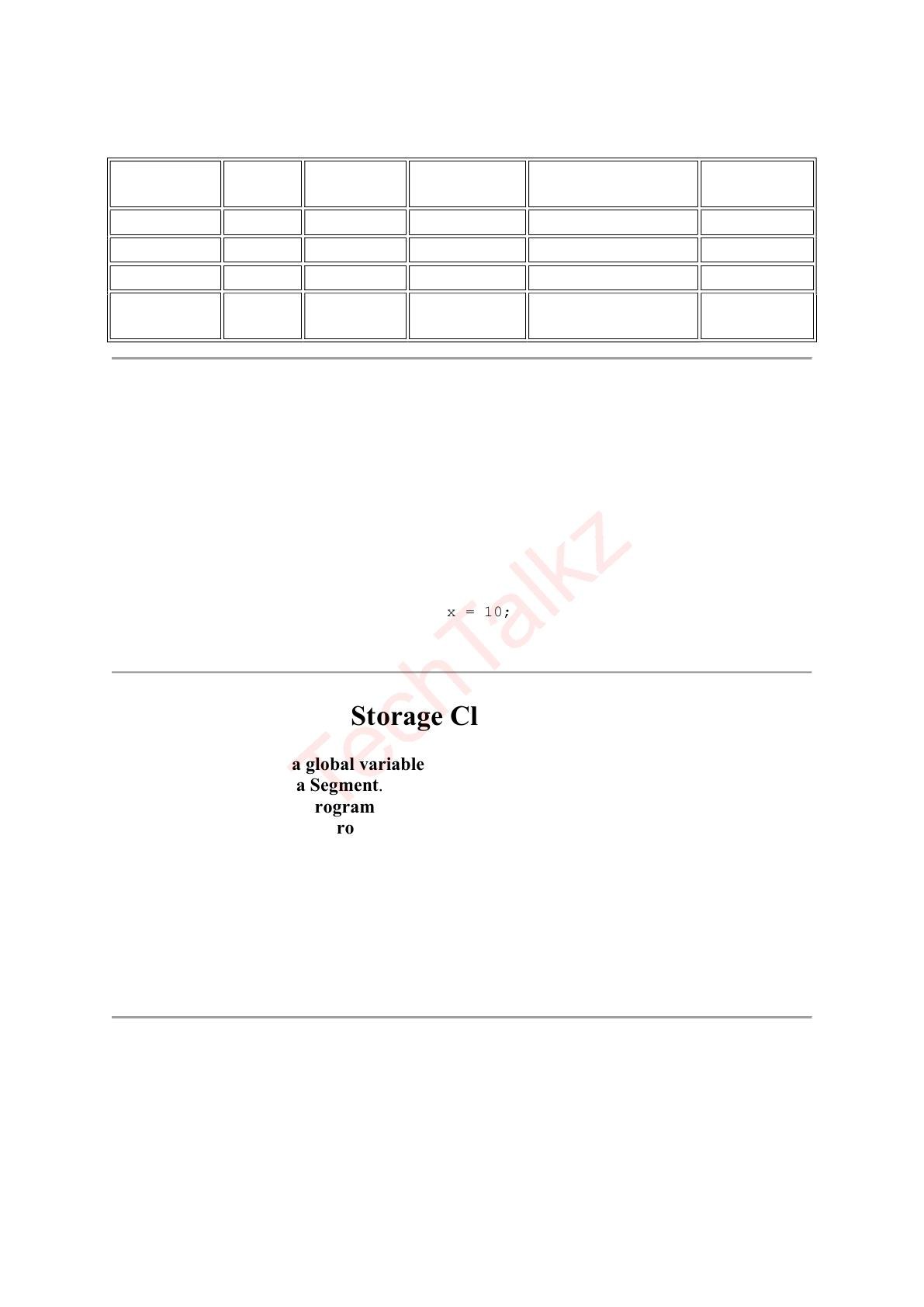
Summary Table
Storage
Class
Keyword
Scope Lifetime Memory Location
Default
Value
Automatic
auto
Local Function/block
Stack
Garbage value
External
extern
Global Entire program
Data Segment
Zero (0)
Static
static
Local/Global
Entire program
Data Segment
Zero (0)
Register
register
Local Function/block
CPU Register /
Stack
Garbage value
1. auto (Automatic Storage Class)
Default storage class for local variables.
Exists only during function execution.
Stored in the Stack.
Not accessible outside the block.
Initialized with a garbage value.
void display()
{
auto int x = 10; // same as int x = 10;
printf("%d", x);
}
2. extern (External Storage Class)
Used to declare a global variable defined elsewhere.
Stored in the Data Segment.
Lifetime is entire program execution.
Useful for multi-file programs.
extern int count; // Declaration only
int main()
{
printf("%d", count); // Uses count defined elsewhere
}
// Defined in another file
int count = 5; // Allocated in Data Segment
3. static (Static Storage Class)
Retains value between function calls.
Stored in the Data Segment (even if defined locally).
Lifetime is entire program.
Initialized only once, default = 0 if not explicitly assigned.
#include <stdio.h>
void demo()
{
static int count = 0; // static variable
count++;
printf("Count is %d\n", count);
}
int main()
{
demo(); // Call 1
demo(); // Call 2
demo(); // Call 3
return 0;
}
Each call to demo() will remember the previous value of n.
4. register (Register Storage Class)
Suggests storing the variable in a CPU Register for fast access.
If registers are unavailable, compiler may use Stack.
Cannot access the address using &.
Useful for loop counters, frequently accessed variables.
void fastLoop()
{
register int i;
for (i = 0; i < 10; i++) {
printf("%d ", i);
}
}
Key Differences in Memory