PHY 102: Electricity, Magnetism and Modern Physics @ Physics Dept, Federal University Dutse
Page 1 of 74
PHY 102: ELECTRICITY, MAGNETISM & MODERN PHYSICS
CHAPTER ONE
ELECTROSTATIC AND CAPACITORS
1.0 Introduction
Electricity can either be static or current. Static electricity (Electrostatics) is the study of an
electric charge at rest and the force that exist between them
1.1 Electric charge is the physical property of matter that causes it to experience a force when
placed in an electromagnetic field. It is a familiar experience that, when very dry hair is
combed with an ebonite or plastic comb, some cracking sound is experienced. The same is true
when putting on or off dry cloth made of nylon material, at times it even accompanied with
electric shocks. Also, when a pen is rubbed in the hair, it is found to attract bits of light
materials. This phenomenon is called electrification and the material are said to be electrified.
There are two types of electric charge, positive and negative charge. The net charge of a closed
system never changes
When two objects are rub together there will be a transfer of electron between one object to
another.
An object that loose an electron is said to be positively charge object, while object that gain
electron is said to be negatively charge object. E.g Rubbing glass rod with silk, glass rod
losses electron and becomes positively charge while silk gain electron and becomes negatively
charge, similar process happen when ebonite rod is rub with fur. Fur becomes positively charge
by losing electron while ebonite becomes negatively charge by gaining the electron.
For the subatomic particles proton has a positive charge, and an electron has a negative charge.
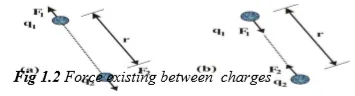
1.1.1 Fundamental law of electrostatics:
like charges repel each other, unlike charges
attract

PHY 102: Electricity, Magnetism and Modern Physics @ Physics Dept, Federal University Dutse
Page 2 of 74
Thus the electric force between
is, if both are positively charged or negatively charged while attractive if the sign of the charges
differ
1.1.2 Conductors and Insulators
Conductors are materials that allow charge to move through them freely; examples all metals
(eg copper, Aluminum), human body, tap water etc.
Insulators (nonconductors) are materials that cannot allow charge to move through them
freely; examples include rubber, plastic, glass, e.t.c
Semiconductors are certain material whose conductivity lies between conductors and
insulators e.g. Silicon, Germanium.
1.1.3 Charging a neutral body
A neutral body is the one with equal number of positive and negative charge, so its net charge
is zero. This body can be charge either by contact or by induction.
1.1.3.1 Charge by contact
Charging a neutral body by contact method can be done by bringing a charge object in contact
with the insulated or neutral object, so the same type of charge is transferred to the insulator.
1.1.3.2 Charge by induction
Unlike charging by contact (friction) to charge the body by induction the two bodies is not
necessary to be in contact. Thus only conducting substances can be charged by induction. Here,
an electrically neutral body is imparting a charge by bringing a charged body near it.
Experiment shows that the sign of the imparted charge is opposite that of the imparting charge.
Thus a negatively charged ebonite rod will impart a positive charge on a previously uncharged
metallic conductor.
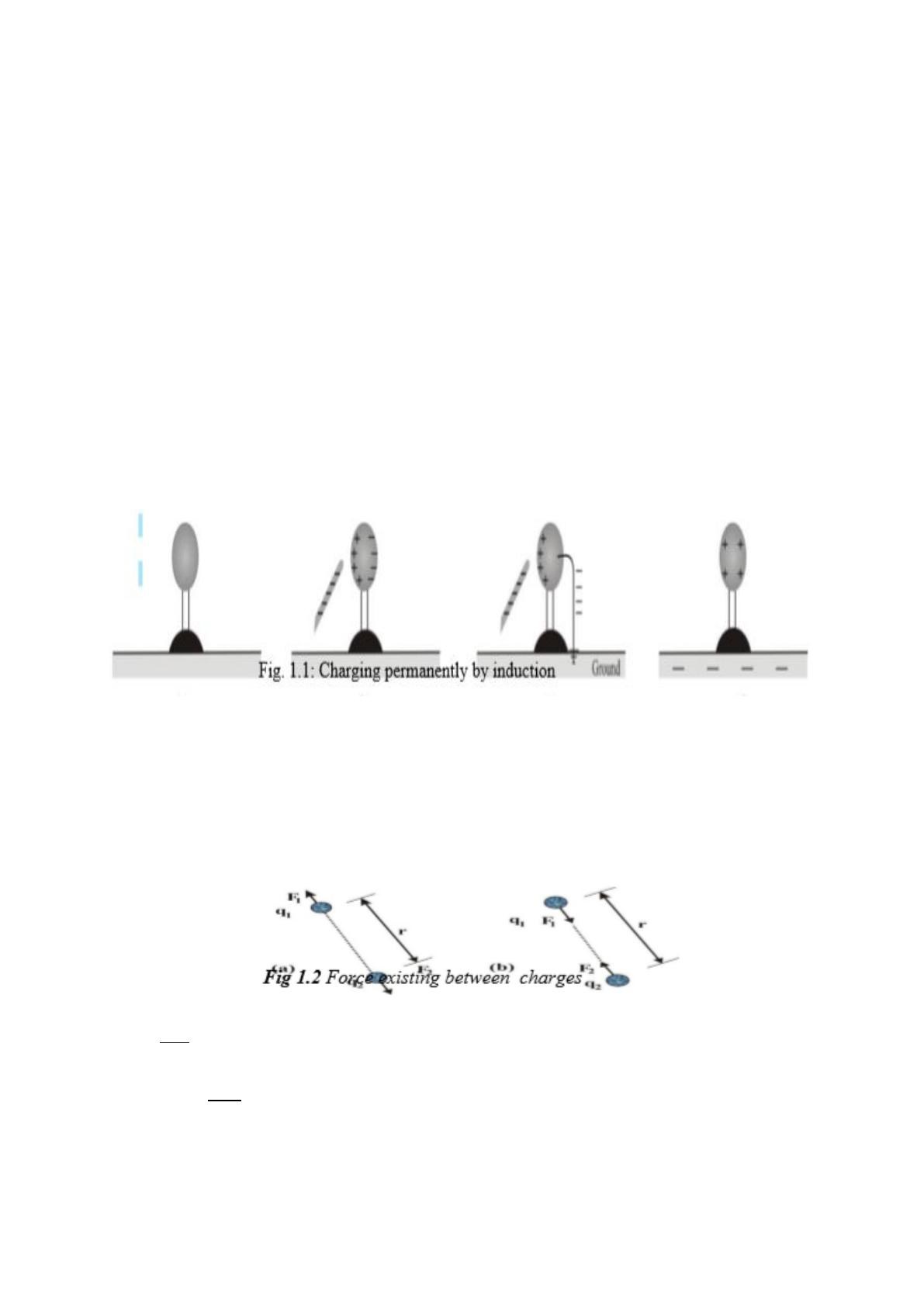
A conductor can be given a permanent charge by the process of induction as follows:
Consider a charged glass rod brought near a metallic conductor mounted on an
insulating stand (fig.1.1a). The positive charges on the glass rod will attract free
PHY 102: Electricity, Magnetism and Modern Physics @ Physics Dept, Federal University Dutse
Page 3 of 74
electrons in the metallic conductor to the side facing the glass rod, and hence, leaving
an equal positive charges on the opposite side.
Momentarily connect the far side of the conductor to the ground (fig. 1.1b). The
positive charge of an electron will be neutralized by influx of electrons from the ground
to which the conductor is connected.
Disconnect the earth and then remove the glass rod. The negative charges in the
conductor distribute themselves over the entire surface (fig. 1.1c).
Noted that if the glass rod is removed first before disconnecting the earth, electrons in the
conductor would flow to the ground so that no charges would be obtained in the conductor.
Example of the devices used for demonstration of charge by induction is the gold leave
electroscope
1.2 Coulomb’s Law
Coulomb’s Law states that “The force of attraction or repulsion between two charges
and
in a given medium is directly proportional to the product of the charges and
inversely proportional to the square of the distance separating the charges
1.1
Where
called a Coulomb constant,
is the permittivity of
free space equal to
.
Figures