about the author
J. R. R. Tolkien and Middle-earth
John Ronald Reuel Tolkien was born in 1892 in Bloemfontein, South Africa, where his
father was a bank manager. At the age of three, Ronald’s poor health led his mother to
move with him and his brother, Hilary, back to England, where they settled in Sarehole, a
county village on the outskirts of Birmingham. His father died soon after, and his mother
died when he was twelve. His early education was at King Edward’s School in Birmingham,
where he showed promise in languages and Old English literature. During his last years
at St. Edward’s, Tolkien fell in love with Edith Bratt, also an orphan, and formed close
friendships––and an informal literary society––with several of his schoolfellows.
In 1911, he entered Exeter College, Oxford, and received a First Class Honours degree in
English in 1915. Immediately after graduation he entered the army. In 1916, he married
Edith and was shipped to France as World War I raged. After four months on the front lines
he was stricken with trench fever and sent home.
Afterthewar,hejoinedthestaffoftheOxford English Dictionary (writing entries in the Ws),
taught at Leeds University, and was elected to a chair in Anglo-Saxon at Oxford.
“And after this, you might say, nothing else really happened. Tolkien came back to Oxford,
was Rawlinson and Bosworth Professor of Anglo-Saxon for twenty-years, was then elected
Merton Professor of English Language and Literature, went to live in a conventional Oxford
suburb where he spent the first part of his retirement, moved to a nondescript seaside resort,
came back to Oxford after his wife died, and himself died a peaceful death at the age of
eighty-one. . . . And that would be that––apart from the strange fact that during these years
when ‘nothing happened’ he wrote two books which have become world best-sellers, books
that have captured the imagination and influenced the thinking of several million readers.”
1
The creation of Middle-earth, which occupied Tolkien for sixty years, can be divided into
three stages. The first stage, begun at the St. Edward’s School, involved first the creation of
languages and then the development of a series of legends that could give these languages a
social context in which to develop. These legends soon became important in their own right,
a mythic cycle that combined Christian and pagan (especially Germanic and Celtic) sources
to provide England with a national mythology that would express the English spirit as the
Edda does for Scandinavia and the Kalevala does for Finland. As Tolkien put it:
“I had a mind to make a body of more or less connected legend, ranging from the large and
cosmogonic to the level of romantic fairy-story—the larger founded on the lesser in contact
with the earth, the lesser drawing splendor from the vast backcloths—which I could dedicate
simply: to England; to my country. . . . I would draw some of the great tales in fullness,
and leave many only placed in the scheme, and sketched. The cycles should be linked to a
majesticwhole,andyetleavescopeforothermindsandhands,wieldingpaintandmusic
and drama.”
2
The death in World War I of most of his St. Edward’s friends apparently firmed Tolkien’s
resolution, and after twenty years, he had elaborated several languages, a cosmology, and
large parts of The Silmarillion, high heroic tales (written in verse and prose, English and
Elvish) of the fall of the angelic Melkor and the futile struggles of men and elves against him.
As a diversion from these weighty labors, Tolkien composed stories and sketches for his own
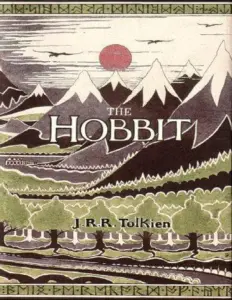
children. About 1930, one of these beginning with the idle sentence “In a hole in the ground
there lived a hobbit,” became more and more involved as Tolkien defined hobbits and
created adventure for one particular hobbit. Gradually it became clear to Tolkien that Bilbo
1 Humphrey Carpenter, Tolkien: A Biography. (New York: Ballantine Books, 1978), p.124.
2 Carpenter, pp.100–101.
2