Appendix.
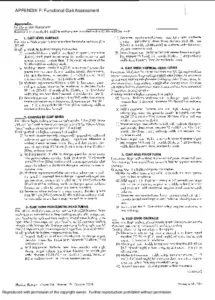
Functional Gait Assessment
a
Requirements: A marked 6-m (20-ft) walkway that is marked with a 30.48-cm (12-in) width.
______1. GAIT LEVEL SURFACE
Instructions: Walk at your normal speed from here to the next mark (6 m
[20 ft]).
Grading: Mark the highest category that applies.
(3) Normal—Walks 6 m (20 ft) in less than 5.5 seconds, no assistive
devices, good speed, no evidence for imbalance, normal gait
pattern, deviates no more than 15.24 cm (6 in) outside of the
30.48-cm (12-in) walkway width.
(2) Mild impairment—Walks 6 m (20 ft) in less than 7 seconds but
greater than 5.5 seconds, uses assistive device, slower speed,
mild gait deviations, or deviates 15.24 –25.4 cm (6–10 in)
outside of the 30.48-cm (12-in) walkway width.
(1) Moderate impairment—Walks 6 m (20 ft), slow speed, abnor-
mal gait pattern, evidence for imbalance, or deviates 25.4–
38.1 cm (10–15 in) outside of the 30.48-cm (12-in) walkway
width. Requires more than 7 seconds to ambulate 6 m (20 ft).
(0) Severe impairment—Cannot walk 6 m (20 ft) without assistance,
severe gait deviations or imbalance, deviates greater than 38.1
cm (15 in) outside of the 30.48-cm (12-in) walkway width or
reaches and touches the wall.
______2. CHANGE IN GAIT SPEED
Instructions: Begin walking at your normal pace (for 1.5 m [5 ft]). When
I tell you “go,” walk as fast as you can (for 1.5 m [5 ft]). When I tell you
“slow,” walk as slowly as you can (for 1.5 m [5 ft]).
Grading: Mark the highest category that applies.
(3) Normal—Able to smoothly change walking speed without loss of
balance or gait deviation. Shows a significant difference in
walking speeds between normal, fast, and slow speeds. Devi-
ates no more than 15.24 cm (6 in) outside of the 30.48-cm
(12-in) walkway width.
(2) Mild impairment—Is able to change speed but demonstrates
mild gait deviations, deviates 15.24–25.4 cm (6–10 in) outside
of the 30.48-cm (12-in) walkway width, or no gait deviations but
unable to achieve a significant change in velocity, or uses an
assistive device.
(1) Moderate impairment—Makes only minor adjustments to walk-
ing speed, or accomplishes a change in speed with significant
gait deviations, deviates 25.4 –38.1 cm (10–15 in) outside the
30.48-cm (12-in) walkway width, or changes speed but loses
balance but is able to recover and continue walking.
(0) Severe impairment—Cannot change speeds, deviates greater
than 38.1 cm (15 in) outside 30.48-cm (12-in) walkway width,
or loses balance and has to reach for wall or be caught.
_______3. GAIT WITH HORIZONTAL HEAD TURNS
Instructions: Walk from here to the next mark 6 m (20 ft) away. Begin
walking at your normal pace. Keep walking straight; after 3 steps, turn
your head to the right and keep walking straight while looking to the
right. After 3 more steps, turn your head to the left and keep walking
straight while looking left. Continue alternating looking right and left
every 3 steps until you have completed 2 repetitions in each direction.
Grading: Mark the highest category that applies.
(3) Normal—Performs head turns smoothly with no change in gait.
Deviates no more than 15.24 cm (6 in) outside 30.48-cm (12-in)
walkway width.
(2) Mild impairment—Performs head turns smoothly with slight
change in gait velocity (eg, minor disruption to smooth gait
path), deviates 15.24–25.4 cm (6–10 in) outside 30.48-cm
(12-in) walkway width, or uses an assistive device.
(1) Moderate impairment—Performs head turns with moderate
change in gait velocity, slows down, deviates 25.4–38.1 cm
(10–15 in) outside 30.48-cm (12-in) walkway width but recov-
ers, can continue to walk.
(0) Severe impairment—Performs task with severe disruption of gait
(eg, staggers 38.1 cm [15 in] outside 30.48-cm (12-in) walkway
width, loses balance, stops, or reaches for wall).
_______4. GAIT WITH VERTICAL HEAD TURNS
Instructions: Walk from here to the next mark (6 m [20 ft]). Begin walking
at your normal pace. Keep walking straight; after 3 steps, tip your head
up and keep walking straight while looking up. After 3 more steps, tip
your head down, keep walking straight while looking down. Continue
alternating looking up and down every 3 steps until you have completed
2 repetitions in each direction.
Grading: Mark the highest category that applies.
(3) Normal—Performs head turns with no change in gait. Deviates
no more than 15.24 cm (6 in) outside 30.48-cm (12-in) walkway
width.
(2) Mild impairment—Performs task with slight change in gait
velocity (eg, minor disruption to smooth gait path), deviates
15.24–25.4 cm (6–10 in) outside 30.48-cm (12-in) walkway
width or uses assistive device.
(1) Moderate impairment—Performs task with moderate change in
gait velocity, slows down, deviates 25.4–38.1 cm (10–15 in)
outside 30.48-cm (12-in) walkway width but recovers, can
continue to walk.
(0) Severe impairment—Performs task with severe disruption of gait
(eg, staggers 38.1 cm [15 in] outside 30.48-cm (12-in) walkway
width, loses balance, stops, reaches for wall).
_______5. GAIT AND PIVOT TURN
Instructions: Begin with walking at your normal pace. When I tell you,
“turn and stop,” turn as quickly as you can to face the opposite direction
and stop.
Grading: Mark the highest category that applies.
(3) Normal—Pivot turns safely within 3 seconds and stops quickly
with no loss of balance.
(2) Mild impairment—Pivot turns safely in ⬎3 seconds and stops
with no loss of balance, or pivot turns safely within 3 seconds
and stops with mild imbalance, requires small steps to catch
balance.
(1) Moderate impairment—Turns slowly, requires verbal cueing, or
requires several small steps to catch balance following turn and
stop.
(0) Severe impairment—Cannot turn safely, requires assistance to
turn and stop.
_______6. STEP OVER OBSTACLE
Instructions: Begin walking at your normal speed. When you come to the
shoe box, step over it, not around it, and keep walking.
Grading: Mark the highest category that applies.
(3) Normal—Is able to step over 2 stacked shoe boxes taped
together (22.86 cm [9 in] total height) without changing gait
speed; no evidence of imbalance.
(2) Mild impairment—Is able to step over one shoe box (11.43 cm
[4.5 in] total height) without changing gait speed; no evidence
of imbalance.
(1) Moderate impairment—Is able to step over one shoe box (11.43
cm [4.5 in] total height) but must slow down and adjust steps to
clear box safely. May require verbal cueing.
(0) Severe impairment—Cannot perform without assistance.
(Continued)
Physical Therapy . Volume 84 . Number 10 . October 2004 Wrisley et al . 917
ўўўўўўўўўўўўўўўўўўўўўў