of the “craft” between consumers and producers, thus leading to con-
fusion over what is and is not a CFP. As far as the Southeast Asian
region of Asia, which includes 11 countries, despite food label regula-
tion approaches having undergone partial harmonisation, there is no
formal definition of “craft” or “artisanal” (
Kasapila & Shaarani, 2011).
This review does not aim to provide a prescriptive definition of CFPs.
Rather, it tries to fill two important research gaps in the literature. First,
little attention has been paid to give a systematic overview of key
motives which underlie the consumer ’s perception of craftsmanship of
foods. Second, a model of the key determinants of CFPs purchasing and
consumption behavioural intention is not yet available. This in-
vestigation fills these gaps by adopting the Alphabet Theory from
Zepeda and Deal (2009) as framework to analyse the recurring elements
which emerged from the present review of the literature regarding
consumer perception of food product craftsmanship.
2. Theoretical framework
Many theories have been adopted throughout the years to try to
understand how human beliefs, values, attitudes and the resulting be-
haviours interact with one another to shape actions. The Value-Belief-
Norm (VBN) Theory (Stern, Dietz, Abel, Guagnano, & Kalof, 1999)isa
framework which was introduced to predict pro-environmental beha-
viour. Since then, it has been applied also to describe behaviours of
activism, non-activist public sphere behaviours, private sphere beha-
viours as well as behaviours within organizations. The VBN Theory is in
turn based on other three theories which were also used to predict
environmentally conscious behaviours: the Schwartz’ value Theory
(Schwartz, 1994), the New Ecological Paradigm (Dunlap & Van Liere,
1978
) and Norm-Activation Theory (Schwartz, 1977). According to the
Schwartz’ value Theory, actions are always supported by ten basic
personal values types (i.e. stimulation, self‐direction, universalism,
benevolence, achievement, power, security, conformity, hedonism and
tradition). The New Ecological Paradigm framework focuses instead on
measuring the degree to which an individual agrees with the concept
that we must limit our growth and be in balance with nature in order to
truly thrive as a species. Norm-Activation Theory postulates that moral
norms are put into action when individuals become aware of the pos-
sible adverse consequences of their actions and take responsibility for
trying to avoid them. Taking these three theories into consideration, the
VBN Theory asserts that values are key elements in shaping beliefs,
which affect norms, and eventually lead to certain behaviours. There-
fore, VBN Theory can be effectively adopted to explain how personal
attitudes are formulated.
The Attitudes-Behaviours-Context (ABC) Theory, was introduced by
Guagnano, Stern, and Dietz (1995) and is a model used to explain how
attitudes can result in behaviour (
Hiamey & Hiamey, 2018); it states
that, when context is neutral, attitudes are the prime determinants of
behaviour. Contextual factors (which comprise policies, regulations,
costs and other exogenous elements) can be either positive or negative;
when they are particularly strong and influential, they can shadow at-
titudes and shape behaviour.
In
Zepeda and Deal (2009) work, VBN Theory and ABC Theory were
combined and enriched with other elements (namely the demographics
(D), knowledge (K), information seeking (IS) and habit (H)) in order to
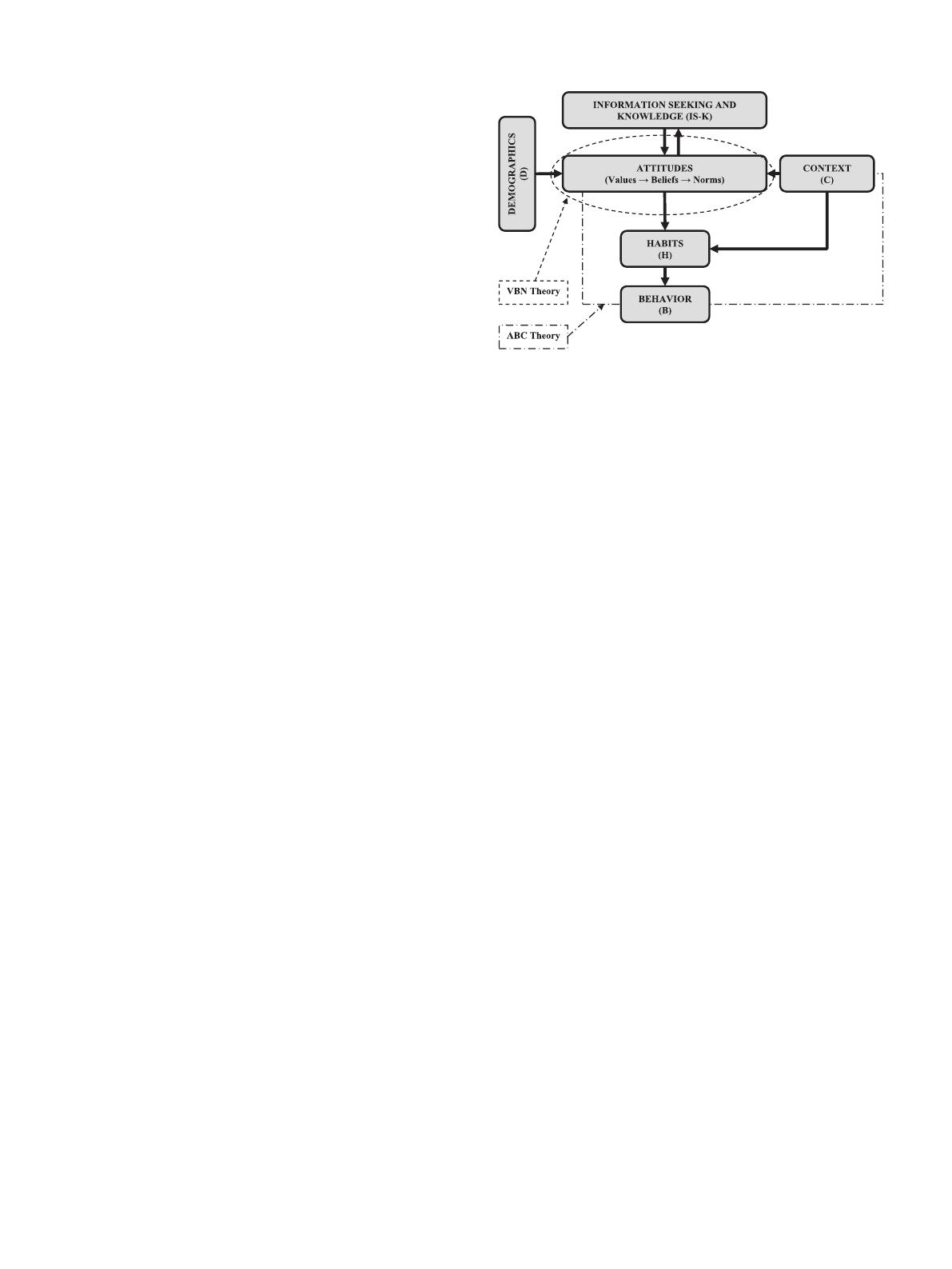
obtain VBN-ABC-D-K-IS-H theory, or Alphabet Theory (
Fig. 1). Thus,
based on current consumer theories on environmental behaviour, the
Alphabet Theory was successfully applied both in explaining consumer
behaviour and in a literature review regarding consumers’ perceptions
and preferences (
Feldmann & Hamm, 2015).
In this investigation, we adopted the Alphabet Theory to systematise
the motives which emerged from the literature review regarding con-
sumer’s perception of food product craftsmanship, as well as of the key
factors affecting consumer behaviour towards CFPs. Based on the fra-
mework of the Alphabet Theory, demographic characteristics affect
consumer’s attitudes towards CFPs (i.e. values, belief and norms) that,
in turn, are continually updated by information seeking, knowledge,
and contextual factors (i.e. external conditions such as price, adver-
tising). What is more, the context and attitudes impact consumer habits
(namely a personal routine related to a specific situation) that finally
affect consumer’ s behaviour.
3. Methods
The review of the literature was carried out following the steps set
out by
Arksey and O ’Malley (2005). First, the research questions were
established. Second, relevant studies were identified. Third, after a
screening procedure, pertinent articles were selected and included in
the study. The process was then completed by charting the data, col-
lating, and summarizing it. Finally, the findings of the review of lit-
erature were reported.
3.1. Research questions
Two research questions were investigated:
•
What are the distinguishing attributes of CFPs for consumers?
•
How are these attributes implemented in consumers’ purchasing and
consumption behaviour?
3.2. Selection of bibliographic sources
For refereed literature, Elsevier Scopus®, Web of Science™,
PsycINFO®, PsycARTICLES®, ScienceDirect and EconPapers™ were the
sources of database. The search strategy was defined a priori to assure
transparency and replicability (
Webster & Watson, 2002).
3.3. Keywords and search strategy
The search strategy included the adoption of a combination of
keywords. The string “ (artisanal OR *craft* OR hand-made OR hand-
made OR handcrafted) AND (food OR beverage)” was used to focus the
research on CFPs. In addition to this, the string “(attitudes OR beha-
viour OR motives OR preferences OR perception OR attributes OR
culture) AND (consumer OR consumption OR purchasing)” was run in
combination to the above string search to find key aspects for con-
sumers during their decision making process to purchase and consume
CFPs. The Elsevier Scopus®, PsycINFO®, and PsycARTICLES®,
ScienceDirect and EconPapers databases were searched in the fi eld
abstract, title and keywords. Instead, the Web of Science™ database was
searched in the field topic.
Fig. 1. Alphabet Theory adapted from Zepeda and Deal (2009).
S. Rivaroli, et al.
Food Quality and Preference 79 (2020) 103796
2