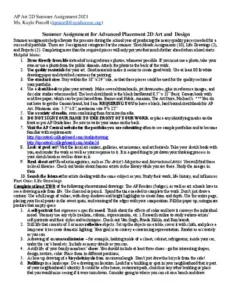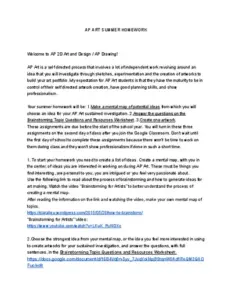
AP 2D Art & Design and AP Drawing Summer Assignments
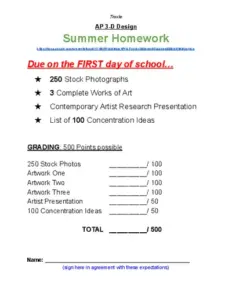
All of these assignments are due on the first day of classes for all students (Wednesday, August
13). Failure to complete these assignments to the best of your ability may result in you being placed
in 2D Studio Art 3 Honors instead of AP.
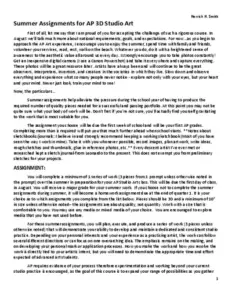
• At Least 1 Visual Journal Spread: Two pages next to each other is considered one visual
journal spread. Collage, draw, paint, layer, and have fun. Base it on your summer life or find
inspiration in magazines, photographs, or your physical surroundings. This is a direct reflection
of you, have fun with it. A minimum of 1 spread is due, but I encourage doing more.
• 5 Pieces from the Selected Works section (5 pieces are required).
This section of the AP Art and Design Portfolio Exams offers students the opportunity to make
and present works of art and design with minimal constraints. Each work is expected to
demonstrate skillful synthesis of materials, processes, and ideas. Suggested sizes: 8x10
inches, 11x14 inches, 12x18 inches.
There is no preferred (or unacceptable) material, process, idea, style, or content as long as the
work is the student’s original creation. As a reminder, the use of Artificial Intelligence tools is
prohibited at any stage of the creative process and while students can build upon pre-existing
artist-created works, students must be the principal artist or designer of the work they submit.
Students should carefully select works that best demonstrate their skillful synthesis of materials,
processes, and ideas. The submission can be a group of related works, unrelated works, or a
combination of related and unrelated works.
Email:
jmendez@cmhs-sarasota.org Feel free to send me in-process pictures of your work. I
will check email once a day and give you feedback, if you want.
TIPS:
• Don’t forget your Elements of Art and Principles of Design. These are the bases of successful
works of art. Try choosing one from each to use as your focus for each project.
o Elements of art: color, shape, space, texture, line, form, value, contrast
o Principles of design: Rhythm, movement, balance, emphasis, proportion, repetition,
pattern, unity, and variety.
• Don’t forget your rules of composition: Rule of thirds (keep the focal point off of the center), odd
numbers (odd numbers and asymmetry are more pleasing to the eye), simplification (letting
objects fill the page and go off the edge of the page), and use of line (lines help move the
viewer’s eye around the page).