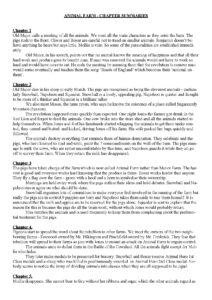
This document is Animal Farm, a political allegory written by George Orwell in 1945, which tells the story of a group of farm animals on Manor Farm who, inspired by the visionary speech of an old pig named Major, rebel against their neglectful human owner Mr. Jones and establish a self-governing farm based on the principles of equality and collective ownership called “Animalism”; however, over time the pigs — led by the cunning Napoleon and the eloquent Snowball — gradually seize control, manipulate the other animals through propaganda and fear, rewrite history, alter the original Seven Commandments to justify their growing privileges, eliminate rivals, and ultimately transform into the very tyranny they once overthrew, culminating in the chilling final scene where the other animals can no longer distinguish the pigs from the humans — a powerful satirical critique of totalitarianism, the corruption of power, and the betrayal of revolutionary ideals.

1
George Orwell: Animal Farm
2
Chapter 1
------------------------------------------------------------------------------
I
MR. JONES, of the Manor Farm, had locked the hen-houses for the
night, but was too drunk to remember to shut the popholes. With the
ring of light from his lantern dancing from side to side, he lurched
across the yard, kicked off his boots at the back door, drew himself a
last glass of beer from the barrel in the scullery, and made his way up
to bed, where Mrs. Jones was already snoring.
As soon as the light in the bedroom went out there was a stirring and
a fluttering all through the farm buildings. Word had gone round
during the day that old Major, the prize Middle White boar, had had
a strange dream on the previous night and wished to communicate it
to the other animals. It had been agreed that they should all meet in
the big barn as soon as Mr. Jones was safely out of the way. Old
Major (so he was always called, though the name under which he
had been exhibited was Willingdon Beauty) was so highly regarded
on the farm that everyone was quite ready to lose an hour's sleep in
order to hear what he had to say.
At one end of the big barn, on a sort of raised platform, Major was
already ensconced on his bed of straw, under a lantern which hung
from a beam. He was twelve years old and had lately grown rather
stout, but he was still a majestic-looking pig, with a wise and be-
nevolent appearance in spite of the fact that his tushes had never
been cut. Before long the other animals began to arrive and make
themselves comfortable after their different fashions. First came the
three dogs, Bluebell, Jessie, and Pincher, and then the pigs, who set-
tled down in the straw immediately in front of the platform. The hens
perched themselves on the window-sills, the pigeons fluttered up to
the rafters, the sheep and cows lay down behind the pigs and began
to chew the cud. The two cart-horses, Boxer and Clover, came in to-
gether, walking very slowly and setting down their vast hairy hoofs
with great care lest there should be some small animal concealed in

3
the straw. Clover was a stout motherly mare approaching middle life,
who had never quite got her figure back after her fourth foal. Boxer
was an enormous beast, nearly eighteen hands high, and as strong as
any two ordinary horses put together. A white stripe down his nose
gave him a somewhat stupid appearance, and in fact he was not of
first-rate intelligence, but he was universally respected for his steadi-
ness of character and tremendous powers of work. After the horses
came Muriel, the white goat, and Benjamin, the donkey. Benjamin
was the oldest animal on the farm, and the worst tempered. He sel-
dom talked, and when he did, it was usually to make some cynical
remark-for instance, he would say that God had given him a tail to
keep the flies off, but that he would sooner have had no tail and no
flies. Alone among the animals on the farm he never laughed. If
asked why, he would say that he saw nothing to laugh at. Neverthe-
less, without openly admitting it, he was devoted to Boxer; the two
of them usually spent their Sundays together in the small paddock
beyond the orchard, grazing side by side and never speaking.
The two horses had just lain down when a brood of ducklings, which
had lost their mother, filed into the barn, cheeping feebly and wan-
dering from side to side to find some place where they would not be
trodden on. Clover made a sort of wall round them with her great
foreleg, and the ducklings nestled down inside it and promptly fell
asleep. At the last moment Mollie, the foolish, pretty white mare who
drew Mr. Jones's trap, came mincing daintily in, chewing at a lump
of sugar. She took a place near the front and began flirting her white
mane, hoping to draw attention to the red ribbons it was plaited with.
Last of all came the cat, who looked round, as usual, for the warmest
place, and finally squeezed herself in between Boxer and Clover;
there she purred contentedly throughout Major's speech without lis-
tening to a word of what he was saying.
All the animals were now present except Moses, the tame raven, who
slept on a perch behind the back door. When Major saw that they had
all made themselves comfortable and were waiting attentively, he
cleared his throat and began:
4
"Comrades, you have heard already about the strange dream that I
had last night. But I will come to the dream later. I have something
else to say first. I do not think, comrades, that I shall be with you for
many months longer, and before I die, I feel it my duty to pass on to
you such wisdom as I have acquired. I have had a long life, I have
had much time for thought as I lay alone in my stall, and I think I
may say that I understand the nature of life on this earth as well as
any animal now living. It is about this that I wish to speak to you.
"Now, comrades, what is the nature of this life of ours? Let us face
it: our lives are miserable, laborious, and short. We are born, we are
given just so much food as will keep the breath in our bodies, and
those of us who are capable of it are forced to work to the last atom
of our strength; and the very instant that our usefulness has come to
an end we are slaughtered with hideous cruelty. No animal in Eng-
land knows the meaning of happiness or leisure after he is a year old.
No animal in England is free. The life of an animal is misery and
slavery: that is the plain truth.
"But is this simply part of the order of nature? Is it because this land
of ours is so poor that it cannot afford a decent life to those who
dwell upon it? No, comrades, a thousand times no! The soil of Eng-
land is fertile, its climate is good, it is capable of affording food in
abundance to an enormously greater number of animals than now in-
habit it. This single farm of ours would support a dozen horses,
twenty cows, hundreds of sheep-and all of them living in a comfort
and a dignity that are now almost beyond our imagining. Why then
do we continue in this miserable condition? Because nearly the
whole of the produce of our labour is stolen from us by human be-
ings. There, comrades, is the answer to all our problems. It is
summed up in a single word-Man. Man is the only real enemy we
have. Remove Man from the scene, and the root cause of hunger and
overwork is abolished for ever.
"Man is the only creature that consumes without producing. He does
not give milk, he does not lay eggs, he is too weak to pull the plough,
he cannot run fast enough to catch rabbits. Yet he is lord of all the
animals. He sets them to work, he gives back to them the bare mini-

5
mum that will prevent them from starving, and the rest he keeps for
himself. Our labour tills the soil, our dung fertilises it, and yet there
is not one of us that owns more than his bare skin. You cows that I
see before me, how many thousands of gallons of milk have you
given during this last year? And what has happened to that milk
which should have been breeding up sturdy calves? Every drop of it
has gone down the throats of our enemies. And you hens, how many
eggs have you laid in this last year, and how many of those eggs ever
hatched into chickens? The rest have all gone to market to bring in
money for Jones and his men. And you, Clover, where are those four
foals you bore, who should have been the support and pleasure of
your old age? Each was sold at a year old-you will never see one of
them again. In return for your four confinements and all your labour
in the fields, what have you ever had except your bare rations and a
stall?
"And even the miserable lives we lead are not allowed to reach their
natural span. For myself I do not grumble, for I am one of the lucky
ones. I am twelve years old and have had over four hundred children.
Such is the natural life of a pig. But no animal escapes the cruel knife
in the end. You young porkers who are sitting in front of me, every
one of you will scream your lives out at the block within a year. To
that horror we all must come-cows, pigs, hens, sheep, everyone.
Even the horses and the dogs have no better fate. You, Boxer, the
very day that those great muscles of yours lose their power, Jones
will sell you to the knacker, who will cut your throat and boil you
down for the foxhounds. As for the dogs, when they grow old and
toothless, Jones ties a brick round their necks and drowns them in the
nearest pond.
"Is it not crystal clear, then, comrades, that all the evils of this life of
ours spring from the tyranny of human beings? Only get rid of Man,
and the produce of our labour would be our own. A1most overnight
we could become rich and free. What then must we do? Why, work
night and day, body and soul, for the overthrow of the human race!
That is my message to you, comrades: Rebellion! I do not know
when that Rebellion will come, it might be in a week or in a hundred
years, but I know, as surely as I see this straw beneath my feet, that
6
sooner or later justice will be done. Fix your eyes on that, comrades,
throughout the short remainder of your lives! And above all, pass on
this message of mine to those who come after you, so that future
generations shall carry on the struggle until it is victorious.
"And remember, comrades, your resolution must never falter. No ar-
gument must lead you astray. Never listen when they tell you that
Man and the animals have a common interest, that the prosperity of
the one is the prosperity of the others. It is all lies. Man serves the
interests of no creature except himself. And among us animals let
there be perfect unity, perfect comradeship in the struggle. All men
are enemies. All animals are comrades."
At this moment there was a tremendous uproar. While Major was
speaking four large rats had crept out of their holes and were sitting
on their hindquarters, listening to him. The dogs had suddenly caught
sight of them, and it was only by a swift dash for their holes that the
rats saved their lives. Major raised his trotter for silence.
"Comrades," he said, "here is a point that must be settled. The wild
creatures, such as rats and rabbits-are they our friends or our ene-
mies? Let us put it to the vote. I propose this question to the meeting:
Are rats comrades?"
The vote was taken at once, and it was agreed by an overwhelming
majority that rats were comrades. There were only four dissentients,
the three dogs and the cat, who was afterwards discovered to have
voted on both sides. Major continued:
"I have little more to say. I merely repeat, remember always your
duty of enmity towards Man and all his ways. Whatever goes upon
two legs is an enemy. Whatever goes upon four legs, or has wings, is
a friend. And remember also that in fighting against Man, we must
not come to resemble him. Even when you have conquered him, do
not adopt his vices. No animal must ever live in a house, or sleep in a
bed, or wear clothes, or drink alcohol, or smoke tobacco, or touch
money, or engage in trade. All the habits of Man are evil. And, above
all, no animal must ever tyrannise over his own kind. Weak or