AP Calculus AB Unit 2 Progress Check MCQ Part A provides answers to multiple-choice questions designed for students preparing for the AP Calculus exam. This resource includes detailed explanations and solutions for each question, helping learners understand key calculus concepts. Ideal for high school students studying for the AP exam, this guide covers derivatives, functions, and average rates of change. Use this answer key to enhance your understanding and improve your performance on the AP Calculus exam.

Key Points

  • Includes answers and explanations for AP Calculus AB Unit 2 MCQs.
  • Covers key topics such as derivatives and average rates of change.
  • Designed for students preparing for the AP Calculus exam.
  • Helps clarify complex calculus concepts through detailed solutions.
newtopiccyclegrowin
9 pages
Language:English
Type:Study Guide
newtopiccyclegrowin
9 pages
Language:English
Type:Study Guide
96
/ 9
AP Calculus AB Scoring Guide
Unit 2 Progress Check: MCQ Part A
Copyright © 2017. The College Board. These materials are part of a College Board program. Use or distribution of these materials online or
in print beyond your school’s participation in the program is prohibited.
Page 1 of 9
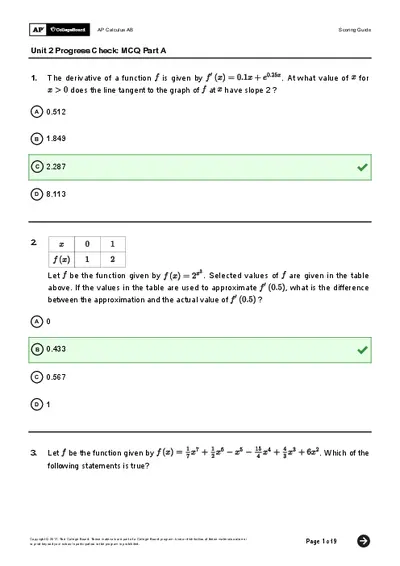
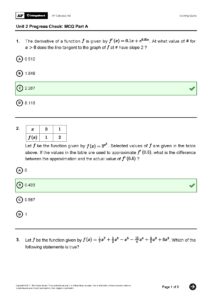
1. The derivative of a function is given by . At what value of for
does the line tangent to the graph of at have slope 2 ?
A
0.512
B
1.849
C
2.287
D
8.113
2.
Let be the function given by . Selected values of are given in the table
above. If the values in the table are used to approximate , what is the difference
between the approximation and the actual value of ?
A
0
B
0.433
C
0.567
D
1
3.
Let be the function given by . Which of the
following statements is true?
AP Calculus AB Scoring Guide
Unit 2 Progress Check: MCQ Part A
Copyright © 2017. The College Board. These materials are part of a College Board program. Use or distribution of these materials online or
in print beyond your school’s participation in the program is prohibited.
Page 2 of 9
A
B
C
D
4.
Selected values of a function are shown in the table above. What is the average rate of
change of over the interval ?
A
B
C
D
AP Calculus AB Scoring Guide
Unit 2 Progress Check: MCQ Part A
Copyright © 2017. The College Board. These materials are part of a College Board program. Use or distribution of these materials online or
in print beyond your school’s participation in the program is prohibited.
Page 3 of 9
5.
The graph of the function , shown above, consists of three line segments. What is the
average rate of change of over the interval ?
A
B
0
C
D
4
6. The function is given by . What is the average rate of change of
over the interval ?
/ 9
End of Document
96

FAQs

What is the average rate of change over a specific interval in the document?
The average rate of change of a function over an interval can be calculated using the selected values provided in the document. For example, in question 4, the average rate of change of the function over the interval is derived from the values at the endpoints of the interval, specifically from the function values at the given points. This calculation is essential for understanding how the function behaves over that interval.
How is the derivative of a function related to the slope of the tangent line?
The derivative of a function at a certain point gives the slope of the tangent line to the graph of the function at that point. In question 1, the document asks for the value of x where the tangent line has a specific slope of 2, highlighting the relationship between derivatives and tangent lines. This concept is crucial in calculus as it helps analyze the behavior of functions at specific points.
What conditions must be met for a function to be differentiable?
For a function to be differentiable at a point, it must be continuous at that point, and its derivative must exist. According to question 10, if a function is continuous and differentiable, it meets the necessary conditions for differentiability. The document emphasizes the importance of these conditions in determining the behavior of functions, particularly in calculus.
What does the document state about vertical and horizontal tangents?
The document mentions that vertical tangents indicate points where the function is not differentiable. For instance, in question 12, it is noted that a function has a vertical tangent at a specific point, which means the derivative does not exist there. Conversely, horizontal tangents can exist at points where the function is continuous but may not be differentiable, as highlighted in the same question.
Which statements about continuity and differentiability are true according to the document?
In question 11, the document presents several statements regarding the continuity and differentiability of a function. It concludes that a function can be continuous but not differentiable at certain points, such as where there are sharp corners. This distinction is important for understanding the behavior of functions in calculus and their graphical representations.
How is the instantaneous rate of change related to the average rate of change?
The document discusses the relationship between instantaneous and average rates of change in question 9. It states that the instantaneous rate of change at a point can equal the average rate of change over an interval at certain points on the graph. This concept is vital for understanding how functions behave locally compared to their overall behavior across an interval.
What is the significance of the derivative in the context of the document?
The derivative plays a crucial role in understanding the behavior of functions as it provides information about their slopes and rates of change. In various questions throughout the document, such as question 7, the derivative is used to find equations of tangent lines, illustrating its practical application in calculus. This significance extends to analyzing function behavior in both theoretical and applied contexts.