AP Chemistry Scoring Guide
Unit 9 Progress Check: MCQ
Copyright © 2020. The College Board. These materials are part of a College Board program. Use or distribution of these materials online or in print
beyond your school’s participation in the program is prohibited.
Page 2 of 21
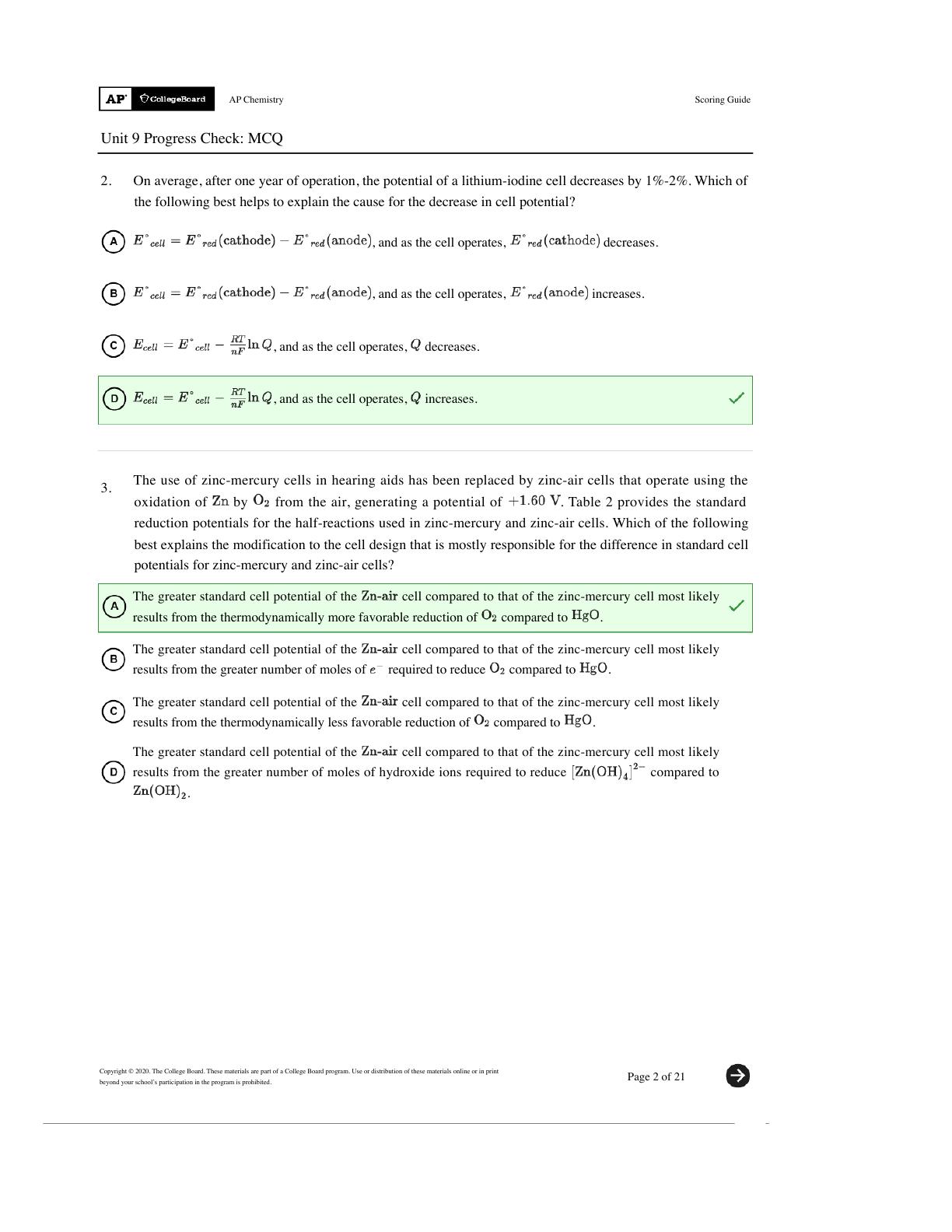
2. On average, after one year of operation, the potential of a lithium-iodine cell decreases by 1%-2%. Which of
the following best helps to explain the cause for the decrease in cell potential?
, and as the cell operates, decreases.
, and as the cell operates, increases.
, and as the cell operates, decreases.
, and as the cell operates, increases.
3.
The use of zinc-mercury cells in hearing aids has been replaced by zinc-air cells that operate using the
oxidation of by from the air, generating a potential of . Table 2 provides the standard
reduction potentials for the half-reactions used in zinc-mercury and zinc-air cells. Which of the following
best explains the modification to the cell design that is mostly responsible for the difference in standard cell
potentials for zinc-mercury and zinc-air cells?
The greater standard cell potential of the cell compared to that of the zinc-mercury cell most likely
results from the thermodynamically more favorable reduction of compared to .
The greater standard cell potential of the cell compared to that of the zinc-mercury cell most likely
results from the greater number of moles of required to reduce compared to .
The greater standard cell potential of the cell compared to that of the zinc-mercury cell most likely
results from the thermodynamically less favorable reduction of compared to .
The greater standard cell potential of the cell compared to that of the zinc-mercury cell most likely
results from the greater number of moles of hydroxide ions required to reduce compared to
Unit 9 AP Chem Progress Check: MCQ Prep for Taylor 2