The Kailash Manasarovar Yatra Information Guide 2019 provides essential details for pilgrims embarking on this spiritual journey. It covers important preparations, medical check-ups, and accommodations in Delhi, as well as the daily itinerary for the Yatra. Key logistical information includes routes, facilities on both the Indian and Chinese sides, and contact details for assistance. This guide is designed for Yatris seeking a comprehensive understanding of the journey, ensuring a smooth and enlightening experience.
Key Points
Details daily itinerary for the Kailash Manasarovar Yatra from Day 1 to Day 21.
Includes essential preparations, medical check-up procedures, and accommodation arrangements in Delhi.
Outlines facilities available on both the Indian and Chinese sides during the Yatra.
Provides important contact information for assistance and logistics during the pilgrimage.
This link leads to an external site. We do not know or endorse its content, and are not responsible for its safety. Click the link to proceed only if you trust this site.
KMSKA Museum Visit Information and Ticketing GuideGuide
PDFGuide
German Jugendsprache Reference GuideGuide
PDFGuide
Disney Gift Card eGift Instructions and Redemption GuideGuide
PDFGuide
Training Organisation Guide for TVET Certificate V in Electronics and Telecommunication – April 2024Guide
PDFGuide
Études en France: Guide pour les Étudiants InternationauxGuide
PDFGuide
PCOD PCOS Guide: Managing Symptoms and Lifestyle ChangesGuide
PDFGuide
Drafting Resource GuideGuide
PDFGuide
CIMUN 2025 Security Council Academic GuideGuide
PDFGuide
DNS Configuration and Management GuideGuide
PDFGuide
Ty V2: Comprehensive Guide to Hajj and UmrahGuide
PDFGuide
Getting Your Driver’s Licence in Ontario: Official MTO GuideGuide
PDFGuide
Claude Canva Setup GuideGuide
FAQs
What are the important documents required for the Kailash Manasarovar Yatra?
Selected applicants must bring several important documents for the Yatra. These include a valid Indian passport, a photocopy of the passport, six recent passport-sized photographs, an Indemnity Bond executed on non-judicial stamp paper, an undertaking for evacuation by helicopter in case of emergency, and a consent form for cremation of mortal remains on the Chinese side. Additionally, original documents for payment to the Kumaon Mandal Vikas Nigam Limited or Sikkim Tourism Development Corporation are required.
What is the fee structure for the Kailash Manasarovar Yatra?
The estimated expenditure per Yatri varies depending on the route taken. For the Lipulekh route, a confirmation amount of Rs. 5,000 is payable, followed by a balance amount of Rs. 30,000 to Kumaon Mandal Vikas Nigam Ltd. Other costs include return airfare, medical tests, and porter charges. For the Nathu La route, the fees are similar, with a confirmation amount of Rs. 5,000 and a balance amount of Rs. 20,000. Additional costs for food, transport, and other logistics are also outlined in the guide.
What preparations should Yatris make before the Yatra?
Yatris are advised to obtain necessary items listed in Annexure-A and useful medicines from Annexure-B. They should arrive in Delhi one day earlier than the scheduled medical tests and finalize their travel plans accordingly. Common transport will be provided for Yatris to specific places in Delhi for medical check-ups and visa collection. It is also recommended that Yatris be in good physical condition and acclimatize properly to high altitudes.
What medical tests are required before participating in the Yatra?
Yatris must undergo medical tests at the Delhi Heart and Lung Institute (DHLI) to assess their fitness for high altitude endurance. These tests include blood tests, ECG, and other evaluations. The acceptable reference ranges and cut-off values for these tests are specified in the guide. If a Yatri is declared unfit, they will not be permitted to participate in any other batch during that year.
What are the do's and don'ts for Yatris during the Yatra?
Yatris are encouraged to develop a good understanding among fellow pilgrims and treat the mountains with respect. They should maintain a steady pace, keep the environment clean, and avoid high conical rocks. It is essential to wear appropriate clothing in layers and ensure feet remain dry to prevent blisters. Conversely, Yatris should avoid separating from their group, neglecting injuries, or consuming alcohol during the Yatra, especially at high altitudes.
What facilities are available on the Indian side during the Yatra?
Accommodation on the Indian side is provided in 'pucca' barracks or prefabricated fiberglass huts, equipped with regular toilet facilities. Portable generators supply electricity for limited hours. Yatris are provided with mattresses and quilts, so they do not need to carry sleeping bags. Additionally, utensils for cooking are provided, and Yatris are advised to carry some food items from India.
How does the Yatra schedule vary between the Lipulekh and Nathu La routes?
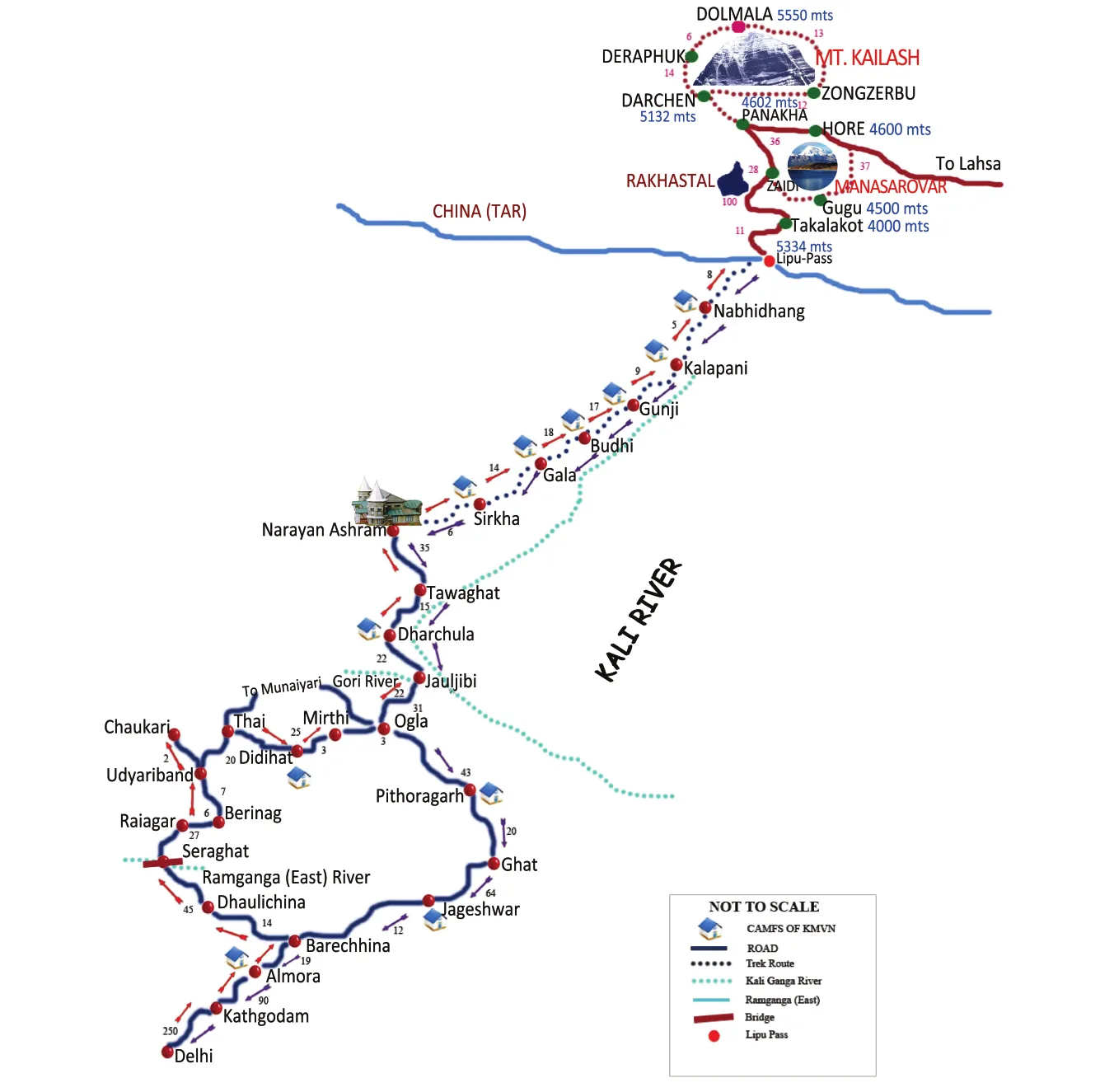
The Yatra schedule differs significantly between the two routes. For the Lipulekh route, the journey spans 21 days, starting from Delhi to Almora and culminating in the return journey. The Nathu La route has a slightly shorter duration, with a total of 18 days. Each route has specific daily itineraries, including travel distances, altitudes, and modes of transport, as detailed in the guide.