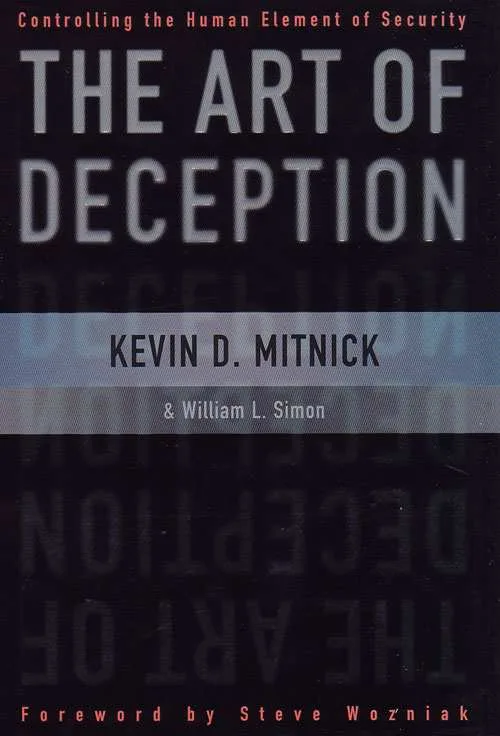
Classic cybersecurity book focused on social engineering, human psychology, information security, phishing, impersonation, corporate espionage, and defensive security practices through real-world inspired scenarios.

Scanned by kineticstomp
THE ART OF DECEPTION
Controlling the Human Element of Security
KEVIN D. MITNICK
& William L. Simon
Foreword by Steve Wozniak

For Reba Vartanian, Shelly Jaffe, Chickie Leventhal, and Mitchell
Mitnick, and for the late Alan Mitnick, Adam Mitnick,
and Jack Biello
For Arynne, Victoria, and David, Sheldon,Vincent, and Elena.
Social Engineering
Social Engineering uses influence and persuasion to deceive people
by convincing them that the social engineer is someone he is not,
or by manipulation. As a result, the social engineer is able to take
advantage of people to obtain information with or without the use of
technology.
Contents
Foreword
Preface
Introduction
Part 1 Behind the Scenes
Chapter 1 Security's Weakest Link
Part 2 The Art of the Attacker
Chapter 2 When Innocuous Information Isn't
Chapter 3 The Direct Attack: Just Asking for it
Chapter 4 Building Trust
Chapter 5 "Let Me Help You"
Chapter 6 "Can You Help Me?"
Chapter 7 Phony Sites and Dangerous Attachments
Chapter 8 Using Sympathy, Guilt and Intimidation
Chapter 9 The Reverse Sting
Part 3 Intruder Alert
Chapter 10 Entering the Premises
Chapter 11 Combining Technology and Social Engineering
Chapter 12 Attacks on the Entry-Level Employee
Chapter 13 Clever Cons
Chapter 14 Industrial Espionage

Part 4 Raising the Bar
Chapter 15 Information Security Awareness and Training
Chapter 16 Recommended Corporate Information Security Policies
Security at a Glance
Sources
Acknowledgments
Foreword
We humans are born with an inner drive to explore the nature
of our surroundings. As young men, both Kevin Mitnick and
I were intensely curious about the world and eager to prove
ourselves. We were rewarded often in our attempts to learn new things,
solve puzzles, and win at games. But at the same time, the world around
us taught us rules of behavior that constrained our inner urge toward free
exploration. For our boldest scientists and technological entrepreneurs, as
well as for people like Kevin Mitnick, following this inner urge offers the
greatest thrills, letting us accomplish things that others believe cannot be
done.
Kevin Mitnick is one of the finest people I know. Ask him, and he will
say forthrightly that what he used to do - social engineering - involes
conning people. But Kevin is no longer a social engineer. And even when
he was, his motive never was to enrich himself or damage others. That's
not to say that there aren't dangerous and destructive criminals out there
who use social engineering to cause real harm. In fact, that's exactly why
Kevin wrote this book - to warn you about them.
The Art of Deception shows how vulnerable we all are - government,
business, and each of us personally - to the intrusions of the social
engineer. In this security-conscious era, we spend huge sums on
technology
to protect our computer networks and data. This book points out how easy
it is to trick insiders and circumvent all this technological protection.
Whether you work in business or government, this book provides a
powerful road map to help you understand how social engineers work and
what you can do to foil them. Using fictionalized stories that are both
Figures