Grade 11 Vocabulary Review Questions for Units 6-10 focus on enhancing language skills through targeted exercises. This resource is designed for students preparing for vocabulary assessments, featuring fill-in-the-blank questions that challenge comprehension and application of vocabulary terms. Each question is crafted to reinforce learning and retention of key concepts. Ideal for classroom use or individual study, this review aids in mastering vocabulary essential for academic success.

Key Points

  • Includes vocabulary review questions specifically for Grade 11 students
  • Focuses on Units 6-10 to enhance language skills and comprehension
  • Features fill-in-the-blank exercises to reinforce vocabulary retention
  • Designed for both classroom and individual study use
Haymanot
2 pages
Language:English
Type:Worksheet
Haymanot
2 pages
Language:English
Type:Worksheet
116
/ 2
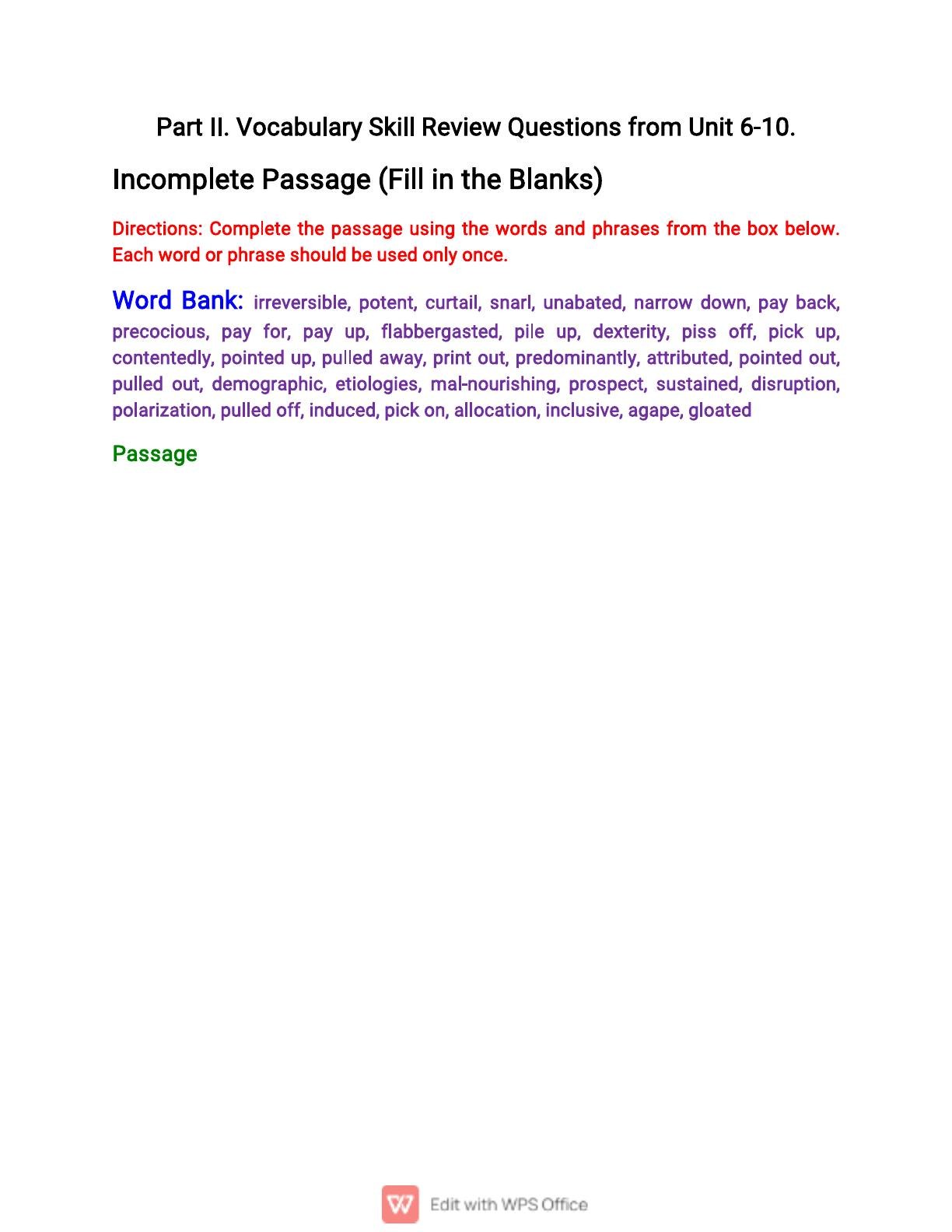
Pa rt II. Voca bulary Skill Review Questions from Unit 6-10.
In compl ete Pa ssage (Fill in the Blanks)
Di rections: Complete the passage u sing th e wo rds and phrases from the box below.
Ea ch word or phrase should be used only once.
Word Bank: irreversible, potent, curta il, snar l, unabated, narrow down, pay back,
precocious, pay for, pay up, flabb ergasted, pile up, dexterity, piss off, pick up,
contentedly, pointed up, pulled away, print out, predomina ntly, attributed, pointed out,
pulled out, demographic, etiologies, mal-nourishing, prospe ct, sustained, disruption,
polarization, pulled off, induced, pick on, allocation, inclusive, agape, g loated
Passage
The research team was studying the causes and effects of poor nutrition in a rural community.
The region was __________ (1) inhabited by farming families, and a recent __________ (2) survey
revealed alarming trends among children. Several medical experts examined the possible
__________ (3) of the health problems and discovered that many children were suffering from
__________ (4) diets.
The lead researcher, a __________ (5) young scientist, used a highly __________ (6) analytical
method to __________ (7) the most significant factors contributing to the crisis. The findings
suggested that if immediate action was not taken, the damage could become __________ (8).
The team therefore recommended a fair __________ (9) of resources and an __________ (10)
approach that would benefit all members of the community.
Despite these efforts, t he difficulties continued __________ (11). Transportation problems
created a traffic __________ (12) on the main road, causing supplies to __________ (13) at
distribution centers. The resulting __________ (14) affected schools and health clinics alike.
During a public meeting, one official __________ (15) that poor planning had worsened the
situation, while another __________ (16) the crisis to prolonged drought. A few citizens
complained that some authorities tended to __________ (17) vulnerable groups instead of helping
them.
To address the issue, donors promised to __________ (18) the costs of emergency supplies,
while local businesses agreed to __________ (19) previous debts owed to comm unity
organizations. Those who had failed to contribute earlier were urged to __________ (20) their
pledged amounts.
The project required remarkable __________ (21) and determination. Many volunteers learned to
__________ (22) new skills quickly and worked tirelessly. At one point, a funding agency suddenly

__________ (23) its support, but another organization stepped in and successfully __________ (24)
a rescue plan.
When the final report was ready, the coordinator asked the secretary to __________ (25) several
copies. As the results were presented, audience members listened __________ (26), while some
stared __________ (27) at the unexpected success of the initiative. Many were __________ (28) by
the dramatic improvement.
The program's long-term __________ (29) looked promising because of the __________ (30)
commitment of local leaders. However, some experts warned that growing so cial __________ (31)
could __________ (32) future progres s if left unaddressed.
One controversial policy had been __________ (33) by external pressures, causing resentment
among residents and threatening to __________ (34) many community members. Nevertheless,
the organizers never __________ (35) their responsibilities. Instead, they __________ (36) from
unnecessary disputes and focused on their mission.
At the celebration ceremony, a few officials __________ (37) about their achievements, but mos t
participants simply felt proud that they had managed to __________ (38) such a difficult project.
Good Trying
By: Habtamu.A
May, 2018E.C/June, 2026G.C
/ 2
End of Document
116

FAQs

what are the grade 11 vocabulary review questions for units 6-10

The Grade 11 Vocabulary Review Questions for Units 6-10 focus on essential vocabulary skills and comprehension.

  • These questions cover key terms and concepts from the units.
  • Students are encouraged to apply their knowledge in various contexts.
  • The review aims to reinforce understanding and retention of vocabulary.

how to complete the grade 11 vocabulary review questions for units 6-10

To complete the Grade 11 Vocabulary Review Questions for Units 6-10, follow these steps:

  1. Read through the vocabulary terms provided in the units.
  2. Refer to the context in which each word is used.
  3. Answer the questions by filling in the blanks or providing definitions.
  4. Review your answers to ensure comprehension.

what topics are covered in the grade 11 vocabulary review questions for units 6-10

The Grade 11 Vocabulary Review Questions for Units 6-10 cover a variety of topics related to vocabulary development.

  • Key themes include word meanings, usage, and context.
  • Students explore synonyms, antonyms, and related terms.
  • Practical applications of vocabulary in writing and speaking are emphasized.

how can grade 11 students improve vocabulary using the review questions for units 6-10

Grade 11 students can improve their vocabulary using the review questions for Units 6-10 by engaging in active learning.

  • Practice regularly with the review questions to reinforce memory.
  • Utilize flashcards for difficult terms.
  • Discuss vocabulary in study groups to enhance understanding.
  • Apply new words in writing assignments and daily conversations.

what is the format of the grade 11 vocabulary review questions for units 6-10

The format of the Grade 11 Vocabulary Review Questions for Units 6-10 typically includes multiple-choice, fill-in-the-blank, and short answer questions.

  • Each question is designed to assess understanding of vocabulary terms.
  • Students may be asked to use words in sentences or identify synonyms and antonyms.
  • The review encourages comprehensive engagement with the material.

why are vocabulary review questions important for grade 11 students

Vocabulary review questions are important for Grade 11 students as they enhance language skills and comprehension.

  • They help students build a robust vocabulary essential for academic success.
  • Improved vocabulary aids in better reading comprehension and writing skills.
  • These questions prepare students for standardized tests and future academic challenges.