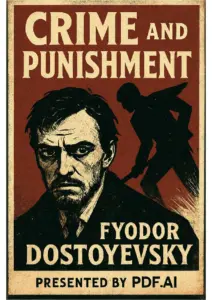
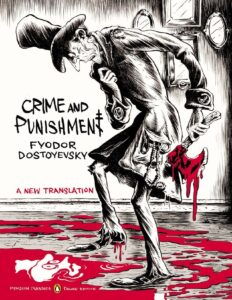
Crime and Punishment is a novel by Fyodor Dostoevsky that explores the psychological turmoil of Raskolnikov, a former student in St. Petersburg who commits murder. The narrative delves into themes of guilt, redemption, and the moral dilemmas faced by individuals in society. As Raskolnikov grapples with the consequences of his actions, he is pursued by a relentless police investigator and haunted by his conscience. The novel also features Sonya, a compassionate character who represents hope and redemption for Raskolnikov. This edition offers a fresh translation that captures the urgency and intensity of Dostoevsky’s masterpiece, making it accessible for both new readers and long-time fans.

Key Points

  • Explores the psychological conflict of Raskolnikov after committing murder
  • Examines themes of guilt, redemption, and morality in society
  • Features Sonya, a character representing hope and compassion
  • Includes a new translation that enhances the original text’s urgency
137
/ 755
CRIME AND PUNISHMENT
This acclaimed new translation of Dostoyevsky’s ‘psychological record of a
crime’ gives his dark masterpiece of murder and pursuit a renewed vitality,
expressing its jagged, staccato urgency and fevered atmosphere as never
before. Raskolnikov, a destitute and desperate former student, wanders alone
through the slums of St Petersburg, deliriously imagining himself above
society’s laws. But when he commits a random murder, only suffering ensues.
Embarking on a dangerous game of cat and mouse with a suspicious police
investigator, Raskolnikov is pursued by the growing voice of his conscience and
finds the noose of his own guilt tightening around his neck. Only Sonya, a
downtrodden prostitute, can offer the chance of redemption.
* * *
A truly great translation . . . Sometimes new translations of old favourites are
surplus to our requirements. . . . Sometimes, though, a new translation really
makes us see a favourite masterpiece afresh. And this English version of
Crime
and Punishment
really is better. . . .
Crime and Punishment
, as well as being an
horrific story and a compelling drama, is also extremely funny. Ready brings
out this quality well. . . . That knife-edge between sentimentality and farce has
been so skilfully and delicately captured here. . . . Ready’s version is colloquial,
compellingly modern and—in so far as my amateurish knowledge of the
language goes—much closer to the Russian. . . . The central scene in the book .
. . is a masterpiece of translation.’
—A. N. Wilson,
The Spectator
‘This vivid, stylish, and rich rendition by Oliver Ready compels the attention of
the reader in a way that none of the others I’ve read comes close to matching.
Using a clear and forceful mid-twentieth-century idiom, Ready gives us an
entirely new kind of access to Dostoyevsky’s singular, self-reflexive and at times
unnervingly comic text. This is the Russian writer’s story of moral revolt, guilt,
and possible regeneration turned into a new work of art. . . . [It] will give a jolt
to the nervous system to anyone interested in the enigmatic Russian author.’
—John Gray,
New Statesman
, ‘Books of the Year’
At last we have a translation that brings out the wild humour and vitality of the
original.’
—Robert Chandler,
PEN Atlas
A gorgeous translation . . . Inside one finds an excellent apparatus: a
chronology, a terrific contextualizing introduction, a handy compendium of

suggestions for further reading, and cogent notes on the translation. . . . But
the best part is Ready’s supple translation of the novel itself. Ready manages to
cleave as closely as any prior translator to both spirit and letter, while
rendering them into an English that is a relief to read.’
—The East-West Review
‘Oliver Ready’s dynamic translation certainly succeeds in implicating new
readers in Dostoyevsky’s old novel.’
The Times Literary Supplement
‘What a pleasure it is to see Oliver Ready’s new translation bring renewed
power to one of the world’s greatest works of fiction. . . . Ready’s work is of
substantial and superb quality. . . . [His] version portrays more viscerally and
vividly the contradictory nature of Raskolnikov’s consciousness. . . . Ready
evokes the crux of
Crime and Punishment
with more power than the previous
translators have . . . with an enviably raw economy of prose.’
The Curator
‘Ready’s new translation of
Crime and Punishment
is thoughtful and elegant
[and] shows us once again why this novel is one of the most intriguing
psychological studies ever written. His translation also manages to revive the
disturbing humor of the original. . . . In some places, Ready’s version echoes
Pevear and Volokhonsky’s prize-winning nineties version, but he often renders
Dostoyevsky’s text more lucidly while retaining its deliberately uncomfortable
feel. . . . Ready’s colloquial, economical use of language gives the text a new
power.’
Russia Beyond the Headlines
‘[A] five-star hit, which will make you see the original with new eyes.’
The Times Literary Supplement
, ‘Books of the Year’
/ 755
End of Document
137

FAQs

What is the main plot of Crime and Punishment?
The novel follows Raskolnikov, a destitute former student living in the slums of St. Petersburg, who believes he is above societal laws. He commits a random murder, which leads to intense suffering and a psychological struggle with guilt. As he is pursued by a suspicious police investigator, Raskolnikov grapples with his conscience, ultimately seeking redemption through Sonya, a downtrodden prostitute.
Who is Raskolnikov and what is his internal conflict?
Raskolnikov is the protagonist of Crime and Punishment, characterized as a desperate former student who believes he can transcend moral boundaries. After committing murder, he experiences profound internal conflict, battling feelings of guilt and the fear of being caught. His conscience becomes a relentless voice, tightening the noose of guilt around him as he navigates the consequences of his actions.
How does Sonya influence Raskolnikov's journey?
Sonya, a downtrodden prostitute, plays a crucial role in Raskolnikov's quest for redemption. Despite her own suffering, she embodies compassion and moral strength, offering Raskolnikov a chance to confront his guilt. Her unwavering support and love challenge him to seek forgiveness and grapple with the moral implications of his crime, ultimately guiding him towards potential salvation.
What themes are explored in Crime and Punishment?
Crime and Punishment delves into themes of morality, guilt, and redemption. It examines the psychological turmoil of committing a crime and the subsequent struggle with conscience. The novel also explores the social conditions of 19th-century Russia, highlighting the disparities between the wealthy and the impoverished, as well as the philosophical questions surrounding justice and the nature of evil.
What is the significance of Raskolnikov's crime in the novel?
Raskolnikov's crime serves as the catalyst for the entire narrative, symbolizing his internal struggle and the philosophical dilemmas he faces. It raises questions about morality and the justification of actions based on a perceived higher purpose. The murder not only leads to Raskolnikov's psychological unraveling but also sets the stage for his eventual confrontation with guilt and the search for redemption.
How does Dostoevsky portray the character of Raskolnikov?
Dostoevsky portrays Raskolnikov as a complex character, embodying both intellectual brilliance and deep moral confusion. His justifications for murder stem from a belief in his superiority and a desire to test his theories about human nature. Throughout the novel, Raskolnikov's psychological depth is explored, revealing his vulnerabilities, fears, and the profound impact of guilt on his psyche.
What role does the setting play in Crime and Punishment?
The setting of St. Petersburg is integral to Crime and Punishment, reflecting the social and economic struggles of the time. The oppressive atmosphere of the city mirrors Raskolnikov's internal turmoil and isolation. Dostoevsky uses the urban landscape to enhance themes of despair and moral decay, illustrating how the environment influences the characters' actions and psychological states.