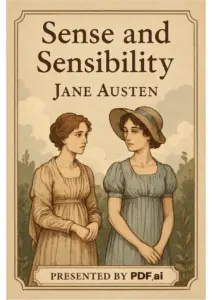
Sense and Sensibility, a novel by Jane Austen, explores the lives of the Dashwood sisters, Elinor and Marianne, as they navigate love, heartbreak, and societal expectations in early 19th-century England. The story begins with the death of their father, which leaves the family in a precarious financial situation, forcing them to rely on their own resources and relationships. Themes of sense versus sensibility, the constraints of social class, and the importance of marriage are central to the narrative. Austen’s keen observations of human behavior and her witty dialogue make this work a timeless classic, appealing to readers interested in romance and social commentary. This edition is perfect for literature enthusiasts and students studying classic English novels.

Key Points

  • Explores the contrasting personalities of Elinor and Marianne Dashwood in their romantic pursuits
  • Highlights the societal pressures faced by women in early 19th-century England
  • Examines themes of love, heartbreak, and financial security in relationships
  • Features Austen’s signature wit and keen social commentary throughout the narrative
PAMUDI SAJANA
Author: Jane Austen More by Jane Austen Love and Friendship by Jane Austen Love and Friendship by Jane Austen
459 pages
Language:English
Type:Book
PAMUDI SAJANA
Author: Jane Austen More by Jane Austen Love and Friendship by Jane Austen Love and Friendship by Jane Austen
459 pages
Language:English
Type:Book
46
/ 459
Download free eBooks of classic literature, books and
novels at Planet eBook. Subscribe to our free eBooks blog
and email newsletter.
Sense and Sensibility
By Jane Austen
S  S
Chapter 1
T
he family of Dashwood had long been settled in Sussex.
Their estate was large, and their residence was at Nor-
land Park, in the centre of their property, where, for many
generations, they had lived in so respectable a manner as to
engage the general good opinion of their surrounding ac-
quaintance. The late owner of this estate was a single man,
who lived to a very advanced age, and who for many years of
his life, had a constant companion and housekeeper in his
sister. But her death, which happened ten years before his
own, produced a great alteration in his home; for to supply
her loss, he invited and received into his house the family of
his nephew Mr. Henry Dashwood, the legal inheritor of the
Norland estate, and the person to whom he intended to be-
queath it. In the society of his nephew and niece, and their
children, the old Gentlemans days were comfortably spent.
His attachment to them all increased. The constant atten-
tion of Mr. and Mrs. Henry Dashwood to his wishes, which
proceeded not merely from interest, but from goodness of
heart, gave him every degree of solid comfort which his age
could receive; and the cheerfulness of the children added a
relish to his existence.
By a former marriage, Mr. Henry Dashwood had one
son: by his present lady, three daughters. The son, a steady
respectable young man, was amply provided for by the for-
F B  P B.
tune of his mother, which had been large, and half of which
devolved on him on his coming of age. By his own marriage,
likewise, which happened soon afterwards, he added to his
wealth. To him therefore the succession to the Norland es-
tate was not so really important as to his sisters; for their
fortune, independent of what might arise to them from their
father’s inheriting that property, could be but small. Their
mother had nothing, and their father only seven thousand
pounds in his own disposal; for the remaining moiety of his
first wife’s fortune was also secured to her child, and he had
only a life-interest in it.
The old gentleman died: his will was read, and like al-
most every other will, gave as much disappointment as
pleasure. He was neither so unjust, nor so ungrateful, as to
leave his estate from his nephew;—but he left it to him on
such terms as destroyed half the value of the bequest. Mr.
Dashwood had wished for it more for the sake of his wife
and daughters than for himself or his son;—but to his son,
and his son’s son, a child of four years old, it was secured,
in such a way, as to leave to himself no power of providing
for those who were most dear to him, and who most needed
a provision by any charge on the estate, or by any sale of its
valuable woods. The whole was tied up for the benefit of this
child, who, in occasional visits with his father and mother at
Norland, had so far gained on the affections of his uncle, by
such attractions as are by no means unusual in children of
two or three years old; an imperfect articulation, an earnest
desire of having his own way, many cunning tricks, and a
great deal of noise, as to outweigh all the value of all the at-
/ 459
End of Document
46

FAQs

What is the main conflict regarding the inheritance in Sense and Sensibility?
The main conflict regarding inheritance in 'Sense and Sensibility' revolves around the will of Mr. Henry Dashwood, who leaves his estate to his son, John Dashwood, while providing only a small legacy to his three daughters, Elinor, Marianne, and Margaret. The estate is tied up in such a way that John cannot provide for his sisters, despite his father's dying wish for him to assist them. This creates tension between the Dashwood sisters and their half-brother, as their financial security is jeopardized.
How do the Dashwood sisters differ in their personalities?
Elinor Dashwood is characterized by her strength of understanding and cool judgment, which allows her to be a stabilizing influence on her family. In contrast, Marianne Dashwood is passionate and impulsive, displaying her emotions openly and lacking the prudence that Elinor possesses. While both sisters are intelligent and capable, Elinor's rationality often tempers Marianne's emotional extremes, leading to a dynamic interplay between their contrasting approaches to life and love.
What role does Mrs. John Dashwood play in the story?
Mrs. John Dashwood, the wife of Elinor and Marianne's half-brother, is portrayed as cold-hearted and selfish. After Mr. Henry Dashwood's death, she takes control of Norland Park and is dismissive of her mother-in-law and sisters-in-law's needs. She actively discourages her husband from providing financial assistance to them, arguing that it would impoverish their own child. Her actions create further complications for the Dashwood sisters, highlighting themes of familial duty and selfishness.
How does Elinor respond to her family's financial situation?
Elinor Dashwood responds to her family's financial difficulties with composure and practicality. Despite her own grief and disappointment regarding their reduced circumstances, she takes on the role of counselor to her mother and sister, encouraging them to remain hopeful and to act with dignity. Elinor's ability to manage her emotions contrasts sharply with Marianne's more dramatic reactions, showcasing her strength in navigating their challenging situation.
What is the significance of Mr. Dashwood's dying request?
Mr. Dashwood's dying request to his son John to assist his widow and daughters is significant as it sets the moral framework for the family's dynamics. This request highlights the tension between familial duty and personal interest, as John struggles between honoring his father's wishes and succumbing to his wife's selfishness. It underscores the themes of responsibility and the consequences of neglecting familial bonds, which are central to the narrative.
How does the Dashwood family's situation change after Mr. Henry Dashwood's death?
After Mr. Henry Dashwood's death, the Dashwood family faces a dramatic change in their living situation and financial security. They are forced to leave Norland Park, which had been their home, and are relegated to the status of visitors under Mrs. John Dashwood's control. This transition marks the beginning of their struggles for stability and respectability in a society that values wealth and inheritance, setting the stage for the sisters' subsequent challenges and growth.
What are the contrasting views of Elinor and Marianne on love and emotion?
Elinor and Marianne Dashwood embody contrasting views on love and emotion throughout 'Sense and Sensibility.' Elinor values restraint and rationality, believing that love should be approached with caution and practicality. In contrast, Marianne embraces passionate expression and spontaneity, believing that true love should be felt intensely and openly. Their differing philosophies lead to varied experiences in their romantic pursuits, reflecting the broader themes of sensibility versus reason in the novel.