Dark They Were and Golden-Eyed by Ray Bradbury explores the psychological and emotional struggles of Earth settlers on Mars. The story follows the Bittering family as they confront their fears of being stranded on an alien planet after a catastrophic event on Earth. Themes of identity, change, and the impact of environment on human nature are central to the narrative. As the family adapts to their new life, they begin to lose their connection to Earth, leading to profound transformations. This work is essential for fans of science fiction and those interested in the complexities of human adaptation.

Key Points

  • Follows the Bittering family as they navigate life on Mars after losing contact with Earth.
  • Explores themes of identity and transformation in an alien environment.
  • Highlights the psychological impact of isolation and fear on settlers.
  • Examines the loss of connection to one's origins and the resulting changes in character.
newtopiccyclegrowin
Author:Ray Bradbury
12 pages
Language:English
Type:Short Story
newtopiccyclegrowin
Author:Ray Bradbury
12 pages
Language:English
Type:Short Story
365
/ 12
DARK THEY WERE AND GOLDEN-EYED
BY RAY BRADBURY
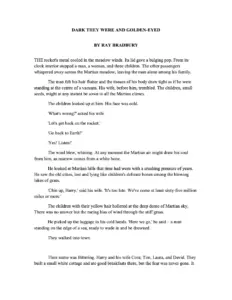
THE rocket's metal cooled in the meadow winds. Its lid gave a bulging pop. From its
clock interior stepped a man, a woman, and three children. The other passengers
whispered away across the Martian meadow, leaving the man alone among his family.
The man felt his hair flutter and the tissues of his body draw tight as if he were
standing at the centre of a vacuum. His wife, before him, trembled. The children, small
seeds, might at any instant be sown to all the Martian climes.
The children looked up at him. His face was cold.
'What's wrong?' asked his wife.
'Let's get back on the rocket.'
'Go back to Earth?'
'Yes! Listen!'
The wind blew, whining. At any moment the Martian air might draw his soul
from him, as marrow comes from a white bone.
He looked at Martian hills that time had worn with a crushing pressure of years.
He saw the old cities, lost and lying like children's delicate bones among the blowing
lakes of grass.
'Chin up, Harry,' said his wife. 'It's too late. We've come at least sixty-five million
miles or more.'
The children with their yellow hair hollered at the deep dome of Martian sky.
There was no answer but the racing hiss of wind through the stiff grass.
He picked up the luggage in his cold hands. 'Here we go,' he said a man
standing on the edge of a sea, ready to wade in and be drowned.
They walked into town.
Their name was Bittering. Harry and his wife Cora; Tim, Laura, and David. They
built a small white cottage and ate good breakfasts there, but the fear was never gone. It
lay with Mr Bittering and Mrs Bittering, a third unbidden partner at every midnight talk,
at every dawn awakening.
'I feel like a salt crystal,' he often said, 'in a mountain stream, being washed away.
We don't belong here. We're Earth people. This is Mars. It was meant for Martians. For
heaven's sake, Cora, let's buy tickets for home!'
But she only shook her head. 'One day the atom bomb will fix Earth. Then we'll
be safe here.'
'Safe and insane!'
Tick-tock, seven o'clock sang the voice clock; time to get up. And they did.
Something made him check everything each morning warm hearth, potted
blood-geraniums - precisely as if he expected something to be amiss. The morning paper
was toast-warm from the six a.m. Earth rocket. He broke its seal and tilted it at his
breakfast plate. He forced himself to be convivial.
'Colonial days all over again,' he declared. 'Why, in another year there'll be a
million Earthmen on Mars. Big cities, everything! They said we'd fail. Said the Martians
would resent our invasion. But did we, find any Martians! Not a living soul! Oh, we
found their empty cities, but no one in them. Right?'
A river of wind submerged the house. When the windows ceased rattling, Mr
Bittering swallowed and looked at the children.
'I don't know,' said David. 'Maybe there're Martians around we don't see.
Sometimes nights I think I hear 'em. I hear the wind. The sand hits my window. I get
scared. And I see those towns way up in the mountains where the Martians lived a long
time ago. And I think I see things moving around those towns, Papa. And I wonder if
those Martians mind us living here. I wonder if they won't do something to us for coming
here.'
'Nonsense!' Mr Bittering looked out of the windows. 'We're clean, decent people.'
He looked at his children. 'All dead cities have some kind of ghosts in them. Memories, I
mean.' He stared at the hills. 'You see a staircase and wonder what Martians looked like
climbing it. You see Martian paintings and you wonder what the painter was like. You
make a little ghost in your mind, a memory. It's quite natural. Imagination.' He stopped.
'You haven't been prowling up in those ruins, have you?'
'No, Papa.' David looked at his shoes.
'See that you stay away from them. Pass the jam.'
'Just the same,' said little David, 'I bet something happens.'

Something happened that afternoon.
Laura stumbled through the settlement, crying. She dashed blindly on to the
porch.
'Mother, Father - the war, Earth!' she sobbed. 'A radio flash just came. Atom
bombs hit New York! All the space rockets blown up. No more rockets to Mars, ever!'
'Oh, Harry!' The mother held on to her husband and daughter.
'Are you sure, Laura?' asked the father quietly.
Laura wept. 'We're stranded on Mars, for ever and ever!'
For a long time there was only the sound of the wind in the late afternoon.
Alone, thought Bittering. Only a thousand of us here. No way back. No way. No
way. Sweat poured from his face and his hands and his body; he was drenched in the
hotness of his fear. He wanted to strike Laura, cry, 'No, you're lying! The rockets will
come back!' Instead, he stroked Laura's head against him and said, 'The rockets will get
through, some day.'
'In five years maybe. It takes that long to build one. Father, Father, what will we
do?'
'Go about our business, of course. Raise crops and children. Wait. Keep things
going until the war ends and the rockets come again.'
The two boys stepped out on to the porch.
'Children,' he said, sitting there, looking beyond them, 'I've something to tell you.'
'We know,' they said.
Bittering wandered into the garden to stand alone in his fear. As long as the
rockets had spun a silver web across space, he had been able to accept Mars. For he had
always told himself: Tomorrow, if I want, I can buy a ticket and go back to Earth.
But now: the web gone, the rockets lying in jigsaw heaps of molten girder and unsnaked
wire. Earth people left to the strangeness of Mars, the cinnamon dusts and wine airs, to be
baked like gingerbread shapes in Martian summers, put into harvested storage by Martian
winters.
/ 12
End of Document
365

FAQs

What happens to the Bittering family on Mars?
The Bittering family, consisting of Harry, Cora, and their three children, arrive on Mars after escaping a war on Earth. Initially, they try to adapt to their new environment, but Harry is plagued by fear and a sense of not belonging. He learns that Earth has been devastated by atomic bombs, leaving them stranded on Mars indefinitely. As time passes, the family begins to change physically and mentally, adopting Martian traits and names, ultimately losing their connection to Earth.
How does Harry Bittering's perception of Mars change?
Harry Bittering initially views Mars with trepidation, feeling that they do not belong there. He expresses a desire to return to Earth, fearing that the Martian air might consume him. However, as the story progresses, he becomes increasingly acclimated to the Martian environment, even forgetting his Earthly identity. The influence of the planet leads him to accept a new life, culminating in his children adopting Martian names and identities.
What does the term 'Iorrt' signify in the story?
The term 'Iorrt' is revealed to be the Martian word for Earth. Harry Bittering unknowingly utters this word, signifying a deepening connection to Mars and a shift in his identity. This moment symbolizes the transformation of the Bittering family from Earthlings to Martians, as they begin to embrace their new life on the planet, further emphasizing the theme of adaptation and change.
What is the significance of the children's name changes?
The children of the Bittering family change their names to Ttil, Linnl, and Werr, reflecting their adaptation to Martian culture. This shift symbolizes their complete transformation and acceptance of their new identity on Mars. The name changes indicate a departure from their Earthly origins and a deeper connection to their environment, illustrating the story's theme of change and the impact of the alien landscape on human identity.
How do the Bitterings' physical appearances change on Mars?
As the Bittering family spends more time on Mars, their physical appearances begin to change, notably with their eyes turning yellow. This transformation signifies their adaptation to the Martian environment and the gradual loss of their Earthly identities. The changes in their appearance serve as a metaphor for the broader theme of transformation and the effects of the alien landscape on human beings.
What is the fate of the Bittering family at the end of the story?
By the end of the story, the Bittering family has fully embraced their new life on Mars, having abandoned their Earthly identities and possessions. When a rescue rocket arrives from Earth years later, they are nowhere to be found. Instead, the Martian landscape is inhabited by new life forms with yellow eyes, suggesting that the Bitterings have become part of the Martian culture and environment, illustrating the irreversible nature of their transformation.