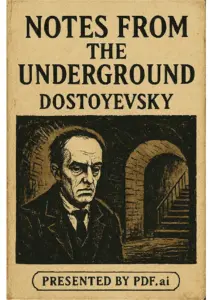
The Grand Inquisitor is a powerful parable from Fyodor Dostoyevsky’s novel, The Brothers Karamazov, exploring themes of faith, freedom, and authority. Set during the Spanish Inquisition, the narrative presents a confrontation between Christ and the Grand Inquisitor, who challenges the notion of free will in the face of human suffering. This philosophical dialogue raises questions about the nature of belief and the role of religious institutions in society. Dostoyevsky’s work is essential for students of literature, philosophy, and theology, providing deep insights into human nature and moral dilemmas. Ideal for readers interested in existentialism and the complexities of faith.

Key Points

  • Explores the conflict between faith and authority during the Spanish Inquisition
  • Features a dialogue between Christ and the Grand Inquisitor on free will
  • Examines Dostoyevsky’s themes of human suffering and moral choice
  • Part of Dostoyevsky’s larger work, The Brothers Karamazov
  • Essential reading for students of philosophy and theology
newtopiccyclegrowin
24 pages
Language:English
Type:Novel
newtopiccyclegrowin
24 pages
Language:English
Type:Novel
161
/ 24
THE GRAND INQUISITOR
By
Feodor Dostoevsky
(Translation by H.P. Blavatsky)
[Dedicated by the Translator to those sceptics who clamour so loudly,
both in print and private letters—"Show us the wonder-working 'Brothers,'
let them come out publicly—and we will believe in them!"]
[The following is an extract from M. Dostoevsky's celebrated novel, The
Brothers Karamazof, the last publication from the pen of the great Russian
novelist, who died a few months ago, just as the concluding chapters
appeared in print. Dostoevsky is beginning to be recognized as one of the
ablest and profoundest among Russian writers. His characters are invariably
typical portraits drawn from various classes of Russian society, strikingly
life-like and realistic to the highest degree. The following extract is a
cutting satire on modern theology generally and the Roman Catholic
religion in particular. The idea is that Christ revisits earth, coming to Spain
at the period of the Inquisition, and is at once arrested as a heretic by the
Grand Inquisitor. One of the three brothers of the story, Ivan, a rank
materialist and an atheist of the new school, is supposed to throw this
conception into the form of a poem, which he describes to Alyosha—the
youngest of the brothers, a young Christian mystic brought up by a "saint"
in a monastery—as follows: (—Ed. Theosophist, Nov., 1881)]
"Quite impossible, as you see, to start without an introduction," laughed
Ivan. "Well, then, I mean to place the event described in the poem in the
sixteenth century, an age—as you must have been told at school—when it
/ 24
End of Document
161

FAQs

What is the main theme of The Grand Inquisitor?
The main theme of 'The Grand Inquisitor' revolves around the conflict between freedom and authority. Dostoyevsky explores the idea that humanity struggles with the concept of free will, often preferring security and comfort over the burdens of freedom. The Grand Inquisitor argues that people are inherently weak and require guidance, thus justifying the Church's authoritarian control over them. This theme is illustrated through the Inquisitor's dialogue with Christ, where he asserts that the promise of freedom leads to suffering and chaos.
Who are the main characters in The Grand Inquisitor?
The main characters in 'The Grand Inquisitor' are Christ and the Grand Inquisitor, who represents the Catholic Church's authority. The Inquisitor is a powerful figure who confronts Christ upon His return to Earth during the Inquisition. He embodies the Church's justification for controlling humanity, while Christ symbolizes unconditional love and freedom. Their interaction highlights the philosophical and moral dilemmas surrounding faith, power, and the human condition.
What does the Grand Inquisitor accuse Christ of?
The Grand Inquisitor accuses Christ of burdening humanity with the gift of free will, which he believes causes suffering and unrest. He argues that by rejecting the temptation to provide bread and miracles, Christ has left people to struggle with their own freedom, leading them to chaos and despair. The Inquisitor claims that the Church has taken on the responsibility of guiding humanity, offering them security and happiness in exchange for their freedom, thus accusing Christ of being naive about human nature.
How does the Grand Inquisitor justify his actions?
The Grand Inquisitor justifies his actions by claiming that humanity is not capable of handling the burden of freedom. He believes that people are inherently weak and require authority to maintain order and happiness in society. By controlling the masses and providing them with a sense of security, the Inquisitor argues that he is ultimately serving their best interests. He sees the Church's role as a necessary evil to prevent chaos and suffering, positioning himself as a protector of the people.
What is the significance of the kiss in The Grand Inquisitor?
The kiss in 'The Grand Inquisitor' serves as a profound symbol of love and compassion. When Christ kisses the Grand Inquisitor, it represents an unconditional love that transcends the Inquisitor's harsh beliefs and authority. This act of tenderness contrasts sharply with the Inquisitor's cold rationale and highlights the theme of spiritual freedom versus institutional control. The kiss leaves the Inquisitor shaken, indicating that despite his convictions, the power of love remains an undeniable force.
What philosophical questions does The Grand Inquisitor raise?
'The Grand Inquisitor' raises several philosophical questions regarding the nature of freedom, faith, and human existence. It challenges the reader to consider whether true freedom is desirable or if people are better off under authoritarian rule for their own happiness. The dialogue between Christ and the Inquisitor prompts reflections on the moral implications of power, the responsibilities of faith, and the complexities of human desires. These questions resonate with existential themes and the struggle for meaning in a chaotic world.