


Access an extensive, community-driven library of photosynthesis PDFs, Calvin cycle flowcharts, chloroplast structure worksheets, and plant bioenergetics study guides on Chesser Resources. We provide a centralized, 100% free-to-read hub for biological and botanical study material, featuring over 300,000 documents across the sciences. This dedicated collection tracks the fundamental process of autotrophic energy conversion—ranging from the microscopic precision of photon absorption by chlorophyll in the thylakoid membrane to the complex enzymatic orchestration of carbon fixation in the stroma. Whether you are troubleshooting the kinetics of Rubisco, mapping the metabolic differences between C3, C4, and CAM pathways, or preparing for an advanced university botany or biochemistry exam, our browser-based reader, AI summaries, and Ask-AI tools provide instant, deep-dive clarity.
Photosynthesis is the fundamental bioenergetic process by which photoautotrophs (plants, algae, and cyanobacteria) convert light energy into chemical energy, sequestering atmospheric $CO_2$ into organic carbon compounds. It is the literal foundation of the global food web and the source of the Earth’s oxygen-rich atmosphere. The field branches into three fundamental frameworks: The Light-Dependent Reactions (the production of $ATP$ and $NADPH$ via photolysis of water), The Calvin Cycle (the light-independent fixation of $CO_2$ into $G3P$), and Metabolic Adaptations (the specialized physiology of C4 and CAM plants to mitigate photorespiration). Studying photosynthesis builds advanced competencies in thermodynamics, enzymatic catalysis, and ecological modeling—skills foundational to every career in agriculture, environmental science, biotechnology, and renewable energy.
Our library hosts a vast array of student-shared experiment logs, energy flux maps, and comprehensive review packages organized for deep study:
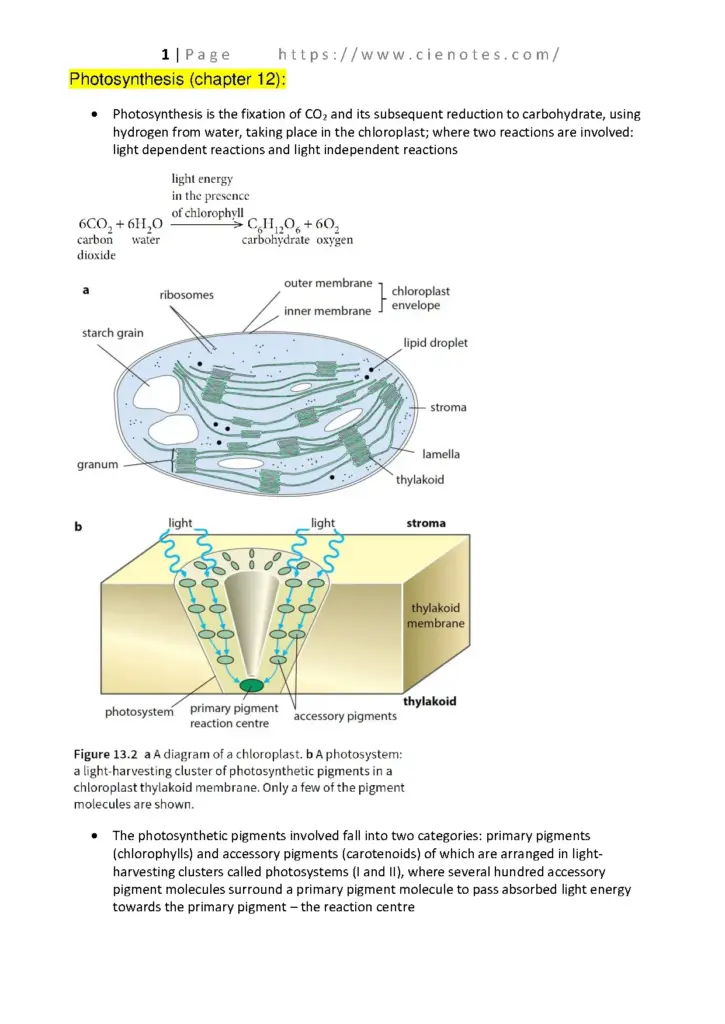
Photon Capture: Find high-yield light-dependent reaction diagrams detailing the Photosystem II ($P680$) and Photosystem I ($P700$) complexes.
Electron Flow: Access non-cyclic photophosphorylation guides mapping the path of electrons from water splitting to the generation of $NADPH$.
Carbon Fixation: Browse Calvin cycle charts detailing the three phases: fixation (Rubisco), reduction, and regeneration of RuBP.
Biochemical Flux: Access G3P production notes illustrating how plants convert $CO_2$ into glucose and other structural carbohydrates.
C3, C4, and CAM: Download functional photosynthetic adaptation guides analyzing how different plant species optimize carbon fixation to minimize water loss and photorespiration.
Efficiency Metrics: Browse photosynthesis vs. respiration comparison worksheets that clarify the bioenergetic balance of plant cells.
| Photosynthetic Variable | Scientific Definition | Functional Significance |
| Action Spectrum | Efficiency of light wavelength for photosynthesis | Shows peaks in blue and red light absorption |
| Quantum Yield | Moles of $O_2$ produced per mole of photons | Measures efficiency of light-to-chemical conversion |
| Rubisco Activity | Rate of $CO_2$ fixation | The primary rate-limiting step in the Calvin cycle |
| Thylakoid Proton Gradient | Electrochemical potential across membrane | Drives $ATP$ synthase for energy production |
Rubisco (Ribulose-1,5-bisphosphate carboxylase/oxygenase) is arguably the most important enzyme on Earth. It is responsible for the “fixation” step of the Calvin cycle, where it captures inorganic $CO_2$ from the atmosphere and attaches it to an organic molecule (RuBP). Because it is relatively slow and can accidentally react with $O_2$ instead of $CO_2$ (a wasteful process called photorespiration), plants have evolved complex adaptations like C4 and CAM pathways to “help” Rubisco function more efficiently.
The two stages are a masterclass in energy coupling. The light reactions act like a “battery charger”—they capture fleeting, high-energy light and store it in temporary, mobile chemical carriers ($ATP$ and $NADPH$). The Calvin cycle acts like the “factory”—it uses that stored energy to perform the heavy-lifting work of building stable, long-term sugar molecules from simple gas. Without the light reactions, the factory has no power; without the factory, the batteries have nothing to build.
Photorespiration occurs when Rubisco binds with oxygen instead of $CO_2$, which wastes energy. C4 plants fix $CO_2$ in a separate cell layer before feeding it to Rubisco, effectively “flooding” the enzyme with $CO_2$. CAM plants fix $CO_2$ at night when it is cooler and store it as an acid, then release it during the day when their stomata are closed to prevent water loss. Both are clever evolutionary workarounds to keep the photosynthetic factory running in hot or dry climates.
Chesser Resources is a free, open library of study and research material designed to democratize access to academic success. We host over 300,000+ documents—including textbooks, lecture notes, research papers, and study guides—across every subject imaginable. We believe students shouldn’t have to navigate paywalls or blurry preview pages just to get the information they need to learn.
Everything on Chesser Resources is free to read and search in your browser. We’ve built in powerful, free tools to help you actually learn from the material: AI summaries for fast comprehension, an Ask-AI chatbot to answer specific questions about your document, highlighting and annotation tools, and even read-aloud audio. Our platform is kept free by the community; by contributing your own notes or sharing content, you earn credits that unlock document downloads and prints, ensuring the library remains a high-performance, open-access resource for students everywhere.
Ready to dive into photosynthesis study guides or Calvin cycle charts? You don’t need to sign up to start learning. Browse our library, use our AI tools to summarize complex botanical pathways, and contribute your own notes to help the student community grow.