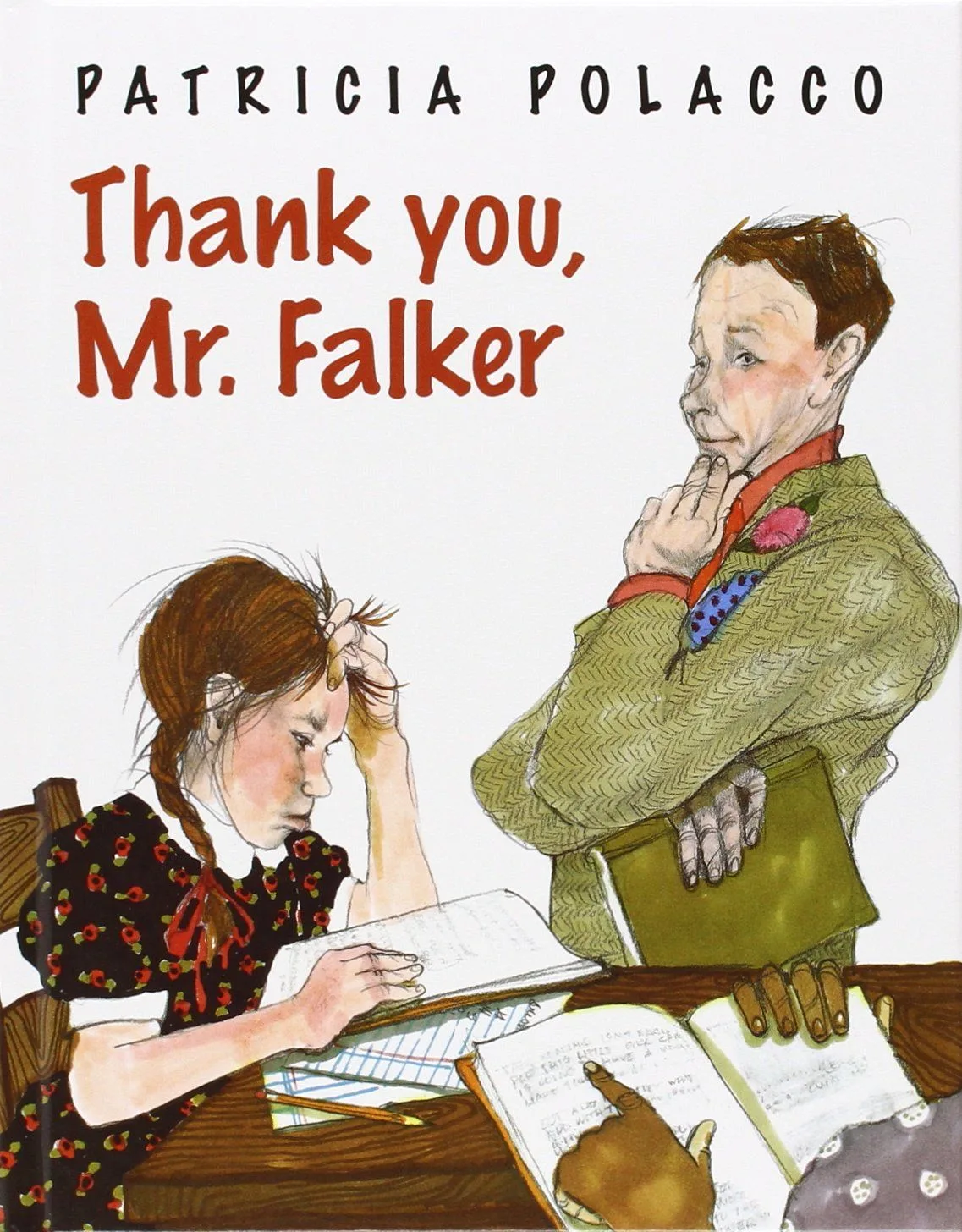
Thank You, Mr. Falker tells the inspiring story of Trisha, a young girl struggling with reading difficulties and bullying in school. Written by Patricia Polacco, this heartfelt narrative explores themes of perseverance, the importance of supportive teachers, and the journey to self-acceptance. As Trisha learns to read with the help of her compassionate teacher, Mr. Falker, she discovers her own talents and the joy of knowledge. This book is perfect for children and educators, emphasizing the impact of encouragement and understanding in overcoming challenges.

Key Points

  • Explores Trisha's struggles with reading and self-esteem in school.
  • Highlights the transformative role of supportive teachers like Mr. Falker.
  • Illustrates the importance of perseverance and self-acceptance.
  • Emphasizes the joy of learning and discovering one's talents.
newtopiccyclegrowin
Author:Patricia Polacco
6 pages
Language:English
Type:Book
newtopiccyclegrowin
Author:Patricia Polacco
6 pages
Language:English
Type:Book
71
/ 6
Thank you, Mr.
Falker
By PATRICIA POLACCO
1
The grandpa held the jar of honey so that all the
family could see, then dipped a ladle into it and
drizzled honey on the cover of a small book.
The little girl had just turned five.
“Stand up, little one,” he cooed. “I did this for
your mother, your uncles, your older brother, and now
you!”
Then he handed the book to her. “Taste!”
She dipped her finger into the honey and put it
into her mouth.
“What is that taste?” the grandma asked.
The little girl answered, “Sweet!”
Then all of the family said in a single voice, “Yes,
and so is knowledge, but knowledge is like the bee that
made that sweet honey, you have to chase it through
the pages of a book!”
The little girl knew that the promise to read was
at last hers. Soon she was going to learn to read.
2
Trisha, the littlest girl in the family, grew up
loving books. Her schoolteacher mother read to her
every night. Her redheaded brother brought his books
home from school and shared them. And whenever she
visited the family farm, her grandfather or
grandmother read to her by the stone fireplace.
When she turned five and went to kindergarten,
most of all she hoped to read. Each day she saw the
kids in the fi rst grade across the hall reading, and
before the year was over, some of the kids in her own
class began to read. Not Trisha.
Still, she loved being at school because she could
draw. The other kids would crowd around her and
watch her do her magic with the crayons.
“In first grade, you’ll learn to read,” her brother
said.
3
In first grade, Trisha sat in a circle with the
other kids. They were all holding Our Neighborhood,
their first reader, sounding out letters and words.
They said, “Beh, beh…oy, boy, and luh, luh…ook, look.”
The teacher smiled at them when they put all the
sounds together and got a word right.
But when Trisha looked at a page, all she saw
were wiggling shapes, and when she tried to sound out
words, the other kids laughed at her.
“Trisha, what are you looking at in that book?”
they’d say.
“I’m reading!” she’d say back to them. But her
teacher would move on to the next person. Always
when it was her turn to read, her teacher had to help
her with every single word. And while the other kids
moved up into the second reader and third reader, she
stayed alone in Our Neighborhood.
Trisha began to feel “different.” She began to
feel dumb.
4
The harder words got for the little girl, the
more and more time she spent drawing –how she loved
to draw! –or just sitting and dreaming. Or, when she
could, going for walks with her grandmother.
One summer day she and her grandma were
walking together in the small woods behind their farm.
It was twilight. The air was sweet and warm. Fireflies
were just coming up from the grasses.
As they walked, Trisha said, “Gramma, do you
think I’m…different?”
“Of course,” her grandma answered. “To be
different is the miracle of life. You see all of those
little fireflies? Everyone is different.”
“Do you think I’m smart?” Trisha didn’t feel
smart.
Her grandma hugged her. “You are the smartest,
quickest, dearest little thing ever.”
Right then the little girl felt safe in her
grandma’s arms. Reading didn’t matters so much.
5
Trisha’s grandma used to say that the stars
were holes in the sky. They were the light of heaven
coming from the other side. And she used to say that
someday she would be on the other side, where the
light comes from.
One evening they lay on the grass together and
counted the lights from heaven. “You know,” her
grandma said, “all of us will go there someday. Hang on
to the grass, or you’ll lift right off the ground, and
there you’ll be!”
They laughed, and both hung onto the grass.
But it was not long after that night that her
grandma must have let go of the grass, because she
went to where the lights were, on the other side. And
not long after that, Trisha’s grandpa let go of the
grass, too.
School seemed harder and harder now.

6
Reading was just plain torture. When Sue Ellyn
read her page, or Tommy Bob read his page, they read
so easily that Trisha would watch the top of their
heads to see if something was happening to their
heads that wasn’t happening to hers.
And numbers were the hardest thing of all to
read. She never added anything right.
“Line the numbers up before you add them,” the
teacher would say. But when Trisha tried, the numbers
looked like a stack of blocks, wobbly and ready to fall.
She just knew she was dumb.
Then, one day, her mother announced that she
had gotten a teaching job in California! A long way
from the family farm in Michigan.
7
Even though her grandma and grandpa were
gone, the little girl didn’t want to move. Maybe,
though, the teachers and kids in her new school
wouldn’t know how dumb she was.
She and her mother and brother moved across
the country in a two-tone 1949 Plymouth. It took five
days.
8
But at the new school it was the same. When she
tried to read, she stumbled over words: “the cah,
cah…cat…rrrr, rrr…ran.” She was reading like a baby in
the third grade!
And when her teacher read along with them, and
called on Trisha for an answer, she gave the wrong
number every time.
“Hey, dummy!” a boy called out to her on the
playground, “How come you are so dumb?” Other kids
stood near him and they laughed.
Trisha could feel the tears burning in her eyes.
How she longed to go back to her grandparents’ farm
in Michigan.
9
Now Trisha wanted to go to school less and less.
“I have a sore throat,” she’d say to her mother. Or, “I
have a stomachache.” She dreamed more and more, and
drew more and more, and she hated, hated, hated
school.
Then, when Trisha started fifth grade, the
school was all abuzz. There was a new teacher. He was
tall and elegant. Everybody loved his striped coat and
slick gray pants –he wore the neatest clothes.
All the usual teacher’s pets gathered around him
–Stevie Joe and Alice Marie, Davy and Michael Lee.
But right from the start, it didn’t seem to matter to
Mr. Falker which kids were the cutest. Or the
smartest. Or the best at anything.
/ 6
End of Document
71

FAQs

What challenges does Trisha face in learning to read?
Trisha struggles with reading because, when she looks at pages, all she sees are wiggling shapes. In first grade, while other kids advance in their reading skills, she remains stuck with the same book, feeling increasingly 'different' and 'dumb.' Her difficulties with reading lead her to spend more time drawing and daydreaming instead of focusing on her studies.
How does Mr. Falker support Trisha in her learning?
Mr. Falker provides Trisha with encouragement and support by recognizing her artistic talent and praising her drawings. He stands up for her when other kids tease her and takes the time to help her improve her reading skills. He introduces her to various engaging activities, such as writing letters with a wet sponge and playing games with letters, which help her gradually overcome her reading difficulties.
What is the significance of the honey in the story?
The honey symbolizes the sweetness of knowledge and the effort required to attain it. At the beginning of the story, Trisha tastes honey as a promise of her future ability to read, with her family emphasizing that knowledge is like the bee that produces honey—it must be chased through the pages of books. This metaphor recurs throughout her journey, culminating in her realization that knowledge is indeed sweet when she finally learns to read.
What impact does Trisha's grandmother have on her life?
Trisha's grandmother plays a crucial role in shaping her self-esteem and perspective on being different. She reassures Trisha that being unique is a 'miracle of life' and emphasizes that everyone is different, which comforts Trisha during her struggles. After her grandmother passes away, Trisha feels a deep sense of loss, and her struggles with reading intensify, making her long for the safety and love her grandmother provided.
How does Trisha's perception of herself change throughout the story?
Initially, Trisha sees herself as 'dumb' and feels isolated due to her reading difficulties. However, with Mr. Falker's support and encouragement, she begins to recognize her own intelligence and artistic talent. By the end of the story, after successfully learning to read, she experiences a significant transformation in her self-perception, feeling proud and happy about her accomplishments.
What role does bullying play in Trisha's school experience?
Bullying significantly impacts Trisha's school experience, as she is teased by classmates like Eric, who calls her names and ridicules her reading abilities. This bullying exacerbates her feelings of inadequacy and loneliness, leading her to avoid school and seek refuge in drawing. However, Mr. Falker's intervention helps to reduce the bullying, allowing Trisha to feel safer and more supported in her learning environment.
What is the climax of Trisha's journey in learning to read?
The climax of Trisha's journey occurs when she is finally able to read a paragraph from a book on her own. After months of struggling and feeling inadequate, she experiences a moment of clarity where the words begin to take shape, allowing her to understand the text fully. This breakthrough marks a turning point in her confidence and love for learning.